How to Solve the Absolute Value Inequality x|x-3|<-1 for 3x+1?

  • Context: MHB 
  • Thread starter Thread starter mathdad
  • Start date Start date
Click For Summary
SUMMARY

The discussion focuses on solving the absolute value inequality |x - 3| < 1, which leads to the derived inequalities 3x + 1 ≤ 13 and 3x + 1 ≥ 7. The solution involves determining the roots of the quadratic equations x^2 - 3x - 1 ≤ 0 and x^2 - 3x + 1 ≥ 0, yielding critical points at x = (3 ± √13)/2 and x = (3 ± √5)/2. The final solution set is established as 3 ≤ x ≤ (3 + √13)/2 and x ≤ (3 - √5)/2 or (3 + √5)/2 ≤ x ≤ (3 + √13)/2.

PREREQUISITES
  • Understanding of absolute value inequalities
  • Familiarity with quadratic equations and their roots
  • Knowledge of interval notation and solution sets
  • Basic algebraic manipulation skills
NEXT STEPS
  • Study the properties of absolute value functions
  • Learn how to solve quadratic inequalities
  • Explore interval notation and its applications in inequalities
  • Practice solving similar absolute value inequalities
USEFUL FOR

Students, educators, and anyone looking to enhance their understanding of algebraic inequalities, particularly those involving absolute values and quadratic equations.

mathdad
Messages
1,280
Reaction score
0
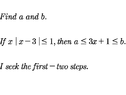
See question for question.

View attachment 8539
 

Attachments

  • MathMagic181029_3.png
    MathMagic181029_3.png
    7.4 KB · Views: 133
Mathematics news on Phys.org
The first thing I would do is remove the "absolute value". If x> 3 then x- 3>0 so |x- 3|= x- 3. The inequality becomes x(x- 3)= x^2- 3x\le 1 We can write that as x^2- 3x- 1\le 0.

The equation, x^2- 3x- 1= 0 has roots x= \frac{3\pm\sqrt{13}}{2}. This is a parabola that opens upward so the inequality is satisfied for x between those two points. Taking the positive sign, \frac{3+ \sqrt{13}}{2} is about 4.67, just slightly larger than 3. Since we require here that x> 3, we require that 3\le x\le \frac{3\pm\sqrt{13}}{2}.

If x< 3, |x- 3| is negative so x|x- 3|= -x(x- 3)= 3x- x^2. The inequality becomes 3x- x^2\le 1 or x^2- 3x+ 1\ge 0. The equation x^2- 3x+ 1has roots \frac{3\pm\sqrt{5}}{2}. This time the inequality is satisfied for x &lt;b&gt;outside&lt;/b&gt; those points. \frac{3+ \sqrt{5}}{2}is approximately 2.6, &amp;amp;lt;b&amp;amp;gt;less&amp;amp;lt;/b&amp;amp;gt; than 3. Of course \frac{3- \sqrt{5}}{2} is less than 3. So this inequality is satisfied by x\le \frac{3- \sqrt{5}}{2} and \frac{3+\sqrt{5}}{2}\le x\le \frac{3\pm\sqrt{13}}{2}.
 
RTCNTC said:
I seek the first 2 steps.
Step 1: get paper
Step 2: get pencil with eraser
 
Country Boy said:
The first thing I would do is remove the "absolute value". If x> 3 then x- 3>0 so |x- 3|= x- 3. The inequality becomes x(x- 3)= x^2- 3x\le 1 We can write that as x^2- 3x- 1\le 0.

The equation, x^2- 3x- 1= 0 has roots x= \frac{3\pm\sqrt{13}}{2}. This is a parabola that opens upward so the inequality is satisfied for x between those two points. Taking the positive sign, \frac{3+ \sqrt{13}}{2} is about 4.67, just slightly larger than 3. Since we require here that x> 3, we require that 3\le x\le \frac{3\pm\sqrt{13}}{2}.

If x< 3, |x- 3| is negative so x|x- 3|= -x(x- 3)= 3x- x^2. The inequality becomes 3x- x^2\le 1 or x^2- 3x+ 1\ge 0. The equation x^2- 3x+ 1has roots \frac{3\pm\sqrt{5}}{2}. This time the inequality is satisfied for x &lt;b&gt;outside&lt;/b&gt; those points. \frac{3+ \sqrt{5}}{2}is approximately 2.6, &amp;amp;lt;b&amp;amp;gt;less&amp;amp;lt;/b&amp;amp;gt; than 3. Of course \frac{3- \sqrt{5}}{2} is less than 3. So this inequality is satisfied by x\le \frac{3- \sqrt{5}}{2} and \frac{3+\sqrt{5}}{2}\le x\le \frac{3\pm\sqrt{13}}{2}.
&amp;amp;lt;br /&amp;amp;gt; &amp;amp;lt;br /&amp;amp;gt; I cannot read your reply on my phone. The words block most of the LaTex. In any case, what is the value of a and b? Are you saying that the value of a and b is the fraction involving the sqrt{13} on the numerator?
 
RTCNTC said:
I cannot read your reply on my phone. The words block most of the LaTex.

Is this better?

Country Boy said:
The first thing I would do is remove the "absolute value". If x> 3 then x- 3>0 so |x- 3|= x- 3. The inequality becomes x(x- 3)= x^2- 3x\le 1 We can write that as x^2- 3x- 1\le 0.

The equation, x^2- 3x- 1= 0 has roots x= \frac{3\pm\sqrt{13}}{2}. This is a parabola that opens upward so the inequality is satisfied for x between those two points. Taking the positive sign, \frac{3+ \sqrt{13}}{2} is about 4.67, just slightly larger than 3. Since we require here that x> 3, we require that 3\le x\le \frac{3\pm\sqrt{13}}{2}.

If x< 3, |x- 3| is negative so x|x- 3|= -x(x- 3)= 3x- x^2. The inequality becomes 3x- x^2\le 1 or x^2- 3x+ 1\ge 0. The equation x^2- 3x+ 1 has roots \frac{3\pm\sqrt{5}}{2}. This time the inequality is satisfied for x outside those points. \frac{3+ \sqrt{5}}{2} is approximately 2.6, less than 3. Of course \frac{3- \sqrt{5}}{2} is less than 3. So this inequality is satisfied by x\le \frac{3- \sqrt{5}}{2} and \frac{3+\sqrt{5}}{2}\le x\le \frac{3\pm\sqrt{13}}{2}.

RTCNTC said:
In any case, what is the value of a and b? Are you saying that the value of a and b is the fraction involving the sqrt{13} on the numerator?

From the last inequality involving $x$, what do you have to do to $x$ to obtain $3x + 1$ ?
 
Country Boy said:
The first thing I would do is remove the "absolute value". If x> 3 then x- 3>0 so |x- 3|= x- 3. The inequality becomes x(x- 3)= x^2- 3x\le 1 We can write that as x^2- 3x- 1\le 0.

The equation, x^2- 3x- 1= 0 has roots x= \frac{3\pm\sqrt{13}}{2}. This is a parabola that opens upward so the inequality is satisfied for x between those two points. Taking the positive sign, \frac{3+ \sqrt{13}}{2} is about 4.67, just slightly larger than 3. Since we require here that x> 3, we require that 3\le x\le \frac{3\pm\sqrt{13}}{2}.

If x< 3, |x- 3| is negative so x|x- 3|= -x(x- 3)= 3x- x^2. The inequality becomes 3x- x^2\le 1 or x^2- 3x+ 1\ge 0. The equation x^2- 3x+ 1has roots \frac{3\pm\sqrt{5}}{2}. This time the inequality is satisfied for x &lt;b&gt;outside&lt;/b&gt; those points. \frac{3+ \sqrt{5}}{2}is approximately 2.6, &amp;amp;lt;b&amp;amp;gt;less&amp;amp;lt;/b&amp;amp;gt; than 3. Of course \frac{3- \sqrt{5}}{2} is less than 3. So this inequality is satisfied by x\le \frac{3- \sqrt{5}}{2} and \frac{3+\sqrt{5}}{2}\le x\le \frac{3\pm\sqrt{13}}{2}.
&amp;amp;lt;br /&amp;amp;gt; &amp;amp;lt;br /&amp;amp;gt; I made a typo. There should be no x in front of the absolute value.
 
Joppy said:
Is this better?From the last inequality involving $x$, what do you have to do to $x$ to obtain $3x + 1$ ?

A friend responded to my question this way:

|x - 3| ≤ 1

-1 ≤ x - 3 ≤ 1

3 * (-1) ≤ 3 * (x - 3) ≤ 3 * 1

-3 ≤ 3x - 9 ≤ 3

-3 + 10 ≤ 3x - 9 + 10 ≤ 3 + 10

7 ≤ 3x + 1 ≤ 13

a = 7, b = 3

Is this correct?

Where did 10 come from in his reply?
 
Last edited:
RTCNTC said:
|x - 3| ≤ 1

-1 ≤ x - 3 ≤ 1

3 * (-1) ≤ 3 * (x - 3) ≤ 3 * 1

-3 ≤ 3x - 9 ≤ 3

-3 + 10 ≤ 3x - 9 + 10 ≤ 3 + 10

7 ≤ 3x + 1 ≤ 13

a = 7, b = 3

Is this correct?

Yes, though it might have been simpler to get $x$ by itself from the first line.
 
I will try more similar questions at home. If I get the wrong answer or get stuck, I will post all three questions with my work shown.
 
  • #10
RTCNTC said:
I will try more similar questions at home. If I get the wrong answer or get stuck, I will post all three questions with my work shown.

Did you read my previous PM about posting useless comments?
 
  • #11
Klaas van Aarsen said:
Did you read my previous PM about posting useless comments?

No comment is useless.
 
  • #12
RTCNTC said:
No comment is useless.

The statements:

RTCNTC said:
I will try more similar questions at home. If I get the wrong answer or get stuck, I will post all three questions with my work shown.

don't have any value or 'use' to anyone here reading them. It's good that you are trying more questions, but it's a bit like if I told you that this afternoon I'm going to go shopping and buy some milk and bread.
 
  • #13
Joppy said:
The statements:
don't have any value or 'use' to anyone here reading them. It's good that you are trying more questions, but it's a bit like if I told you that this afternoon I'm going to go shopping and buy some milk and bread.

I totally understand what you're saying. I just thought that revealing some of my daily activities would make for extra conversation. However, I will only stick to math and math only.
 
  • #14
A friend responded to my question this way:

|x - 3| ≤ 1

-1 ≤ x - 3 ≤ 1

3 * (-1) ≤ 3 * (x - 3) ≤ 3 * 1

-3 ≤ 3x - 9 ≤ 3

-3 + 10 ≤ 3x - 9 + 10 ≤ 3 + 10

7 ≤ 3x + 1 ≤ 13

a = 7, b = 3

Is this correct?

Where did 10 come from in his reply?
 

Similar threads

  • · Replies 4 ·
Replies
4
Views
1K
  • · Replies 10 ·
Replies
10
Views
2K
  • · Replies 1 ·
Replies
1
Views
1K
  • · Replies 2 ·
Replies
2
Views
2K
  • · Replies 4 ·
Replies
4
Views
2K
  • · Replies 2 ·
Replies
2
Views
2K
  • · Replies 1 ·
Replies
1
Views
2K
  • · Replies 9 ·
Replies
9
Views
2K
  • · Replies 48 ·
2
Replies
48
Views
4K
  • · Replies 16 ·
Replies
16
Views
1K