mathdad
- 1,280
- 0
Attachments
Step 1: get paperRTCNTC said:I seek the first 2 steps.
[tex][tex][tex][tex] <br /> I cannot read your reply on my phone. The words block most of the LaTex. In any case, what is the value of a and b? Are you saying that the value of a and b is the fraction involving the sqrt{13} on the numerator?[/tex][/tex][/tex][/tex]Country Boy said:The first thing I would do is remove the "absolute value". If x> 3 then x- 3>0 so |x- 3|= x- 3. The inequality becomes [tex]x(x- 3)= x^2- 3x\le 1[/tex] We can write that as [tex]x^2- 3x- 1\le 0[/tex].
The equation, [tex]x^2- 3x- 1= 0[/tex] has roots [tex]x= \frac{3\pm\sqrt{13}}{2}[/tex]. This is a parabola that opens upward so the inequality is satisfied for x between those two points. Taking the positive sign, [tex]\frac{3+ \sqrt{13}}{2}[/tex] is about 4.67, just slightly larger than 3. Since we require here that x> 3, we require that [tex]3\le x\le \frac{3\pm\sqrt{13}}{2}[/tex].
If x< 3, |x- 3| is negative so [tex]x|x- 3|= -x(x- 3)= 3x- x^2[/tex]. The inequality becomes [tex]3x- x^2\le 1[/tex] or [tex]x^2- 3x+ 1\ge 0[/tex]. The equation [tex]x^2- 3x+ 1[tex]has roots [tex]\frac{3\pm\sqrt{5}}{2}[/tex]. This time the inequality is satisfied for x <b>outside</b> those points. [tex]\frac{3+ \sqrt{5}}{2}[tex]is approximately 2.6, <b>less</b> than 3. Of course [tex]\frac{3- \sqrt{5}}{2}[/tex] is less than 3. So this inequality is satisfied by [tex]x\le \frac{3- \sqrt{5}}{2}[/tex] and [tex]\frac{3+\sqrt{5}}{2}\le x\le \frac{3\pm\sqrt{13}}{2}[/tex].[/tex][/tex][/tex][/tex]
RTCNTC said:I cannot read your reply on my phone. The words block most of the LaTex.
Country Boy said:The first thing I would do is remove the "absolute value". If x> 3 then x- 3>0 so |x- 3|= x- 3. The inequality becomes [tex]x(x- 3)= x^2- 3x\le 1[/tex] We can write that as [tex]x^2- 3x- 1\le 0[/tex].
The equation, [tex]x^2- 3x- 1= 0[/tex] has roots [tex]x= \frac{3\pm\sqrt{13}}{2}[/tex]. This is a parabola that opens upward so the inequality is satisfied for x between those two points. Taking the positive sign, [tex]\frac{3+ \sqrt{13}}{2}[/tex] is about 4.67, just slightly larger than 3. Since we require here that x> 3, we require that [tex]3\le x\le \frac{3\pm\sqrt{13}}{2}[/tex].
If x< 3, |x- 3| is negative so [tex]x|x- 3|= -x(x- 3)= 3x- x^2[/tex]. The inequality becomes [tex]3x- x^2\le 1[/tex] or [tex]x^2- 3x+ 1\ge 0[/tex]. The equation [tex]x^2- 3x+ 1[/tex] has roots [tex]\frac{3\pm\sqrt{5}}{2}[/tex]. This time the inequality is satisfied for x outside those points. [tex]\frac{3+ \sqrt{5}}{2}[/tex] is approximately 2.6, less than 3. Of course [tex]\frac{3- \sqrt{5}}{2}[/tex] is less than 3. So this inequality is satisfied by [tex]x\le \frac{3- \sqrt{5}}{2}[/tex] and [tex]\frac{3+\sqrt{5}}{2}\le x\le \frac{3\pm\sqrt{13}}{2}[/tex].
RTCNTC said:In any case, what is the value of a and b? Are you saying that the value of a and b is the fraction involving the sqrt{13} on the numerator?
[tex][tex][tex][tex] <br /> I made a typo. There should be no x in front of the absolute value.[/tex][/tex][/tex][/tex]Country Boy said:The first thing I would do is remove the "absolute value". If x> 3 then x- 3>0 so |x- 3|= x- 3. The inequality becomes [tex]x(x- 3)= x^2- 3x\le 1[/tex] We can write that as [tex]x^2- 3x- 1\le 0[/tex].
The equation, [tex]x^2- 3x- 1= 0[/tex] has roots [tex]x= \frac{3\pm\sqrt{13}}{2}[/tex]. This is a parabola that opens upward so the inequality is satisfied for x between those two points. Taking the positive sign, [tex]\frac{3+ \sqrt{13}}{2}[/tex] is about 4.67, just slightly larger than 3. Since we require here that x> 3, we require that [tex]3\le x\le \frac{3\pm\sqrt{13}}{2}[/tex].
If x< 3, |x- 3| is negative so [tex]x|x- 3|= -x(x- 3)= 3x- x^2[/tex]. The inequality becomes [tex]3x- x^2\le 1[/tex] or [tex]x^2- 3x+ 1\ge 0[/tex]. The equation [tex]x^2- 3x+ 1[tex]has roots [tex]\frac{3\pm\sqrt{5}}{2}[/tex]. This time the inequality is satisfied for x <b>outside</b> those points. [tex]\frac{3+ \sqrt{5}}{2}[tex]is approximately 2.6, <b>less</b> than 3. Of course [tex]\frac{3- \sqrt{5}}{2}[/tex] is less than 3. So this inequality is satisfied by [tex]x\le \frac{3- \sqrt{5}}{2}[/tex] and [tex]\frac{3+\sqrt{5}}{2}\le x\le \frac{3\pm\sqrt{13}}{2}[/tex].[/tex][/tex][/tex][/tex]
Joppy said:Is this better?From the last inequality involving $x$, what do you have to do to $x$ to obtain $3x + 1$ ?
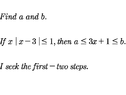
RTCNTC said:|x - 3| ≤ 1
-1 ≤ x - 3 ≤ 1
3 * (-1) ≤ 3 * (x - 3) ≤ 3 * 1
-3 ≤ 3x - 9 ≤ 3
-3 + 10 ≤ 3x - 9 + 10 ≤ 3 + 10
7 ≤ 3x + 1 ≤ 13
a = 7, b = 3
Is this correct?
RTCNTC said:I will try more similar questions at home. If I get the wrong answer or get stuck, I will post all three questions with my work shown.
Klaas van Aarsen said:Did you read my previous PM about posting useless comments?
RTCNTC said:No comment is useless.
RTCNTC said:I will try more similar questions at home. If I get the wrong answer or get stuck, I will post all three questions with my work shown.
Joppy said:The statements:
don't have any value or 'use' to anyone here reading them. It's good that you are trying more questions, but it's a bit like if I told you that this afternoon I'm going to go shopping and buy some milk and bread.