How to study feedback? Which branch of Mathematics does it?

Click For Summary

Discussion Overview

The discussion centers around the mathematical tools and theories applicable to studying systems characterized by feedback between dependent variables. Participants explore the complexities of such systems, particularly in contexts like atmospheric science and control theory, without reaching a consensus on the best approach.

Discussion Character

  • Exploratory
  • Technical explanation
  • Debate/contested

Main Points Raised

  • One participant describes a system where all variables are interdependent, complicating the analysis of relationships between them.
  • Another participant suggests that the discussion may relate to chaos theory, while others contest this view, stating that not all complex systems are chaotic.
  • Some participants propose differential equations, non-linear analysis, and control theory as relevant mathematical frameworks for understanding feedback systems.
  • There is mention of the need for probability theory in analyzing such systems.
  • A participant raises a question about the feasibility of conducting experiments in control theory, especially in complex systems like the atmosphere or universe.
  • Responses indicate that while direct experimentation may not be possible in certain contexts, data collection and system identification are viable methods for studying these systems.

Areas of Agreement / Disagreement

Participants express differing views on the relevance of chaos theory to the discussion, with some asserting it is not applicable unless the system is chaotic. There is no consensus on a singular mathematical approach, as multiple frameworks are proposed and debated.

Contextual Notes

Participants acknowledge the challenges of isolating variables in complex systems and the limitations of direct experimentation in fields like atmospheric science and astrophysics.

Who May Find This Useful

This discussion may be of interest to those studying systems theory, control theory, or anyone exploring the mathematical modeling of complex, interdependent systems.

jonjacson
Messages
450
Reaction score
38
Hello,

I want to study a system, and I have realized that all variables in it are dependent. There is no independent variable. So everytime you modify the input, you get an output but at the same time that output modifies the input itself, there is an important feedback. So the system apparently is evolving searching a kind of equilibrium but it does it in several steps and I find it difficult to "isolate" one variable, or analyze what is the relationship between variables since they are affected by the rest of the system.

I will try to put an example, hopefully it will show the main characteristics I am talking about.

In the atmosphere if there is a raise in the amount of energy that arrives from the sun, the temperature raises. But that changes the amount of water the air can contain, and that modifies the amount of radiation that the atmosphere absorbs which is the factor we started analyzing.

My question is, What is the best mathematical tool to understand systems where feedback between variables is key?

-----

Another example:
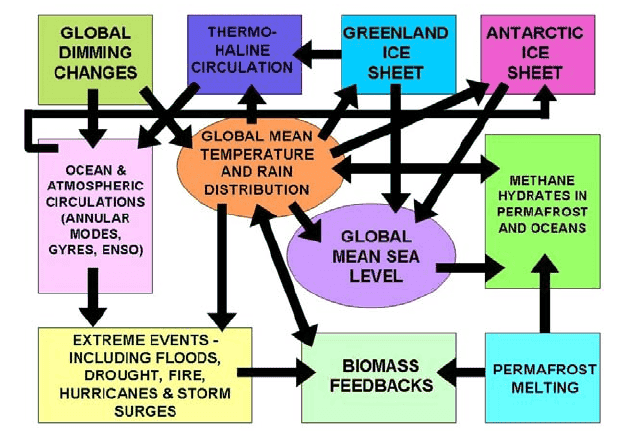
165-Climate_interacting_loops-pittock_2006.png


Would you use differential equations? Variational calculus?
 
Physics news on Phys.org
Is this not Chaos theory, essentially?
 
It has nothing to do with Chaos theory unless the system happens to be chaotic, and many systems as complex as the OP's picture are not.

Differential equations, signal processing (analog and digital), and control systems (stability analysis, etc) would be good topics to start learning. You may need some probability theory as well.
 
With 'feed back', this would be "non-linear differential equations" or, more generally, "non-linear analysis".
 
It's not 'chaos theory' you are looking for, but 'control theory' which deals with inputs to dynamical systems and the resulting feedback:

http://en.wikipedia.org/wiki/Control_theory

It's not a branch of pure mathematics which deals with feedback, but a blend of math and engineering, an inter-disciplinary effort.
 
1MileCrash said:
Is this not Chaos theory, essentially?
Well, I don't know if the system is chaotic or not. It is complex for sure. I guess a small change could have a big impact on other variables but this is only guessing.
HallsofIvy said:
With 'feed back', this would be "non-linear differential equations" or, more generally, "non-linear analysis".
Thanks, I will try to learn that.
AlephZero said:
It has nothing to do with Chaos theory unless the system happens to be chaotic, and many systems as complex as the OP's picture are not.

Differential equations, signal processing (analog and digital), and control systems (stability analysis, etc) would be good topics to start learning. You may need some probability theory as well.

Thank you very much. That looks very interesting.
 
SteamKing said:
It's not 'chaos theory' you are looking for, but 'control theory' which deals with inputs to dynamical systems and the resulting feedback:

http://en.wikipedia.org/wiki/Control_theory

It's not a branch of pure mathematics which deals with feedback, but a blend of math and engineering, an inter-disciplinary effort.

I have a question about this, Can people using control theory do experiments?

I mean, in mechanics you could go to a laboratory and analyze a pendulum. But the problem is that I can't do any experiment, it is like the atmosphere, you can't stop it and analyze any specific variable.

Everything is mixed together and evolving constantly in time. The same problem you have in astrophysics, you can't stop the universe nor isolate a galaxy, I can just watch everything mixed and changing in time.

Does that matter for control theory?
 
jonjacson said:
I have a question about this, Can people using control theory do experiments?

Sure. For example one of the "standard" experiments is to design a system that will balance an inverted pendulum on a moving cart. Making a computer simulation would probably be a good thing to do first. Then build the real world system and get it working!

https://www.youtube.com/watch?v=AuAZ5zOP0yQ

You can't easily experiment with a system like the Earth's atmosphere, but you can collect data and use it to estimate the parameters that control how the system behaves. That procedure is called "system identification".
 
AlephZero said:
Sure. For example one of the "standard" experiments is to design a system that will balance an inverted pendulum on a moving cart. Making a computer simulation would probably be a good thing to do first. Then build the real world system and get it working!

https://www.youtube.com/watch?v=AuAZ5zOP0yQ

You can't easily experiment with a system like the Earth's atmosphere, but you can collect data and use it to estimate the parameters that control how the system behaves. That procedure is called "system identification".

That looks exactly what I was looking for. Thanks.
 

Similar threads

  • · Replies 64 ·
3
Replies
64
Views
3K
  • · Replies 7 ·
Replies
7
Views
2K
  • · Replies 19 ·
Replies
19
Views
1K
Replies
22
Views
3K
  • · Replies 1 ·
Replies
1
Views
2K
  • · Replies 4 ·
Replies
4
Views
2K
  • · Replies 5 ·
Replies
5
Views
3K
  • · Replies 4 ·
Replies
4
Views
3K
Replies
6
Views
9K
  • · Replies 7 ·
Replies
7
Views
4K