Lotto
- 260
- 16
- TL;DR
- In the theory of exact plane gravitational waves, we can write the Rosen metric as ##\mathrm{d}s^2 = 2\,\mathrm{d}U\,\mathrm{d}V + e^{2\beta} \left[ e^{2\gamma} (\cos\alpha\,\mathrm{d}x + \sin\alpha\,\mathrm{d}y)^2 + e^{-2\gamma} (-\sin\alpha\,\mathrm{d}x + \cos\alpha\,\mathrm{d}y)^2 \right]##. But how to understand the transformation with the angle of rotation ##\alpha##?
The metric can be written as ##
\mathrm{d}s^2 = 2\,\mathrm{d}U\,\mathrm{d}V + e^{2\beta}
\begin{pmatrix} \mathrm{d}x & \mathrm{d}y \end{pmatrix}
R^T(\alpha)
\begin{pmatrix} e^{2\gamma} & 0 \\ 0 & e^{-2\gamma} \end{pmatrix}
R(\alpha)
\begin{pmatrix} \mathrm{d}x \\ \mathrm{d}y \end{pmatrix}=
\mathrm{d}s^2 = 2\,\mathrm{d}U\,\mathrm{d}V + e^{2\beta}
\begin{pmatrix} \mathrm{d}x & \mathrm{d}y \end{pmatrix}
\begin{pmatrix} \cos\alpha & -\sin\alpha \\ \sin\alpha & \cos\alpha \end{pmatrix}
\begin{pmatrix} e^{2\gamma} & 0 \\ 0 & e^{-2\gamma} \end{pmatrix}
\begin{pmatrix} \cos\alpha & \sin\alpha \\ -\sin\alpha & \cos\alpha \end{pmatrix}
\begin{pmatrix} \mathrm{d}x \\ \mathrm{d}y \end{pmatrix}##
The matrix term is clearly a rotational transformation, but I have problems to understand how the transformation looks like and what vectors we transform.
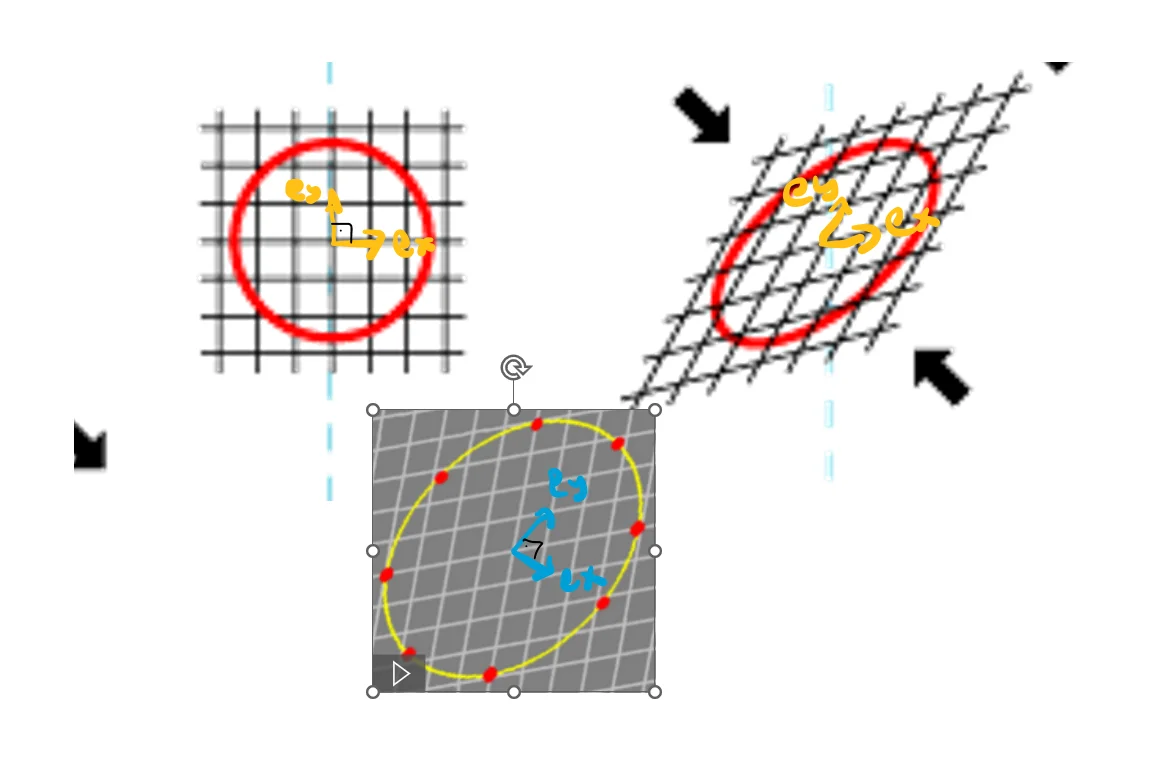
If we have a sandwich plane gravitational wave on the flat background, then in front of the wave, the space-time is flat, so the metric is Minkowskian and the basis vectors ##e_x## and ##e_y## are ortonormal to each other in the flat metric. Then the wave comes and let's say that it is X-polarised. Since the Rosen metric is comoving with rest particles, the basis vectors ##e_x## and ##e_x## will be stretched with the space-time.
The metric in which the basis vectors point in the direction of the principle axes of the ellipse (shown in the picture below) is ##\mathrm{d}s^2 = 2\,\mathrm{d}U\,\mathrm{d}V + e^{2\beta}
\begin{pmatrix} \mathrm{d}x' & \mathrm{d}y' \end{pmatrix}
\begin{pmatrix} e^{2\gamma} & 0 \\ 0 & e^{-2\gamma} \end{pmatrix}
\begin{pmatrix} \mathrm{d}x' \\ \mathrm{d}y' \end{pmatrix}##. And here comes my confusion - the transformation matrices ##R## and ##R^T## rotates the basis, in which the metrix is diagonal, back to the basis, in which the metric ##g_{ij}##,where ##i,j=1,2##, can have non-diagonal components. But the "diagonal basis" must have perpendicular vectors so that these vectors point in the same diretion as the principal axes of the ellipse. But the rotation must preserve its perpendicularity. But the "non-diagonal basis" is oblique as shown in the picture, so there is a contradiction.
The general metric can have non-diagonal components, that is the metric with respect to the "oblique" basis, the stretched basis. But its rotation doesn't ensure that its two vectors point in the same direction as the principle axes. So, what basis do we rotace exactly? Because this looks like we rotate the "perpendicular flat basis" by ##\alpha##. But that doesn't make sense because then we can't get the oblique basis.
I tried to visualise my thoughts in this picture. I hope it clarifies what I mean.
\mathrm{d}s^2 = 2\,\mathrm{d}U\,\mathrm{d}V + e^{2\beta}
\begin{pmatrix} \mathrm{d}x & \mathrm{d}y \end{pmatrix}
R^T(\alpha)
\begin{pmatrix} e^{2\gamma} & 0 \\ 0 & e^{-2\gamma} \end{pmatrix}
R(\alpha)
\begin{pmatrix} \mathrm{d}x \\ \mathrm{d}y \end{pmatrix}=
\mathrm{d}s^2 = 2\,\mathrm{d}U\,\mathrm{d}V + e^{2\beta}
\begin{pmatrix} \mathrm{d}x & \mathrm{d}y \end{pmatrix}
\begin{pmatrix} \cos\alpha & -\sin\alpha \\ \sin\alpha & \cos\alpha \end{pmatrix}
\begin{pmatrix} e^{2\gamma} & 0 \\ 0 & e^{-2\gamma} \end{pmatrix}
\begin{pmatrix} \cos\alpha & \sin\alpha \\ -\sin\alpha & \cos\alpha \end{pmatrix}
\begin{pmatrix} \mathrm{d}x \\ \mathrm{d}y \end{pmatrix}##
The matrix term is clearly a rotational transformation, but I have problems to understand how the transformation looks like and what vectors we transform.
If we have a sandwich plane gravitational wave on the flat background, then in front of the wave, the space-time is flat, so the metric is Minkowskian and the basis vectors ##e_x## and ##e_y## are ortonormal to each other in the flat metric. Then the wave comes and let's say that it is X-polarised. Since the Rosen metric is comoving with rest particles, the basis vectors ##e_x## and ##e_x## will be stretched with the space-time.
The metric in which the basis vectors point in the direction of the principle axes of the ellipse (shown in the picture below) is ##\mathrm{d}s^2 = 2\,\mathrm{d}U\,\mathrm{d}V + e^{2\beta}
\begin{pmatrix} \mathrm{d}x' & \mathrm{d}y' \end{pmatrix}
\begin{pmatrix} e^{2\gamma} & 0 \\ 0 & e^{-2\gamma} \end{pmatrix}
\begin{pmatrix} \mathrm{d}x' \\ \mathrm{d}y' \end{pmatrix}##. And here comes my confusion - the transformation matrices ##R## and ##R^T## rotates the basis, in which the metrix is diagonal, back to the basis, in which the metric ##g_{ij}##,where ##i,j=1,2##, can have non-diagonal components. But the "diagonal basis" must have perpendicular vectors so that these vectors point in the same diretion as the principal axes of the ellipse. But the rotation must preserve its perpendicularity. But the "non-diagonal basis" is oblique as shown in the picture, so there is a contradiction.
The general metric can have non-diagonal components, that is the metric with respect to the "oblique" basis, the stretched basis. But its rotation doesn't ensure that its two vectors point in the same direction as the principle axes. So, what basis do we rotace exactly? Because this looks like we rotate the "perpendicular flat basis" by ##\alpha##. But that doesn't make sense because then we can't get the oblique basis.
I tried to visualise my thoughts in this picture. I hope it clarifies what I mean.
Attachments