PhDeezNutz
- 851
- 561
- Homework Statement
- According to Hubble's Law, the distant galaxies are receding from us speeds proportional to their distance from us;
$$v \left( r \right) = \alpha r$$
Where ##\alpha = 2.18 \cdot 10^{-18} \text{ sec}^{-1}##
(a) How far would a galaxy be whose speed with respect to the Earth is ##c##? Would it be observable from the Earth?
(b) Consider the same questions (including Doppler Effect) for a hypothetical galaxy for which ##v(r) = 1.1c##
- Relevant Equations
- $$v \left( r \right) = \alpha r$$
Where ##\alpha = 2.18 \cdot 10^{-18} \text{ sec}^{-1}##
$$1 \text{ lightyear} = 9.4608 \cdot 10^{15} \text{ m }$$
According to wikipedia the observable universe has a radius of ##4.65 \cdot 10^{10} \text{ lightyears}##
(a) How far would a galaxy be whose speed with respect to the Earth is ##c##? Would it be observable from the Earth?
r=rα=1.5⋅1026 m =1.6⋅1010 lightyears<4.65⋅1010 lightyearsr=rα=1.5⋅1026 m =1.6⋅1010 lightyears<4.65⋅1010 lightyearsr=rα=1.5⋅1026 m =1.6⋅1010 lightyears<4.65⋅1010 lightyears
r=ca=1.5⋅1026 m=1.6⋅1010 lightyears<4.65⋅1010lightyearsr=ca=1.5⋅1026 m=1.6⋅1010 lightyears<4.65⋅1010lightyearsSo Yes, the galaxy would be visible from the Earth. That said, the answers in the back of the book indicate that it is not (correct answer: No). That also said, my numerical answer for part (a) is correct according to the back of the book. Is it possible that the observable universe was smaller in 1968 when the book was published? I can't find what it was in 1968? Or is the method used/referenced in wiki different than the one under consideration?
(b) Consider the same questions (including Doppler Effect) for a hypothetical galaxy for which ##v(r) = 1.1c##
I honestly don't know how to do this apart accounting for Doppler Effect but here's what I get without accounting for Doppler Effect (using the approach from part(a)). There's no mention of wavelength or frequency so I don't understand how the Doppler Effect has anything to do with it.
r=1.1cα≈1.5⋅1026 m=1.6⋅1010 lightyears<4.65⋅1010 lightyearsr=1.1cα≈1.5⋅1026 m=1.6⋅1010 lightyears<4.65⋅1010 lightyearsI'm lost. I don't even understand the premise of part(b).
Edit: I'm going to Latex it up and take pictures and post it because the latex on the forum seems to be messing up.
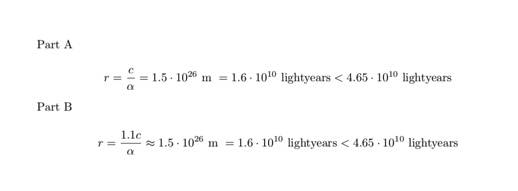
r=rα=1.5⋅1026 m =1.6⋅1010 lightyears<4.65⋅1010 lightyearsr=rα=1.5⋅1026 m =1.6⋅1010 lightyears<4.65⋅1010 lightyearsr=rα=1.5⋅1026 m =1.6⋅1010 lightyears<4.65⋅1010 lightyears
r=ca=1.5⋅1026 m=1.6⋅1010 lightyears<4.65⋅1010lightyearsr=ca=1.5⋅1026 m=1.6⋅1010 lightyears<4.65⋅1010lightyears
(b) Consider the same questions (including Doppler Effect) for a hypothetical galaxy for which ##v(r) = 1.1c##
I honestly don't know how to do this apart accounting for Doppler Effect but here's what I get without accounting for Doppler Effect (using the approach from part(a)). There's no mention of wavelength or frequency so I don't understand how the Doppler Effect has anything to do with it.
r=1.1cα≈1.5⋅1026 m=1.6⋅1010 lightyears<4.65⋅1010 lightyearsr=1.1cα≈1.5⋅1026 m=1.6⋅1010 lightyears<4.65⋅1010 lightyears
Edit: I'm going to Latex it up and take pictures and post it because the latex on the forum seems to be messing up.
Last edited: