Human body growth in the absence of a brain

Click For Summary

Discussion Overview

The discussion centers around the role of the brain in human growth and bodily functions, particularly in the context of scenarios where the brain is absent or non-functional. Participants explore the implications of brain absence on physical growth, organ function, and involuntary activities such as heartbeat and breathing.

Discussion Character

  • Exploratory
  • Debate/contested
  • Conceptual clarification

Main Points Raised

  • One participant suggests that physical growth could occur without a brain, proposing that each cell has its own 'brain' that dictates growth, while acknowledging limitations in movement and responsiveness.
  • Another participant counters this by stating that human growth hormone is essential for growth and that the glands mentioned are derived from nerve tissue, implying that the absence of the brain would hinder growth.
  • There is a discussion about the role of the hypothalamus, pineal gland, and pituitary gland, with some participants questioning whether these glands could function independently of the brain.
  • One participant raises the question of whether involuntary activities, such as heartbeat and breathing, can occur without brain activity, referencing personal experiences and medical definitions of brain death.
  • A later reply elaborates on the embryological origins of the pituitary gland and the brain's role in regulating involuntary functions, including breathing and heart rate, while providing an example of a headless chicken that survived due to retained brainstem function.
  • Another participant expresses confusion about the brain's control over involuntary functions, reflecting on their previous assumptions about the brain's role in regulating bodily activities.

Areas of Agreement / Disagreement

Participants express differing views on the necessity of the brain for growth and involuntary functions. There is no consensus on whether a human can survive or grow without brain activity, and the discussion remains unresolved regarding the extent of the brain's control over bodily functions.

Contextual Notes

Participants reference various medical conditions and examples, such as anencephaly and brain death, to illustrate their points. The discussion highlights the complexity of the relationship between the brain and bodily functions, with several assumptions and definitions left unexamined.

PainterGuy
Messages
938
Reaction score
73
Hi,

Does the brain control the physical growth of a human baby?

I think if, for some unfortunate reason, the brain is absent, the growth would still take place normally but more like a vegetable. I don't think if the brain is absent, one can even blink the eye or move a finger. But the details and data for organ growth such as size and shape, tallness, color, hair color, sex, etc. are present in each cell; in other words each cell has its own 'brain' which tells it how to grow. I think heart and lungs can also work independently of brain because the persons in coma without any brain activity can still pump blood around and breathe. It's possible that in absence of brain the functioning of heart and lungs is not that as smooth and reliable.

I don't think that hypothalamus, pineal gland, and pituitary gland are integral parts of brain so if the brain is absent, the glands could still be there to release the required hormones.

Could you please confirm if I'm thinking along the right lines? Thank you!
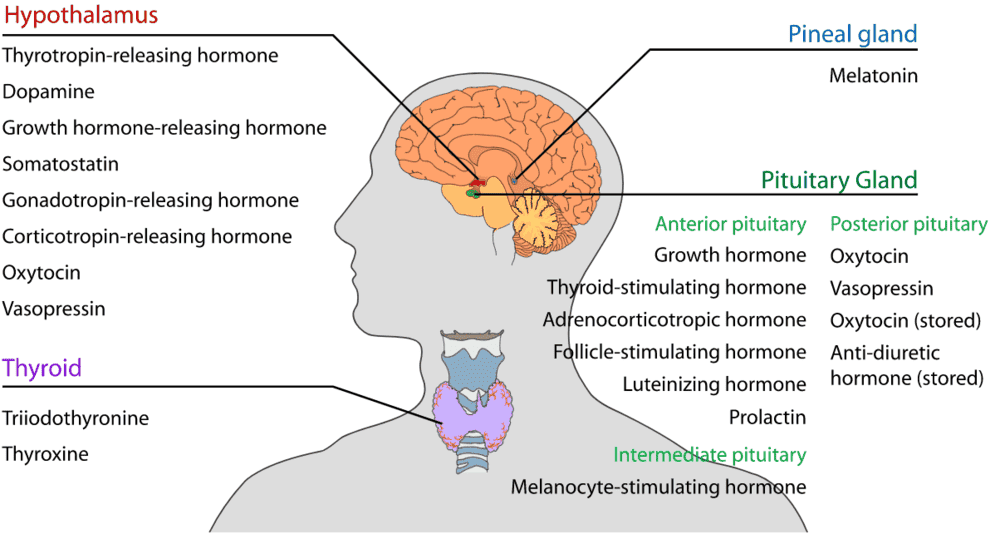
1608714359127.png

Source: https://upload.wikimedia.org/wikipedia/commons/9/96/Endocrine_central_nervous_en.svg
 
Biology news on Phys.org
Human growth hormone has be created over and over. It is required for growth.
The glands you mention are derived from nerve tissue - the same as the brain. So I would say 'no', not correct

I think you are describing anencephaly: https://www.cdc.gov/ncbddd/birthdefects/anencephaly.html
 
  • Like
Likes   Reactions: PainterGuy
Thank you!

jim mcnamara said:
I think you are describing anencephaly: https://www.cdc.gov/ncbddd/birthdefects/anencephaly.html

Yes, though I just made it up, my description was close to 'anencephaly'.

jim mcnamara said:
Human growth hormone has be created over and over. It is required for growth.
The glands you mention are derived from nerve tissue - the same as the brain. So I would say 'no', not correct

But those glands are not part of the organ called brain, right? Does this mean that in absence of brain and those glands, human growth or human baby cannot survive? Is survival possible?
Brain death is the complete loss of brain function (including involuntary activity necessary to sustain life).[1][2][3][4] It differs from persistent vegetative state, in which the person is alive and some autonomic functions remain.[5] It is also distinct from an ordinary coma, whether induced medically or caused by injury and/or illness, even if it is very deep, as long as some brain and bodily activity and function remain; and it is also not the same as the condition locked-in syndrome. A differential diagnosis can medically distinguish these differing conditions.
Source: https://en.wikipedia.org/wiki/Brain_death

Is brain needed for the involuntary activity? I believe heart beating and functioning of lungs are involuntary activities. I was under the impression that even when brain is completely dead, one can survive in vegetative state. I knew an elderly person who slipped into coma and later doctors declared that there was no brain activity of any sort, but that person kept on breathing in the vegetative state for some years.
 
There are two parts of the pituitary gland, one derived embryologically from neural tissue (posterior pit.), one derived embryologically from an invagination (infolding of a sheet of cells) of the roof of the mouth.

The hypothalamus and pineal are entirely derived embryologically from the nervous system. It controls a lot of pituitary function. They are both considered part of the brain.

The human heart can beat in an unregulated way without innervation (not sure for how long). Some other animals require the brain for a heart beat because that is where the rhythmic driver is.

Breathing (using to lungs) requires innervation to happen. It uses skeletal muscles driven by spinal cord motor neurons. I believe the driver neurons of the motor neurons is in the hindbrain (back part of the brain).

There was a famous case of a headless chicken that was kept alive for 18 months (with special care). The head was cut of with an axe for dinner, but it was not a well done job and the brain stem (including the hindbrain) was not removed, allowing the chicken to survive. It became a side show star.
Screen Shot 2020-12-23 at 5.50.10 PM.png

The brainstem is the most "primitive" part of the brain and includes a lot of functions that would have evolved early in the vertebrates, like control of breathing and heart rate.

The brain also has some indirect control over "involuntary" functions because the autonomic nervous system as well as any other part of the nervous system are connected to the central nervous system which can influence it functioning (such as danger --> increase heart rate).

There are also lots of behaviors considered involuntary which occur within the brain. They are just learned, automated, and then let to run with relatively little conscious control, like bicycle riding.
 
  • Like
Likes   Reactions: PainterGuy
Thank you!

The case of Mike the Headless Chicken really intrigued me!

BillTre said:
The human heart can beat in an unregulated way without innervation (not sure for how long). Some other animals require the brain for a heart beat because that is where the rhythmic driver is.

So, I was wrong. I had thought that human heart can beat and keep its rhythm on its own without any intervention from the brain.

BillTre said:
Breathing (using to lungs) requires innervation to happen. It uses skeletal muscles driven by spinal cord motor neurons. I believe the driver neurons of the motor neurons is in the hindbrain (back part of the brain).

Again, I was wrong. I had thought no brain intervention was required.

BillTre said:
The brain also has some indirect control over "involuntary" functions because the autonomic nervous system as well as any other part of the nervous system are connected to the central nervous system which can influence it functioning (such as danger --> increase heart rate).

I find it little confusing because I had thought that human brain controlled all the involuntary functions and it does this on its own without any conscious involvement.

By the way, as a layman, now I think of a human brain as an organ responsible for conscious behavior such as decision making, deciding between right and wrong, etc., storing memories, learning, regulating other organs such as heart and lungs, controlling different body such as moving legs, hands, etc. and producing some hormones.
 

Similar threads

  • · Replies 29 ·
Replies
29
Views
6K
  • · Replies 4 ·
Replies
4
Views
39K
  • · Replies 14 ·
Replies
14
Views
6K
  • · Replies 41 ·
2
Replies
41
Views
9K
  • · Replies 15 ·
Replies
15
Views
6K
Replies
18
Views
7K
  • · Replies 3 ·
Replies
3
Views
5K
  • · Replies 48 ·
2
Replies
48
Views
10K
Replies
82
Views
10K
  • · Replies 8 ·
Replies
8
Views
7K