rogue_system
- 2
- 2
- Homework Statement
- (copied from Pearson)
Huygens' principle (first described by the Dutch scientist Christiaan Huygens in 1678) uses geometry to determine the shape of a wavefront at a time t, given some initial wavefront at an earlier time. This can be constructed by imagining that the initial wavefront is a source of wavelets that propagate from each point at the speed of light. From this principle, one can determine the angles of reflection and refraction by considering the speed of light at each point on the wavefront. In this problem, we will explore some of these concepts.
Part A:
First, let's look at a plane wave that is incident on a flat piece of material with an index of refraction n. Part of the light is transmitted through the material and part of it is reflected. For the moment, let's just look at the part that is transmitted. At time t=0, the wavefront is a distance d away from the surface of the material (Figure 1). At time t=t1, the wavefront is at the position of the material interface (Figure 2). Use Huygens' principle to determine how far into the material ( d′) the wavefront has propagated by time t=2t1 (Figure 3).
Part B:
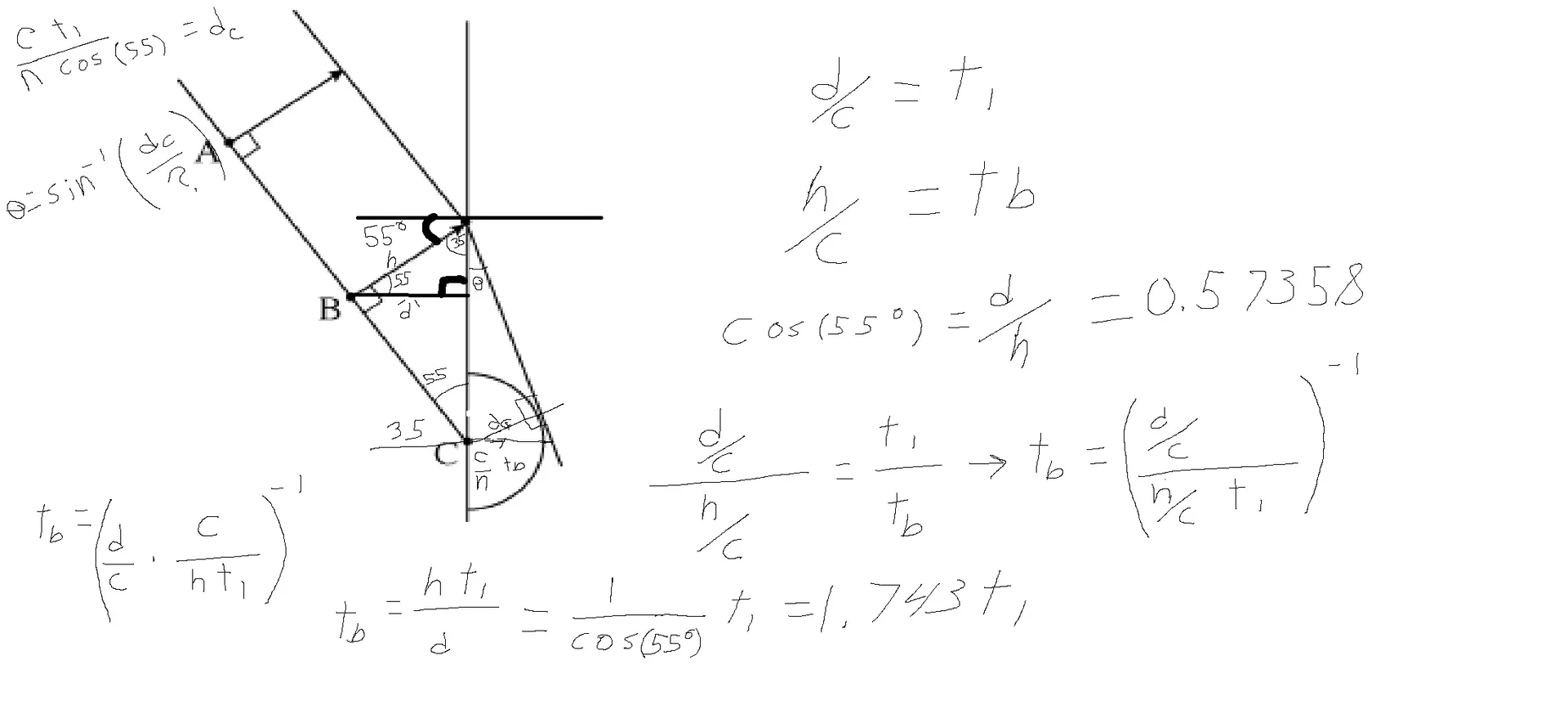
Now, instead of having a flat wavefront propagating normal to the material interface we have a flat wavefront propagating toward the material with an incident angle of 55∘. In this part, we will look at the relative positions of a few points--A, B, and C--on the wavefront to illustrate Huygens' principle (Figure 4). Point C touches the vacuum/material interface at time t=0 whereas point B is a perpendicular distance d from the vacuum/material interface and point A is a perpendicular distance 2d away from the vacuum/material interface.
Part C:
How far did point C move into the material in the time t=tB that it took for point B to get to the interface? Lets call this distance dC.
Part D:
What is the angle of refraction, θ along which the wavefront at point C is propagating? Use the fact that you have a spherical wavefront propagating from the material interface at time t=0 until time tB when the wavefront at point B reached the interface.
- Relevant Equations
- n = c/v
v = c/n
n1sin(φ1)=n2sin(φ2)
sin = (opp/hyp)
cos = (adj/hyp)
tan = (opp/adj)
Part A was simple enough, if the distance traveled in the new medium takes place over the same amount of time in the old medium, then the distance traveled will be the new velocity divided by t1, which makes d'= (c/n)*t1.
Part B is t1/cos(55) = tb
Part C is (c/n) * tb
Where I'm getting a bit hung up though, is part D
The hint given for it is Huygens' principle relies on looking at each point on a wavefront as a source of circular (two-dimensional) wavelets. As a result, we can look at how a wavelet propagates from where point C touches the interface. While this wavelet is propagating in the material (at a speed less than c), point B of the wavefront continues to propagate at speed c until it too hits the interface. When this occurs, one can draw a line from the point at which B touches the interface to the tangent of the wavelet from point C earlier. Since this line is tangent to the circle, it is perpendicular to a line from where point C touched the interface (i.e., the center of the circular wavelet) to the point of tangency (on the circular wavelet). From geometry and the previous part, one should be able to deduce the relevant angles. Note that the distances from point C to points B and A are arbitrary and thus can be considered very small.
The diagram for this problem (which I have taken the liberty of doodling on while I work this problem) is below. I think I need to find a relation where I know the distance from point C to where the ray from point B meets the interface, thus giving me some quantity for the hypotenuse, but I am not sure what that is?
Part B is t1/cos(55) = tb
Part C is (c/n) * tb
Where I'm getting a bit hung up though, is part D
The hint given for it is Huygens' principle relies on looking at each point on a wavefront as a source of circular (two-dimensional) wavelets. As a result, we can look at how a wavelet propagates from where point C touches the interface. While this wavelet is propagating in the material (at a speed less than c), point B of the wavefront continues to propagate at speed c until it too hits the interface. When this occurs, one can draw a line from the point at which B touches the interface to the tangent of the wavelet from point C earlier. Since this line is tangent to the circle, it is perpendicular to a line from where point C touched the interface (i.e., the center of the circular wavelet) to the point of tangency (on the circular wavelet). From geometry and the previous part, one should be able to deduce the relevant angles. Note that the distances from point C to points B and A are arbitrary and thus can be considered very small.
The diagram for this problem (which I have taken the liberty of doodling on while I work this problem) is below. I think I need to find a relation where I know the distance from point C to where the ray from point B meets the interface, thus giving me some quantity for the hypotenuse, but I am not sure what that is?