Hyperbola's asymptote, where's my mistake?

  • Thread starter Thread starter Poznerrr
  • Start date Start date
  • Tags Tags
    Asymptote Mistake
Join the discussion
Ask a follow-up here, or get your own question answered by working scientists, mathematicians and engineers — people, not an autocomplete.
Real named experts · corrections over time · the nuance an AI answer skips
9 replies · 2K views
Poznerrr
Messages
10
Reaction score
0
Member warned to not delete the homework template in future posts
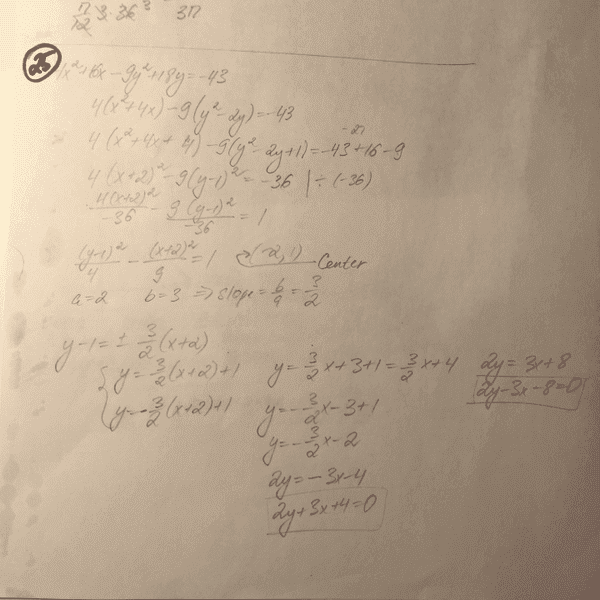
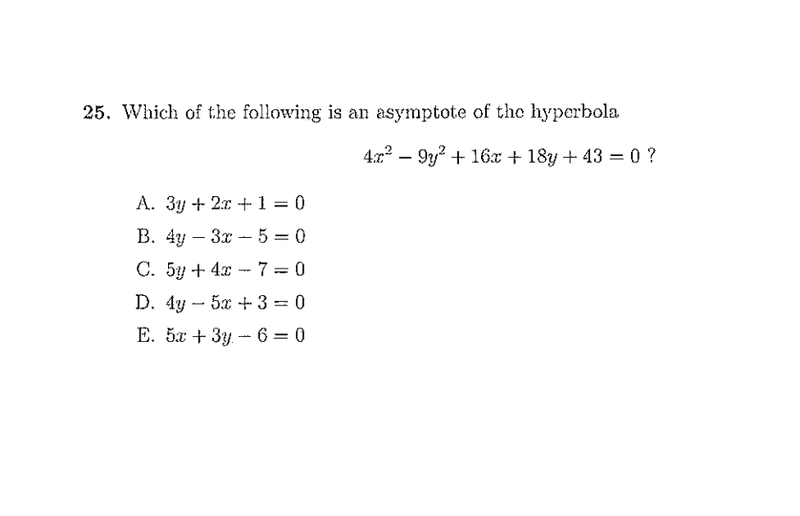
I have tried like 5 times to do this problem ans still don't get the answer I'm supposed to (A). Anybody finds mistake in my work below?
upload_2016-7-6_13-30-13.png

upload_2016-7-6_13-31-53.png
 
Physics news on Phys.org
If I'm not mistaken, it should be ##a/b## and not ##b/a##. so the factor appearing will be ##2/3## and not ##3/2##.
 
Fightfish said:
If I'm not mistaken, it should be ##a/b## and not ##b/a##. so the factor appearing will be ##2/3## and not ##3/2##.
Yeah, I thought about it, and it works out with a/b being the slope of the asymptote. But different sources stick to either a/b and b/a, so it's really confusing which slope is actually correct.
 
Poznerrr said:
Yeah, I thought about it, and it works out with a/b being the slope of the asymptote. But different sources stick to either a/b and b/a, so it's really confusing which slope is actually correct.
The way to remember it is well, to derive it yourself, which isn't very hard. The general equation for a hyperbola is in the form
[tex]\frac{y^2}{a^2} - \frac{x^2}{b^2} = 1[/tex]
In the asymptotic limit, the term ##1## becomes insignificant and so we drop it, leaving
[tex]\frac{y^2}{a^2} = \frac{x^2}{b^2}[/tex]
and so
[tex]y = \pm \frac{a}{b} x[/tex]
 
Given a conic section
[tex]Ax^2 + Bxy + Cy^2 + Dx + Ey + F = 0[/tex]
the asymptotes can be calculated by a little trick. Basically, the slope of the asymptote is ##s##, where ##s## is the solution to ##A + Bs + Cs^2=0##.

In your case, this corresponds to the solution of ##4-9s^2=0##. So we get ##s = 2/3## or ##s= -2/3##. The slope of (A) is ##-2/3##.
 
  • Like
Likes   Reactions: member 587159
micromass said:
Given a conic section
[tex]Ax^2 + Bxy + Cy^2 + Dx + Ey + F = 0[/tex]
the asymptotes can be calculated by a little trick. Basically, the slope of the asymptote is ##s##, where ##s## is the solution to ##A + Bs + Cs^2=0##.

In your case, this corresponds to the solution of ##4-9s^2=0##. So we get ##s = 2/3## or ##s= -2/3##. The slope of (A) is ##-2/3##.

Ah, the trick with the homogeneous coordinates and equations ;)
 
  • Like
Likes   Reactions: micromass
micromass said:
Given a conic section
[tex]Ax^2 + Bxy + Cy^2 + Dx + Ey + F = 0[/tex]
the asymptotes can be calculated by a little trick. Basically, the slope of the asymptote is ##s##, where ##s## is the solution to ##A + Bs + Cs^2=0##.

In your case, this corresponds to the solution of ##4-9s^2=0##. So we get ##s = 2/3## or ##s= -2/3##. The slope of (A) is ##-2/3##.
Thanks! I'll use this trick in future.
 
Poznerrr,
For the proof, divide the initial conic section by x2. And find the limit if x->infinity. Thus, your get the equation from post #5, where s = y/x, that is the slope.
 
Poznerrr said:
Thanks! I'll use this trick in future.

Also: in the future do not post images of your work, as most people on this Forum will not read them and will not be willing to help you. Just type out your work.