Seeing Uranus - Two Nights of Celestial Wonders

  • Context: Stargazing 
  • Thread starter Thread starter Andy Resnick
  • Start date Start date
  • Tags Tags
    Uranus
Click For Summary
SUMMARY

The forum discussion centers on astrophotography of Uranus and its moons, specifically Titania, Oberon, and Ariel, captured over two consecutive nights using a DSLR camera with a telephoto lens mounted on an equatorial mount. The images were taken with settings of 800/5.6, 8", ISO 2000, and non-bleached images at 1", ISO 100. Participants discussed the effects of exposure time on image quality and color, particularly noting the loss of Uranus's blue-green hue when capturing the moons.

PREREQUISITES
  • Understanding of DSLR camera settings and exposure times
  • Familiarity with equatorial mounts for astrophotography
  • Knowledge of celestial bodies, specifically Uranus and its moons
  • Basic image editing skills for astrophotography
NEXT STEPS
  • Research advanced astrophotography techniques using DSLR cameras
  • Learn about equatorial mount setup and tracking for celestial photography
  • Explore the characteristics of Uranus and its moons in detail
  • Investigate image processing software for enhancing astrophotography images
USEFUL FOR

Astronomy enthusiasts, astrophotographers, and anyone interested in capturing celestial phenomena, particularly those focusing on Uranus and its moons.

Andy Resnick
Science Advisor
Education Advisor
Insights Author
Messages
7,717
Reaction score
3,846
Sorry for the title, I just can't help myself :)

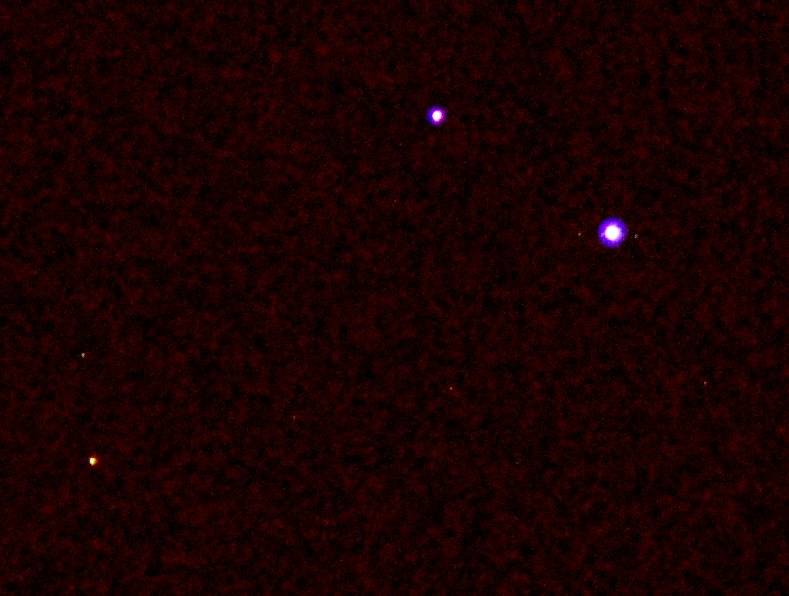
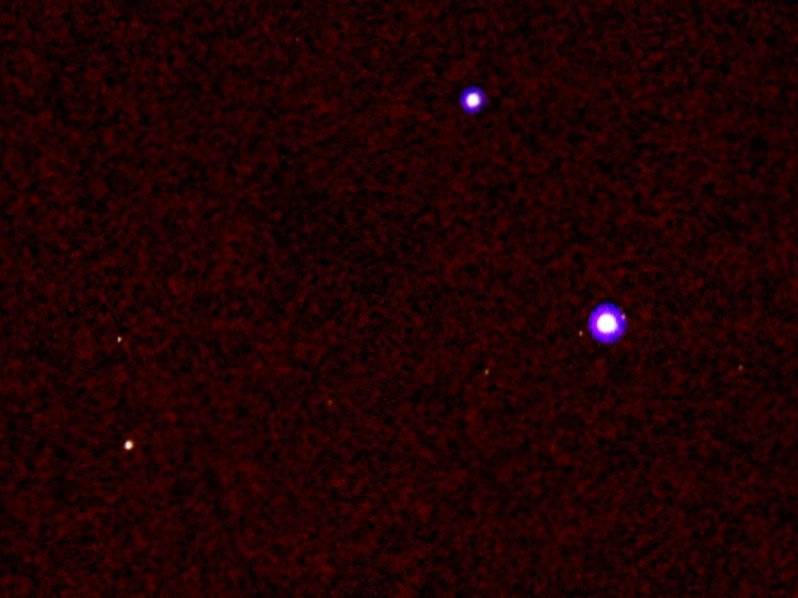
Anyhow, here's shots from 2 consecutive nights- you can even see 3 moons, probably Titania, Oberon, and Ariel:
DSC_6673_crop_zpsltmnkebl.jpg

(10/10/16 at 11pm)

DSC_6696_crop_zpsi1e6rlf3.jpg

(10/11/16 at 10:40 pm)

Deets: 800/5.6, 8", ISO 2000. Non-bleached images (not shown) were taken at 1", ISO 100.
 
  • Like
Likes   Reactions: Fervent Freyja, 1oldman2, DennisN and 4 others
Astronomy news on Phys.org
Wooo! That's how I felt many years ago when I built a 6" Newtonian and first saw the rings of Saturn.

This may be ignorance on my part: why do some background objects (in the "plane" of what I take to be the moons) suddenly appear at 11pm? I assume exposure time...
 
  • Like
Likes   Reactions: Fervent Freyja and hsdrop
jim mcnamara said:
Wooo! That's how I felt many years ago when I built a 6" Newtonian and first saw the rings of Saturn.

This may be ignorance on my part: why do some background objects (in the "plane" of what I take to be the moons) suddenly appear at 11pm? I assume exposure time...

If I am looking at the same dots, those are stars- you can barely see them in the other image. I tweaked both images before posting, one was originally a jpg and the other originally raw, so there's some nonuniformity there.
 
jim mcnamara said:
Wooo! That's how I felt many years ago when I built a 6" Newtonian and first saw the rings of Saturn.

This may be ignorance on my part: why do some background objects (in the "plane" of what I take to be the moons) suddenly appear at 11pm? I assume exposure time...
you know i think i geeked out for almost a week each for Jupiter and saturn throw my little 4.5 in
 
  • Like
Likes   Reactions: Andy Resnick
Andy Resnick said:
Sorry for the title, I just can't help myself :)

Anyhow, here's shots from 2 consecutive nights- you can even see 3 moons, probably Titania, Oberon, and Ariel:

great shots, Andy :smile: pity that the longer exposing to bring out the moons has caused the loss of the nice blue/green colour of the planet

It was only around 4-5 yrs ago that I saw Uranus for the first time through my own scope
The only other time was around 25 yrs ago through my mates scope, back in New Zealand

I really have to try and add Neptune to the collection one dayDave
 
davenn said:
great shots, Andy :smile: pity that the longer exposing to bring out the moons has caused the loss of the nice blue/green colour of the planet

It was only around 4-5 yrs ago that I saw Uranus for the first time through my own scope
The only other time was around 25 yrs ago through my mates scope, back in New Zealand

I really have to try and add Neptune to the collection one dayDave

Thanks- I have some properly exposed shots of the planet (it really is a nice blue-green), but there's not enough space to cut-n-paste it in without blotting out one of the moons. Neptune is also on my to-do list, and maybe Pluto...

Edit- hey! Neptune is very close to Uranus right now... tonight it's cloudy and Neptune is almost directly next to the moon, but within a week (so the moon is a bit away) it should be 'easy' to locate. Stay tuned...
 
  • Like
Likes   Reactions: davenn
Andy Resnick said:
Sorry for the title, I just can't help myself :)
This helpful hint from, http://nineplanets.org/uranus.html :wink: (Nice shots by the way)
Careful pronunciation may be necessary to avoid embarrassment; say "YOOR a nus" , not "your anus" or "urine us".
 
  • Like
Likes   Reactions: Andy Resnick and davenn
Andy Resnick said:
Sorry for the title, I just can't help myself :)

Anyhow, here's shots from 2 consecutive nights- you can even see 3 moons, probably Titania, Oberon, and Ariel:

Deets: 800/5.6, 8", ISO 2000. Non-bleached images (not shown) were taken at 1", ISO 100.
Nice work, but I'm not quite understanding your setup: were those single shots from a DSLR and telephoto lens? Or a telescope? Must have been on an equatorial/motorized mount, right...?
 
russ_watters said:
Nice work, but I'm not quite understanding your setup: were those single shots from a DSLR and telephoto lens? Or a telescope? Must have been on an equatorial/motorized mount, right...?

yes, cropped single shots with a DSLR and telephoto lens. The lens has a tripod mounting foot that I attach to an equatorial mount.
 
  • Like
Likes   Reactions: russ_watters
  • #10
davenn said:
great shots, Andy :smile: pity that the longer exposing to bring out the moons has caused the loss of the nice blue/green colour of the planet

Here's the composite, I left the bright star in the crop:
DSC_6696-1_zpsuyno9pan.jpg
 
  • Like
Likes   Reactions: DennisN and davenn
  • #11
Andy Resnick said:
probably Titania, Oberon, and Ariel

Why those three? In particular, why Ariel? Miranda too close and Umbriel too dark?

Oh and...hehehe...he said "Uranus!" (couldn't resist either)
 
  • #12
Andy Resnick said:
yes, cropped single shots with a DSLR and telephoto lens. The lens has a tripod mounting foot that I attach to an equatorial mount.
Impressive.
 
  • #13
Vanadium 50 said:
Why those three? In particular, why Ariel? Miranda too close and Umbriel too dark?

Those three moons are the brightest, is all. I have no idea which moons they really are.
 

Similar threads

  • · Replies 2 ·
Replies
2
Views
2K
Replies
17
Views
4K
  • · Replies 16 ·
Replies
16
Views
5K
  • · Replies 5 ·
Replies
5
Views
3K
  • · Replies 5 ·
Replies
5
Views
3K
  • · Replies 65 ·
3
Replies
65
Views
11K