I think I found a flaw in vector combination theory

Join the discussion
Registration is free. Ask a follow-up in this thread, or start your own.
4 replies · 2K views
BreezyLeaf
Messages
7
Reaction score
0
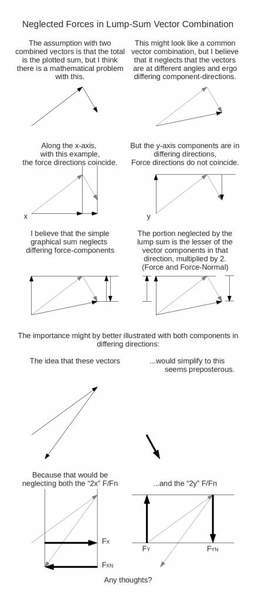
I've seen it often taught that the combination of two vectors is their graphical sum, but I think that there is a problem with this, in that if the vectors have opposite-facing components, then there are portions of the vectors completely neglected by the calculation. The idea seems to only be valid for parallel vectors, a case so narrow-in-applicability as to often be irrelevant.

Here's what I think is flawed about conventional vector combinations:
attachment.php?attachmentid=72400&stc=1&d=1408836408.jpg


Please let me know your impression. Thank you.
 

Attachments

  • posting2page1.jpg
    posting2page1.jpg
    15.9 KB · Views: 552
Physics news on Phys.org
"I think I found a flaw in vector combination theory"

No you didn't
 
Your second set of drawings shows perfectly well why your theory is flawed. You are correct up to that point then you wander off into lala land.

Your "preposterous" drawing is exactly right.
 
Think FEA not motion...

phinds said:
Your "preposterous" drawing is exactly right.

I know that that is the conventional assumption, but it's on a macro scale.
Assuming the vectors are forces, the 'preposterous' vector might be a theory in the sum force on the tendency of a piece as a system. But in terms of internal-force-equilibrium, the vectors are much different than just the assumed sum. While the assumption might work well in terms of continuum physics, in the realm of deformation-physics, it seems completely inadequate.

Let's take a ball for example: If there are 10-'forceunit' pushing up on the ball, and 10-'forceunit' pushing down. The vector would assume there is 0-'forceunit' on the ball. Preposterous, because in terms of FEA, Volume-Physics and rigidity, the ball has to withstand a lump input of '20' and the vector assumptions says '0'.
 
BreezyLeaf said:
I know that that is the conventional assumption, but it's on a macro scale.
It is not a "conventional assumption", it is the only way to add vectors that makes any sense.

If you add -1 and 1, the result is -1+1=1+(-1)=0, but you suggest that the result should be -2 or +2, depending on the order in which you add them (!). Sorry, that makes absolutely no sense.