I with this MCQ question pleae

  • Thread starter Thread starter Shiv Narayanan
  • Start date Start date
Join the discussion
Registration is free. Ask a follow-up in this thread, or start your own.
5 replies · 1K views
Shiv Narayanan
Messages
3
Reaction score
0
< Mentor Note -- Poster has been warned to show their work in future schoolwork threads >[/color]
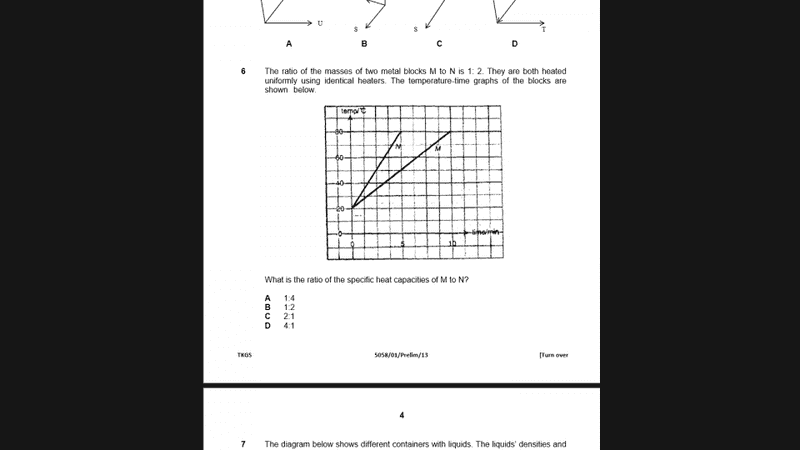
Screenshot 2015-08-10 23.35.26.png
Hello! I need help with this question. The answer is D but I don't understand why :/ Thanks!
 
Last edited by a moderator:
Physics news on Phys.org
Please post your attempt .

Hint : What is formula for ΔQ ? What is power provided ?
 
IMG_20150811_001821.jpg
Hello, Thanks for replying!
 

Attachments

  • IMG_20150811_001821.jpg
    IMG_20150811_001821.jpg
    13.4 KB · Views: 437
Why is Q1 = Q2 ?

Heaters are identical , and so power provided by them will be the same . The heat absorbed by the objects in some time ' t ' will depend on their own properties . It will not necessarily be the same for both .
Try again .

Hope this helps .
 
Oh Yes.. I read the question wrongly. I thought amount of energy provided is the same.

So, if I am not wrong, the gradient of the graph is the specific heat capacity and since mass of N is 2 times the mass of M, in this case, I can just take the mass of N to be 2kg while the mass of M to be 1kg right? (For me to be able to calculate)

I find the gradient of N and divide it by 2 as heat capacity is per kg.Then I have to compare with the gradient of M and derive the ratio.. Am I right?
 
ΔQ = m*c*ΔT ,
∴ P = ΔQ / ΔT = ?

Shiv Narayanan said:
So, if I am not wrong, the gradient of the graph is the specific heat capacity and since mass of N is 2 times the mass of M, in this case, I can just take the mass of N to be 2kg while the mass of M to be 1kg right? (For me to be able to calculate)
No , I think it looks more like ( ΔT / Δt ) .
And no , you can't assume the masses as so . Use P1 / P2 ratio .
 
Last edited: