Discussion Overview
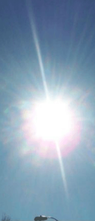
This discussion revolves around the identification of a celestial pole in a photograph taken on 02/21/2010. Participants explore the nature of the observed phenomenon, questioning whether it can be accurately described as the celestial pole and discussing potential atmospheric effects and optical phenomena.
Discussion Character
- Exploratory
- Debate/contested
- Technical explanation
Main Points Raised
- One participant suggests that what they see in the photograph might be the celestial pole, but expresses uncertainty about this identification.
- Another participant argues that the observed line may not be celestial at all, proposing that it could be due to atmospheric effects or lens astigmatism.
- There are mentions of starburst effects, which could relate to the optical characteristics of the photograph.
- A participant explains that the observed phenomenon is likely caused by water and ice crystals in the upper atmosphere refracting sunlight, rather than anything celestial.
- One participant compares their photograph with a wiki image, suggesting that their observation aligns with the celestial pole's position from an Earth standpoint.
- Another participant questions the existence of a physical manifestation of the celestial pole, noting that it is an abstract concept rather than a tangible axis.
- There is curiosity expressed about the Earth's axial tilt and its relationship to the sun, with some confusion about the concept of reflection in this context.
- A later reply reiterates that there is no reflection of the Earth's axial tilt, emphasizing that there is nothing to reflect from.
Areas of Agreement / Disagreement
Participants do not reach a consensus on the nature of the observed phenomenon. Multiple competing views are presented regarding whether the line in the photograph can be considered the celestial pole, with some attributing it to atmospheric effects and others to optical phenomena.
Contextual Notes
The discussion includes unresolved assumptions about the nature of the celestial pole and the effects of atmospheric conditions on photographic observations. There is also ambiguity regarding the interpretation of reflections related to the Earth's axial tilt.