SUMMARY
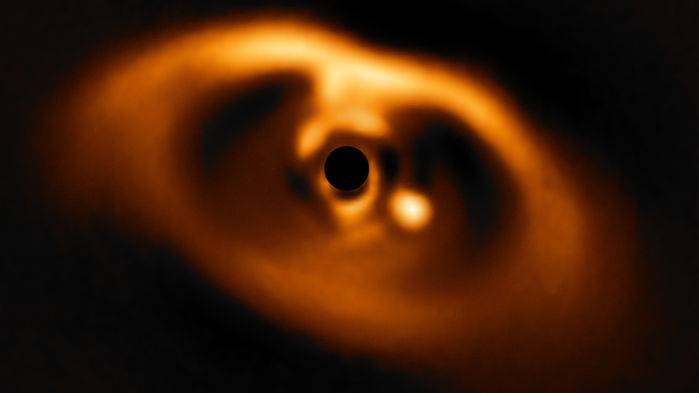
A newly formed planet, designated PDS 70b, has been visualized in the protoplanetary disk surrounding the star PDS 70. Discovered by the Kepler space telescope, PDS 70b is significantly more massive than Jupiter and possesses a cloudy atmosphere with temperatures reaching approximately 1000°C. Research published in Astronomy & Astrophysics by a team led by Müller utilized various orbital and atmospheric models to estimate the planet's size, mass, and orbit, revealing its position at a distance comparable to that of Uranus from the Sun.
PREREQUISITES
- Understanding of protoplanetary disks
- Familiarity with the Kepler space telescope
- Knowledge of atmospheric modeling techniques
- Basic concepts of planetary formation and characteristics
NEXT STEPS
- Research the methods used in orbital and atmospheric modeling for exoplanets
- Explore the characteristics of protoplanetary disks and their role in planet formation
- Study the findings of the Astronomy & Astrophysics paper on PDS 70b
- Investigate the implications of high-temperature atmospheres in planetary science
USEFUL FOR
Astronomers, astrophysicists, and students interested in planetary formation and the study of exoplanets will benefit from this discussion.