Implementing a weird-looking boundary condition (PDE/FDM)

Click For Summary

Discussion Overview

The discussion revolves around implementing boundary conditions for a partial differential equation (PDE) related to heat transfer, specifically from Kraus's heat transfer book. Participants explore numerical methods, particularly finite difference methods, and the challenges associated with unusual boundary conditions.

Discussion Character

  • Technical explanation
  • Mathematical reasoning
  • Debate/contested

Main Points Raised

  • One participant expresses difficulty in dealing with boundary conditions (3.251c and 3.251d) and suggests integrating the equations, noting the presence of constants of integration as a complication.
  • Another participant mentions having an analytical expression for the solution and attempts to graph it, but finds discrepancies between the numerical solution and the analytical graph, even after trying different strategies like integrating the boundary condition and using ghost points.
  • There is confirmation that the problem is being solved using finite difference methods.
  • Mathematical formulations for the second derivative of theta with respect to R are presented, indicating attempts to derive the correct finite difference equations.
  • A participant requests verification of their computational molecules for the boundaries, indicating they plan to use a method similar to Gauss-Seidel iteration.
  • Another participant offers to assist with finite differencing but declines to help with debugging, suggesting the original poster should troubleshoot independently.
  • The original poster reflects on the correctness of their computational molecules but suspects issues may arise from the corners of the domain, questioning which boundary condition to apply at specific corner points.

Areas of Agreement / Disagreement

Participants do not reach a consensus on the appropriate boundary conditions for the corners, with ongoing uncertainty about which conditions (3.251b or 3.251d) should be invoked.

Contextual Notes

There are unresolved issues regarding the assumptions made in the numerical approach, particularly concerning the treatment of boundary conditions and the corners of the computational domain.

maistral
Messages
235
Reaction score
17
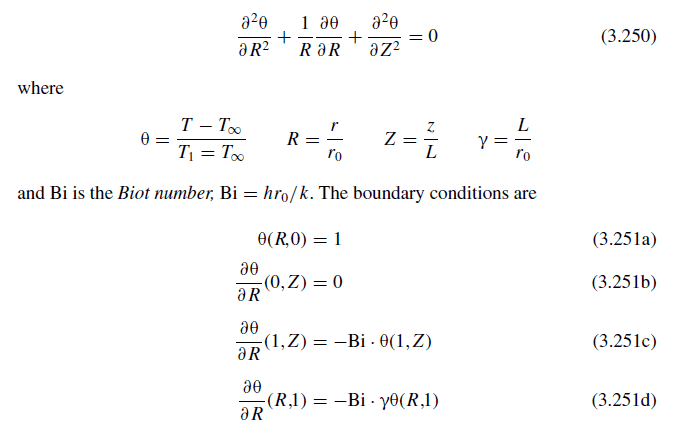
So I have this problem, taken from Kraus's heat transfer book.
63ye6d.png


So deriving the computational molecule, the conditions for (3.251a), (3.251b) is a bit of a no brainer. The issue I am having is about the boundaries for (3.251c) and (3.251d). This is actually the first time I have seen this kind of boundary condition.

How do I deal with this? My hypothesis is to integrate the equations (lol) but the constants of integration stay around... I have no idea what to do at all. Bi and γ are constants. Thanks!
 
Physics news on Phys.org
Oh, to add.

There's an analytical expression for the solution; and I am able to graph the resulting multivariate graph. I intend to do the numerical analysis as another way of solving it. The problem is, even if I implement the 'integrating the boundary condition' part or if I use the ghost point strategy, both of it does not work - the graph from the numerical solution is way too far from the analytical expression's graph.
 
You're solving this by finite difference, correct?
 
Yes sir. Finite difference.
 
$$\theta (1+\Delta R, Z)-\theta (1-\Delta R, Z)=-2(\Delta R) Bi\ \theta (1,Z)$$
so
$$\frac{\partial ^2 \theta}{\partial R^2}=2\frac{(\theta (1-\Delta R, Z)-\theta (1,Z))-(\Delta R) Bi\ \theta (1,Z)}{(\Delta R)^2}$$
or
$$\frac{\partial ^2 \theta}{\partial R^2}=2\frac{(\theta (1-\Delta R, Z)-\theta (1,Z))}{(\Delta R)^2}-2\frac{Bi\ \theta(1,Z)}{\Delta R}$$
or
$$\frac{\partial ^2 \theta}{\partial R^2}=2\frac{(\theta (1-\Delta R, Z)-[1+(\Delta R) Bi]\theta (1,Z))}{(\Delta R)^2}$$
 
Thanks for replying sir. Actually I did it already, but I seem to be getting erroneous results. Could you have my computational molecules for each boundary checked first?

I intend to implement a solution similar to Gauss-Seidel iteration; thus I kept on factoring out the 'center' molecule.
 
Last edited:
Sorry. I'll help with the finite differencing, but, as far as the debugging is concerned, you're on your own.
 
Oh, it's alright sir.

Apparently my computational molecules for the boundaries are correct; but the numerical solution is still given different values. I'm starting to think that the problem comes from the corners - problem is what should I do with the corners (0,1) and (1,1). What boundary should I invoke? Say for the upper left corner (0,1); is it 3.251b or 3.251d?
 
maistral said:
Oh, it's alright sir.

Apparently my computational molecules for the boundaries are correct; but the numerical solution is still given different values. I'm starting to think that the problem comes from the corners - problem is what should I do with the corners (0,1) and (1,1). What boundary should I invoke? Say for the upper left corner (0,1); is it 3.251b or 3.251d?
Both
 

Similar threads

  • · Replies 9 ·
Replies
9
Views
3K
  • · Replies 4 ·
Replies
4
Views
3K
  • · Replies 4 ·
Replies
4
Views
4K
  • · Replies 1 ·
Replies
1
Views
2K
  • · Replies 2 ·
Replies
2
Views
3K
  • · Replies 8 ·
Replies
8
Views
4K
  • · Replies 5 ·
Replies
5
Views
2K
  • · Replies 5 ·
Replies
5
Views
3K
  • · Replies 3 ·
Replies
3
Views
2K
  • · Replies 3 ·
Replies
3
Views
8K