Increase Electromagnet Strength Without Additional Energy

  • Context: Undergrad 
  • Thread starter Thread starter Malverin
  • Start date Start date
  • Tags Tags
    Electromagnet Strength
Click For Summary
SUMMARY

The discussion focuses on increasing the strength of an electromagnet without adding additional energy by reducing the core area to concentrate the magnetic field. Theoretically, reducing the area by a factor of four should increase the magnetic field density (B) and the electromagnet's lifting force by the same factor. However, simulations conducted using FEMM revealed that the actual increase in B was only about two to three times, indicating significant flux loss. Participants debated the factors affecting the simulation results, including the geometry of the setup and the presence of saturation effects.

PREREQUISITES
  • Understanding of electromagnet principles and magnetic flux
  • Familiarity with magnetic field density (B) calculations
  • Experience using FEMM (Finite Element Method Magnetics) for magnetic simulations
  • Knowledge of saturation effects in magnetic materials
NEXT STEPS
  • Explore advanced FEMM simulation techniques for electromagnet design
  • Research the impact of core geometry on magnetic field distribution
  • Study the effects of saturation in different magnetic materials
  • Investigate methods to minimize flux loss in electromagnet setups
USEFUL FOR

Engineers, physicists, and hobbyists interested in electromagnet design, magnetic field optimization, and simulation techniques.

Malverin
Messages
139
Reaction score
7
Hello,
If we have an electromagnet
370px-Electromagnet_with_gap.svg.png

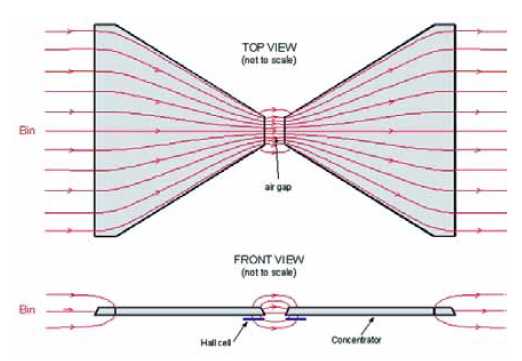
with some lifting force, for example 10N, and make core area smaller at the ends, to concentrate the magnetic field (without saturating the core)
Magnetic-concentrators-used-in-Minisens.jpg


according to the formula, for magnetic flux

7e9e42656cdd33eb62af4b11645baae4.png


magnetic field density B , will be greater.

For example if we make area, 4 times smaller we will get 4 times greater B

Then electromagnet force will increase too, and become 4 time greater

0d4a229eb6eaca489af15547277399f7.png


So we get more force, without puting in additional energy.
But I have made a magnetic field simulation in FEMM
http://www.femm.info/wiki/HomePage

and there is an increase in B, but much smaller than this according to the formula.
Is there something wrong with the simulation, or my thoughts are wrong...?

http://en.wikipedia.org/wiki/Magnetic_flux

http://en.wikipedia.org/wiki/Electromagnet
 
Physics news on Phys.org
and there is an increase in B, but much smaller than this according to the formula.
What do you get as result?

Is your distance between the magnets much smaller than the length scale of the surface, even with the smaller surface?
Is B homogeneous within that surface?
 
mfb said:
What do you get as result?

Is your distance between the magnets much smaller than the length scale of the surface, even with the smaller surface?
Is B homogeneous within that surface?

The result was about 2 times increase in B, with area ratio of 5
Yes, the distance is much smaller than the length scale of the surface.
I have measured the field in the core too (in point near the smaler surface, and in point near the big surface)
Inside the core B change should be according to formula I think (there are minimum or no losses inside), but it is not...
 
Here is a screenshot of Neodymium magnet simulation. Area ratio is 19 , B increase is about 3 times. So this means more then 80 per cent flux loss! How is that possible?
Permeability of air is so much smaller. Where did the flux go?
 

Attachments

  • Konus 9.jpg
    Konus 9.jpg
    54.5 KB · Views: 502
Last edited:
That lacks the opposing magnet, the return yoke, and it looks too sharp. As you can see at the field lines, most of the field goes through the sides.
 
mfb said:
That lacks the opposing magnet, the return yoke, and it looks too sharp. As you can see at the field lines, most of the field goes through the sides.

The return yoke to close the loop makes things worse...

This has no sense...:confused:
 

Attachments

  • Konus 19.jpg
    Konus 19.jpg
    44.5 KB · Views: 773
This does not look like your original sketch. And 2 Tesla is a typical saturation strength... are you sure you do not have saturation?
 
mfb said:
This does not look like your original sketch. And 2 Tesla is a typical saturation strength... are you sure you do not have saturation?

Saturation is not the problem. I have used weaker fields and the ratio is the same.
There can be many variants of this setup. The principal is important.
I have tried differen forms and ratios, and increase in B is never equal to this in the formula.
Not even close...
 
Last edited:
Hmm well, it cannot be exact, but I would have expected that you can get a reasonable amplification. Well okay, you get an amplification...
 

Similar threads

  • · Replies 2 ·
Replies
2
Views
2K
  • · Replies 5 ·
Replies
5
Views
3K
  • · Replies 8 ·
Replies
8
Views
2K
  • · Replies 11 ·
Replies
11
Views
4K
  • · Replies 4 ·
Replies
4
Views
2K
  • · Replies 7 ·
Replies
7
Views
2K
  • · Replies 2 ·
Replies
2
Views
3K
  • · Replies 2 ·
Replies
2
Views
2K
  • · Replies 44 ·
2
Replies
44
Views
5K
  • · Replies 13 ·
Replies
13
Views
4K