Integration of a harmonic function over a period

2 replies · 2K views · last reply
lordcx
Messages
2
Reaction score
0
intgration of a function*** help please***

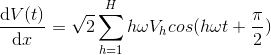
actually this is not a homework, I found this explanation in a journal paper but I could not understand it. Can someone give me an explanation or possibly a proof that:


Homework Statement


if:
Equation: dV(t)/dx = √2 times the sum from h=1 to H of hωV_h cos(hωt + π/2).


then why integration over whole period is:
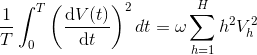
Equation: (1/T) times the integral from 0 to T of (dV(t)/dt) squared dt equals omega times the sum from h=1 to H of h squared V_h squared.


Homework Equations


I have problem with the power of omega, my solution returns w with power 2, while the power of omega in answer is one, Can someone help me for the reason?
 
Last edited:


Well, when you do a change of variable in the integral in the LHS, one omega pops up in the denominator, canceling one of the 2 from the numerator. That's why the RHS contains omega only to the power 1.


bigubau said:
Well, when you do a change of variable in the integral in the LHS, one omega pops up in the denominator, canceling one of the 2 from the numerator. That's why the RHS contains omega only to the power 1.

thank you, but as you see cos(hwt) contains both h and w. means by changing the variable the power of w and h should be equal. I'm confused:cry:

Handwritten-style equation: (1/T) times the integral from 0 to T of (dV(t)/dt)^2 dt equals (2 omega^2 / T) times the integral from 0 to T of the sum from h = 1 to H of h^2 V_(h)^2 sin^2(h omega t) dt.


and over whole period:

Equation: (1/T) times the integral from 0 to T of sin^2(hwt) dt equals T/2.


then we will have

Handwritten or typeset expression: ω² times the sum of h² V², with a small mathematical symbol-based formula fragment written inline.


not

Handwritten expression ω ∑ h²V² on a plain background, with the summation sign and squared terms as shown.


am I wrong??
 
Last edited: