Graduate Interdependent Recursive Equations

Click For Summary
The discussion revolves around solving a system of interdependent recursive equations in terms of the variable m, with constants Rbbase, Rtbase, and Rcc. The initial approach suggests generating numerical sequences using programming tools like R, Python, or Matlab to identify patterns that could lead to a formula. Simplifying the recursion formulas by dividing both numerator and denominator reveals expressions that may help in deriving the solution. The transformation of variables into forms like S_m and K_m is proposed to facilitate further analysis. Despite progress, the exact direct expressions remain elusive, indicating a need for continued exploration.
Himmel
Messages
1
Reaction score
0
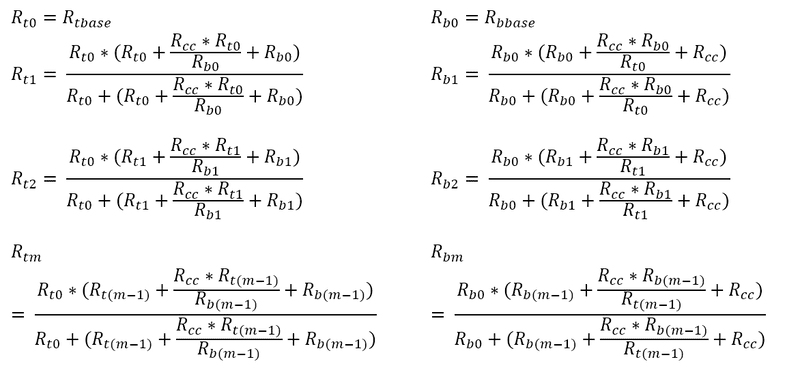
Hi, I have a system that I am trying so solve in terms of m, and have two recursive equations:
O5Igc.png


The problem for me is that each recursion is dependent on the value from the other! I know that they are both solvable, however I have no idea what approach I could take to express each only in terms of m. Rbbase, Rtbase and Rcc are all constants, and if it helps Rbbase is proportional to Rtbase.

Cheers, Himmel
 

Attachments

  • O5Igc.png
    O5Igc.png
    26.4 KB · Views: 1,415
Mathematics news on Phys.org
With sequences like this, where there is obvious way in at first, a good way to develop intuitions that may point towards solutions is to first make numerical calculations of the sequence for a fair number of elements, say twenty. Assume values for the three constants and then use a calculator like R, Python or Matlab to calculate the first twenty values of the two sequences. Then change the constants a few times and see what changes. Hopefully a pattern will start to emerge, suggesting formulas that give values of the sequences in terms of only m and the three constants. For any candidate formula you think of, project the first twenty items using that, and see if they match. If they do, you might then set out to prove that the formula is correct for all m. Induction may well be a handy way to do such a proof.

I also notice that both recursion formulas simplify significantly if you divide both numerator and denominator by the numerator, giving you expressions of the form ##\frac{1}{1/R_{bbase}+1/\textrm{messy factor 1}}## and ##\frac{1}{1/R_{tbase}+1/\textrm{messy factor 2}}## where the 'messy factors' are the second factors in the numerators.
 
Last edited:
Let ##K_m = \frac{R_{bm}}{R_{tm}}##. Let ##R_{cc}=C## to avoid overusing R. Let ##D=R_{b0}## so Rb is gone and drop the index "t" on the remaining ##R_{tx}##.

Then $$R_{m} = \frac{
R_{0} \cdot \left( R_{m-1}(K_{m-1}+1) + \frac{C}{K_{m-1}} \right)
}{
R_{0} + \left( R_{m-1}(K_{m-1}+1) + \frac{C}{K_{m-1}} \right)
}$$
and
$$K_m R_{m} = \frac{
D \cdot \left( R_{m-1}K_{m-1} + CK_{m-1} \right)
}{
D + \left( R_{m-1}K_{m-1} + CK_{m-1} \right)
}$$
Define ##S_m = \frac{1}{R_m}##. And look at m+1 because it shortens the equation. Now
$$S_{m+1} = S_0 + \frac{1}{ \frac{1+K_m}{S_m}+\frac{C}{K_m} }$$
and
$$\frac{S_{m+1}}{K_{m+1}} = \frac{1}{D} + \frac{1}{\frac{K_m}{S_m} + C K_m}$$
I'm still not sure how to find direct expressions, but it looks much nicer already.
 
Here is a little puzzle from the book 100 Geometric Games by Pierre Berloquin. The side of a small square is one meter long and the side of a larger square one and a half meters long. One vertex of the large square is at the center of the small square. The side of the large square cuts two sides of the small square into one- third parts and two-thirds parts. What is the area where the squares overlap?

Similar threads

  • · Replies 4 ·
Replies
4
Views
2K
  • · Replies 11 ·
Replies
11
Views
2K
  • · Replies 3 ·
Replies
3
Views
1K
  • · Replies 18 ·
Replies
18
Views
3K
  • · Replies 1 ·
Replies
1
Views
2K
Replies
1
Views
2K
Replies
2
Views
3K
  • · Replies 1 ·
Replies
1
Views
2K
  • · Replies 2 ·
Replies
2
Views
2K
  • · Replies 10 ·
Replies
10
Views
3K