Interfacial PDs vs Electrode Potentials

Click For Summary
SUMMARY

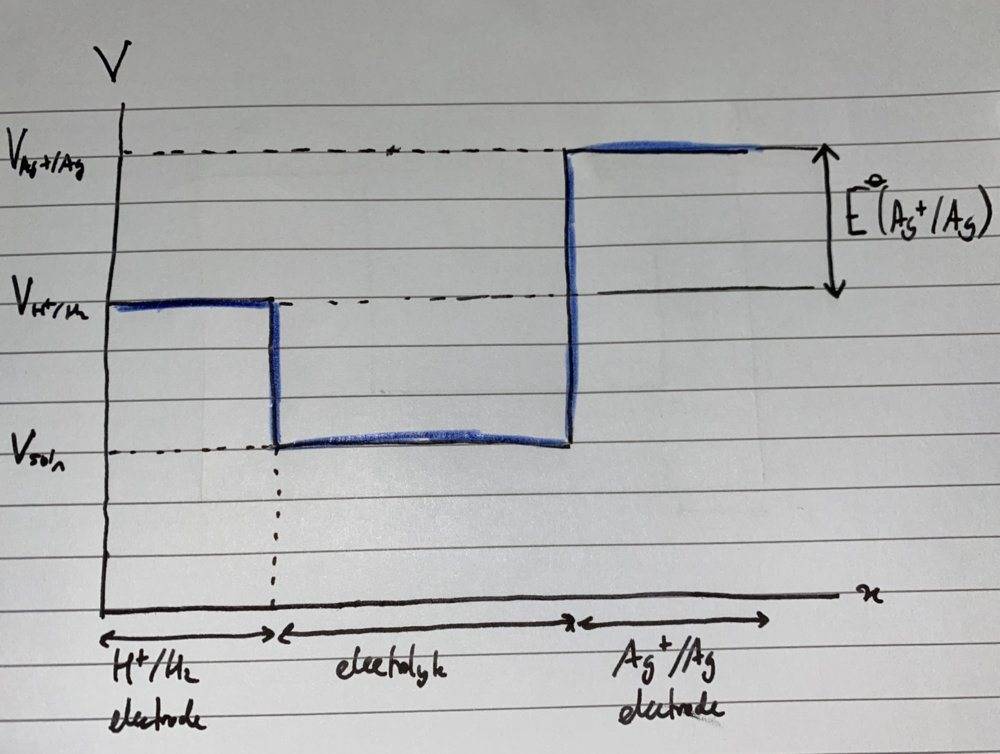
The discussion centers on the definition of electrode potential in electrochemical cells, specifically the cell configuration ##Pt | H_2 | H^+ || Ag^+ | Ag##. The participant initially posits that the electrode potential of the ##Ag+/Ag## electrode is calculated as ##V_{Ag+/Ag} - V_{H^+/H_2}##, while their teacher argues for a definition based on interfacial potential differences. The conversation reveals that the teacher's definition aligns with the IUPAC standard, particularly under the assumption of zero liquid junction potential. The participant acknowledges the teacher's correctness but expresses confusion regarding the implications of setting reference potentials to zero.

PREREQUISITES
  • Understanding of electrochemical cells and standard electrode potentials
  • Familiarity with interfacial potential differences in electrochemistry
  • Knowledge of IUPAC definitions related to electrode potentials
  • Basic concepts of liquid junction potentials and their effects
NEXT STEPS
  • Research the IUPAC definition of standard electrode potential and its applications
  • Study the effects of liquid junction potential on electrochemical measurements
  • Explore the concept of interfacial potential differences in various electrolyte systems
  • Investigate methods to correct for liquid junction potentials in experimental setups
USEFUL FOR

Electrochemists, chemistry students, and researchers involved in electrochemical cell design and analysis will benefit from this discussion, particularly those focused on understanding electrode potentials and interfacial phenomena.

etotheipi
Consider the cell ##Pt | H_2 | H^+ || Ag^+ | Ag##. I’ve sketched the electric potential against distance across the cell:
5F015906-A558-4556-9D38-29B247B71EE2.jpeg


I would think the electrode potential of the ##Ag+/Ag## electrode is ##V_{Ag+/Ag} - V_{H^+/H_2}##, which I’ve labelled on the right. We set ##V_{H^+/H_2} = 0## as per convention.

However, my teacher states that the electrode potential equals the interfacial potential difference between the electrode and electrolyte, subtract (relative to) the interfacial potential difference of the reference electrode/electrolyte. This might well be true in this first example, but I don’t think it generalises so can’t be right!

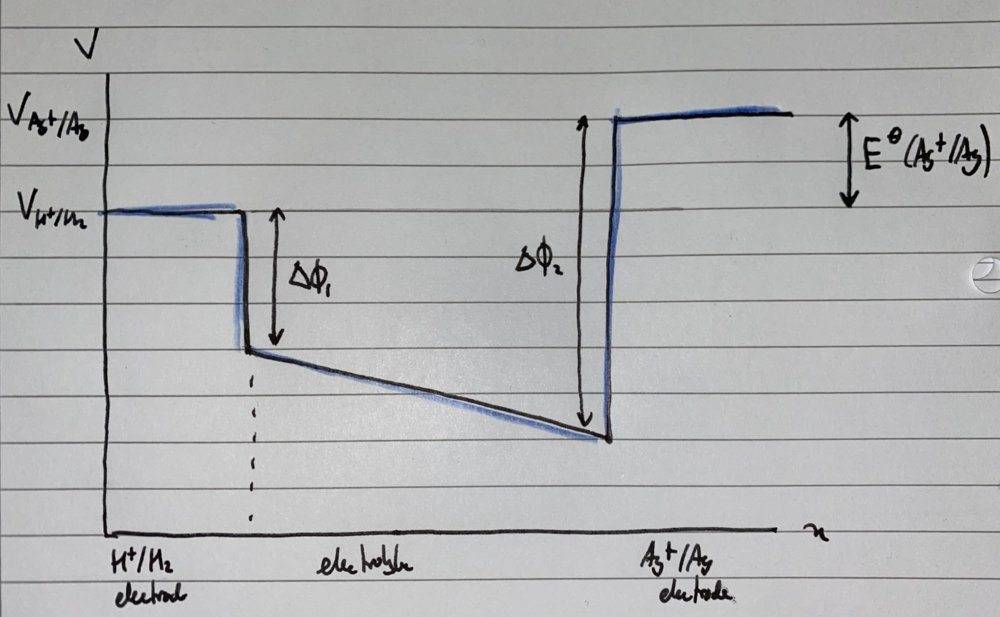
For instance, consider now if we have a potential drop across the electrolyte (e.g. due to an electrolyte-electrolyte interfacial PD or a voltage drop of some other origin). The new potential diagram becomes,
057155EF-1893-4F12-8CAE-E738B55E89C1.jpeg


Ostensibly now, my teacher’s definition no longer gives the correct definition of standard electrode potential (the difference of the interfacial potential differences has changed!). Whilst I assume that##V_{Ag+/Ag} - V_{H^+/H_2}## is still the same as in the first example?

So I wondered whether someone could clarify as to which is correct?
 
Last edited by a moderator:
Chemistry news on Phys.org
If there is no current there is no potential drop "of some other origin" in the electrolyte.
 
  • Like
Likes   Reactions: etotheipi
Borek said:
If there is no current there is no potential drop "of some other origin" in the electrolyte.

Thank you for your reply.

I agree; in that case then I will consider an equilibrium case with a current which approaches zero.

I found a quite illuminating article from the Journal of Chemical Education which says the following, hinging on the IUPAC definition of ##E^o## as the emf of a cell where the couple in question is connected on the right side,

##E_{M^{n+}/M} = (\phi_M - \phi_{M,ref}) = (\phi_M - \phi_{sol}) - (\phi_{M,ref} - \phi_{sol,ref})##

So, it appears my teacher was right! Though this is assuming zero liquid junction potential - I don't know how to correct for this!

In the case of zero liquid junction potential, an electrode potential is then the interfacial potential difference of the electrode in question relative to the interfacial potential difference of the reference electrode - which is arbitrarily set to zero.

Thats sort of weird, because I had assumed we were setting the electrostatic potential of the hydrogen electrode to zero volts, however it appears we are instead defining an (evidently non-zero) potential difference to be zero.

That's quite hard to understand. Are we essentially setting ##\phi_{M,ref} = \phi_{sol,ref}##, when in reality they are different (but unmeasurably so!)?
 

Similar threads

Replies
4
Views
2K
Replies
6
Views
3K
  • · Replies 3 ·
Replies
3
Views
2K
Replies
8
Views
4K
  • · Replies 2 ·
Replies
2
Views
2K
  • · Replies 10 ·
Replies
10
Views
2K
  • · Replies 5 ·
Replies
5
Views
2K
Replies
1
Views
3K
  • · Replies 1 ·
Replies
1
Views
2K
Replies
5
Views
8K