Interference in a Double-Slit Experiment

Join the discussion
Ask a follow-up here, or get your own question answered by working scientists, mathematicians and engineers — people, not an autocomplete.
Real named experts · corrections over time · the nuance an AI answer skips
1 reply · 3K views
annikaw
Messages
1
Reaction score
0
In a double-slit experiment, the distance between slits is 5.0mm and the slits are 1.0m from the screen. Two interference patterns can be seen on the screen: one due to light of wavelength 480nm, and the other due to light of wavelength 600nm. What is the separation on the screen between the third-order (m=3) bright fringes of the two interference patterns?

From my notes, I find that $d\sin\theta=m\lambda$.

However, I do not know how to get values of $\theta$ that can be put to the equation to find the difference in separation.
 
Last edited by a moderator:
Mathematics news on Phys.org
annikaw said:
In a double-slit experiment, the distance between slits is 5.0mm and the slits are 1.0m from the screen. Two interference patterns can be seen on the screen: one due to light of wavelength 480nm, and the other due to light of wavelength 600nm. What is the separation on the screen between the third-order (m=3) bright fringes of the two interference patterns?

From my notes, I find that $d\sin\theta=m\lambda$.

However, I do not know how to get values of $\theta$ that can be put to the equation to find the difference in separation.

Hi annikaw! Welcome to MHB! (Smile)

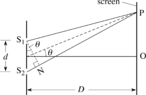
Let's get a drawing of the situation:
View attachment 4506

We get a bright fringe when $d\sin\theta=m\lambda$.
The corresponding position on the screen is $OP=D\sin\theta$.

Can you deduce where the 2 requested fringes are?
 

Attachments

  • phys6_1f_11.png
    phys6_1f_11.png
    13.6 KB · Views: 124