Interpolation of Graphed, Cutoff Sensor Values

  • Context: Undergrad 
  • Thread starter Thread starter mishima
  • Start date Start date
  • Tags Tags
    Interpolation Sensor
Click For Summary

Discussion Overview

The discussion revolves around the challenges of accurately measuring CO2 concentrations using a sensor that quickly reaches its maximum reading capacity. Participants explore mathematical techniques for interpolation of sensor data and consider experimental adjustments to improve measurement accuracy.

Discussion Character

  • Exploratory
  • Technical explanation
  • Debate/contested
  • Experimental/applied

Main Points Raised

  • One participant describes the setup involving a CO2 sensor, noting that it quickly saturates at high concentrations, making accurate readings difficult.
  • Another participant suggests that the sensor's reading curve resembles exponential decay and proposes fitting linear and exponential models to the data.
  • Concerns are raised about achieving 20% accuracy based solely on the curve, with a recommendation to conduct measurements in a larger gas volume to mitigate peak concentrations.
  • Participants discuss the potential of adjusting the sensor's position or using a "Y" connection to manage CO2 flow, while questioning the assumptions of fluid dynamics in this context.
  • One participant mentions the idea of bubbling CO2 through water for titration as an alternative method for measuring CO2 levels.
  • There is a challenge regarding the reliability of measurements when the sensor is exposed to open air, with suggestions to control the flow of additional gases to achieve measurable CO2 levels.
  • A later reply clarifies the sensor's actual placement within a modified rinse bottle, which influences the flow dynamics and measurement accuracy.
  • Participants agree that increasing the volume of the sensor's enclosure could help mix CO2 with air, potentially leading to more accurate readings.

Areas of Agreement / Disagreement

Participants express multiple competing views regarding the best approach to improve measurement accuracy, and the discussion remains unresolved on the most effective method for interpolation and measurement adjustments.

Contextual Notes

Participants note limitations related to the assumptions made about fluid dynamics and the challenges of achieving symmetry in gas flow, which may affect measurement reliability.

mishima
Messages
576
Reaction score
43
Hi, recently I've been playing with a little CO2 sensor. It is capable of reading ppm (parts per million) of CO2 from near the sensor up to a max of 10,000 ppm. We have a small apparatus for holding various absorbent chemicals, such as lithium hydroxide, and are controlling the release of CO2 from a small tank with a valve. Readings are tabulated automatically from a small micro-controller every 2 seconds, and later this information if plotted in google sheets. Here is an example:
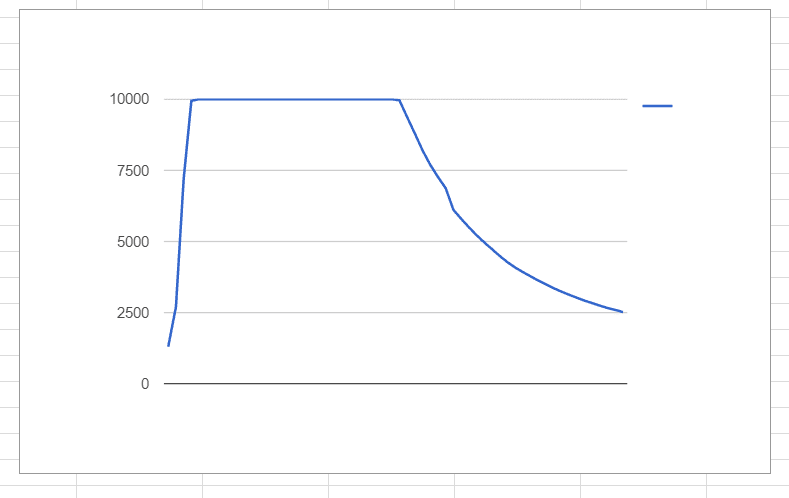
examplePlat.png


Unfortunately, the sensor's capabilities are beyond our current experimental setup. With even the smallest burst from our supply tank (roughly 60 mL of gas as standard temperature/pressure), the sensor quickly plateaus to its maximum before eventually settling down.again.

I was wondering if there was any mathematical technique able to interpolate/estimate the maximum value from the graphs we've been generating. The value does not need to be exact, even 20% accuracy would be fine for our purposes.
 
Physics news on Phys.org
You have to do some assumptions. In this case, your setting curve looks like an exponential decay.
 
I don't think you can get a 20% accuracy just from that curve. You can fit something to the slopes, a linear fit to the rising slope and an exponential fit to the falling slope, and see where the curves intersect, but the combination of the two lines is probably not what actually happened in the transition region.

Can you repeat the measurement with the CO2 sensor in a larger gas volume to reduce the peak CO2 concentration? That plus the existing measurement should lead to a more accurate description.

A CO2 sensor with a larger range would be even better, of course.
 
Thanks!

The sensor is placed in the open just below (~5cm) an outlet from the system. Perhaps I could adjust this distance or just try a "Y" type connection with my hoses to drive some CO2 away before it gets there. I was unsure if it was safe to assume that fluid flow through a Y would divide evenly like electrical current, I don't know much about fluid dynamics but that's a separate question (I think so, as long as pressure is the same in both channels?).

Cost likely prohibits a sensor with a larger range, we were unable to find something better than 0-10,000 ppm. I guess a decent rough estimate from these graphs could guide future purchases. We had considered bubbling the outlet CO2 through water and using titration on the resulting carbonic acid...

We were just trying to compare the absorbent effects, and I suppose we could just look at the time the sensor was maxed out as an indicator instead of a peak value.
 
If the sensor is in the open, how can you be sure it will give reliable measurements? Every motion of air in the lab will influence it.

If everything is perfectly symmetric, flow through a Y will be symmetric, but it is impossible to make everything symmetric.
Adding a different gas (e.g. just air) with a controlled known flow ratio would reduce the CO2 content to measurable levels.
mishima said:
We were just trying to compare the absorbent effects, and I suppose we could just look at the time the sensor was maxed out as an indicator instead of a peak value.
That can give a simple comparison ("more", "less") if the timescale of the reactions is the same, but it does not give ratios ("10% more"), as total CO2 won't be proportional to that time.
 
Sorry I misspoke about it being in the open, that was a poor wording choice on my part. The sensor is inside of a 1 liter chemical rinse bottle that has been cut in half. It can not be completely enclosed because of pressure buildup. Currently the gas flows down from above onto the sensor perpendicularly...like a bowl turned upside down on a table (sensor is the table, CO2 outlet is small hole at peak of dome. There is space on the sides because the dome is circular and the sensor is square.

It was oriented vertically to assist with clearing the dome between trials. It only takes about a minute for the sensor reading to return to a (truly) open room reading of around 1500 ppm after a short 60 mL burst from the supply.

It seems as you said increasing the volume of this dome would be a great idea.
 
It would mix the CO2 with more air, reducing the CO2 levels in it.
 

Similar threads

  • · Replies 3 ·
Replies
3
Views
2K
Replies
4
Views
3K
  • · Replies 5 ·
Replies
5
Views
2K
Replies
5
Views
5K
  • · Replies 39 ·
2
Replies
39
Views
16K
  • · Replies 0 ·
Replies
0
Views
3K
  • · Replies 19 ·
Replies
19
Views
12K
  • · Replies 4 ·
Replies
4
Views
9K
  • · Replies 6 ·
Replies
6
Views
4K
  • · Replies 10 ·
Replies
10
Views
5K