Intersection of quotient modules in Bland 4.2.4

  • Level: Undergrad 
  • Thread starter Math Amateur
  • Start date
  • Tags Tags
    Modules
3 replies · 2K views · last reply
Math Amateur
Gold Member
MHB
Messages
3,920
Reaction score
48
I am reading Paul E. Bland's book, "Rings and Their Modules".

I am focused on Section 4.2: Noetherian and Artinian Modules and need some help to fully understand the proof of part of Proposition 4.2.4 ... ...

Proposition 4.2.4 reads as follows:
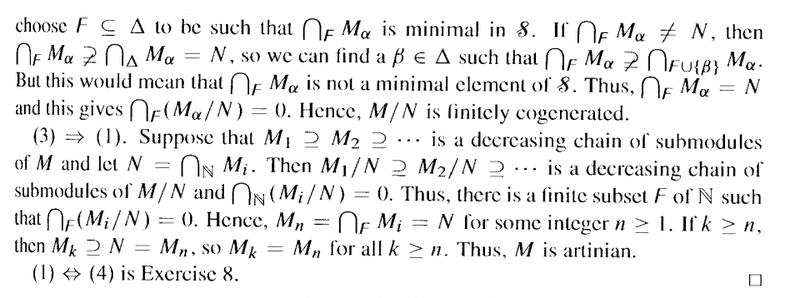
Printed text of Proposition 4.2.4 listing four equivalent conditions for an R-module M (artinian, minimal elements, finitely cogenerated factors, finite subsets F of intersections), followed by the start of its proof.

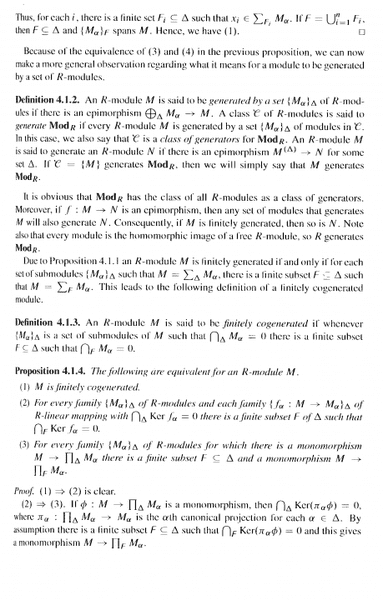
Printed page of a proof from a textbook on modules, covering finitely cogenerated modules and artinian chains of submodules, ending with a reference to Exercise 8.


I need help to fully understand Part of the proof proving that ##(2) \Longrightarrow (3)## ...In that part of the proof Bland seems to be assuming that

## \bigcap_F M_\alpha = N ##

if and only if

## \bigcap_F (M_\alpha / N ) = 0 ##
In other words, if ##F = \{ 1, 2, 3 \}## then

##M_1 \cap M_2 \cap M_3##

if and only if

##M_1 / N \cap M_2 / N \cap M_3 / N## But why exactly is this the case ... ...

... ... how do we formally and rigorously demonstrate that this is true ...Hope someone can help ...

Peter
====================================================

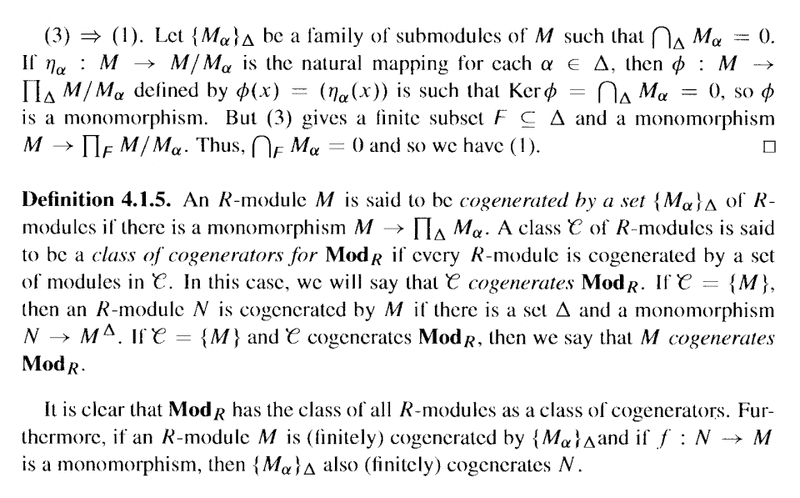
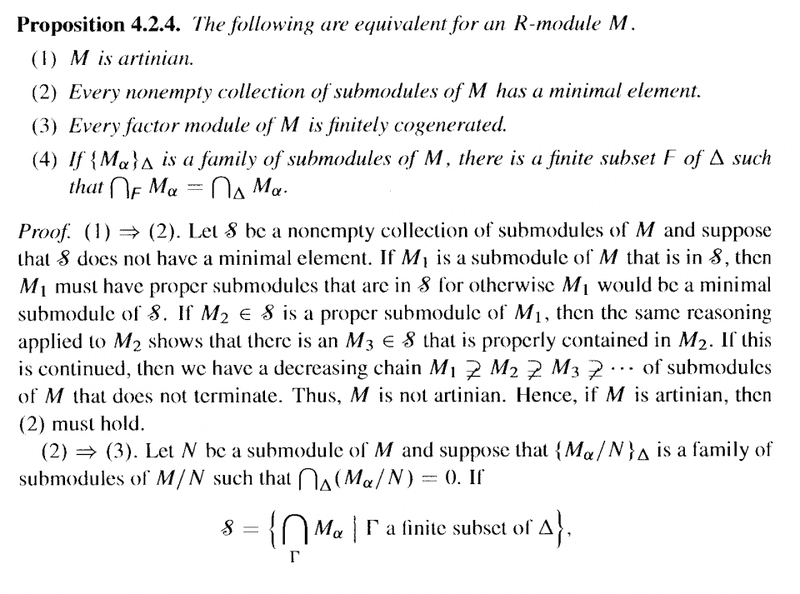
Proposition 4.2.4 refers to the (possibly not well known) concept of cogeneration so I am providing Section 4.1 Generating as Cogenerating Classes ... ... as follows ...
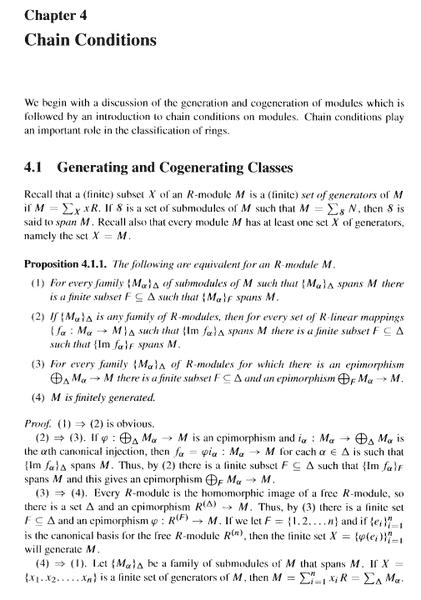
Printed textbook page titled Chapter 4 Chain Conditions, section 4.1 Generating and Cogenerating Classes, with Proposition 4.1.1 and its proof showing equivalences of generating conditions for an R-module.

Printed page of a textbook with definitions and propositions on generated and finitely cogenerated modules, including Definition 4.1.2.3, Definition 4.1.3, and Proposition 4.1.4 with its proof, using subscripted modules and intersections.

Printed page from a textbook showing the end of a proof that a family of submodules with zero intersection gives a monomorphism, followed by Definition 4.1.5 of cogeneration and a short paragraph on class of cogenerators.
 
Attachments
  • Printed text of Proposition 4.2.4 listing four equivalent conditions for an R-module M (artinian; minimal elements; finitely cogenerated factor modules; finite subset F of intersections), followed by the start of the proof of (1) implies (2) and (2) implies (3).
    Bland - 1 - Proposition 4.2.4 - PART !.png
    71.2 KB · Views: 855
  • Printed proof page from a ring theory textbook, covering the step showing (2) implies (3) and the equivalence (1) and (4) for Noetherian and Artinian modules, ending with a small square marking the end of the proof.
    Bland - 2 - Proposition 4.2.4 - PART 2.png
    31.1 KB · Views: 775
  • Printed textbook page titled Chapter 4 Chain Conditions, section 4.1 Generating and Cogenerating Classes, with Proposition 4.1.1 and its proof showing equivalences for an R-module M.
    Bland -1 - Section 4.1 - PART 1.png
    36.1 KB · Views: 769
  • Printed page of Bland's Rings and Their Modules: Definition 4.1.2.2 on generating sets of modules, Definition 4.1.3 of finitely cogenerated modules, and Proposition 4.1.4 with parts (1) to (3) and its proof.
    Bland - 2 - Section 4.1 - PART 2.png
    43.2 KB · Views: 803
  • Printed textbook page showing a proof that a family of submodules with trivial intersection gives a monomorphism into a product of quotients, followed by Definition 4.1.5 of cogenerated modules and class of cogenerators for Mod_R.
    Bland - 3 - Section 4.1 - PART 3.png
    45.4 KB · Views: 813
Start by observing that
$$(\bigcap_{\alpha\in F} M_\alpha)/N=N/N$$
which is the zero element of the module ##M/N##.

So we have to show that
$$\bigcap_{\alpha\in F} (M_\alpha/N)=(\bigcap_{\alpha\in F} M_\alpha)/N\ \ \ \ \ \ \ (1)$$

First observe that if ##m\in \bigcap_{\alpha\in F} M_\alpha## then ##\forall\alpha\in F:\ m\in M_\alpha##
so that ##\forall\alpha\in F:\ m+N \in M_\alpha/N## whence
##m+N \in \bigcap_{\alpha\in F}M_\alpha/N##.

Hence we have
$$(\bigcap_{\alpha\in F} M_\alpha)/N\subseteq \bigcap_{\alpha\in F} (M_\alpha/N)$$

For the other direction of inclusion, consider an arbitrary element ##m+N## of the LHS of (1). That is, ##m+N\in \bigcap_{\alpha\in F} (M_\alpha/N)##. Then for any ##\alpha\in F## we have ##m+N\in M_\alpha/N##, so there exists ##m'\in M_\alpha## and ##n\in N## such that ##m=m'+n##, which is in ##M_\alpha## since ##n\in N\subseteq M_\alpha##. Hence ##m\in \bigcap_{\alpha\in F} M_\alpha## and therefore ##m+N## is an element of the RHS of (1).

This is not as elegant as I would like because it is late at night and I am tired. But hopefully it makes sense.
 
  • Like
Likes   Reactions: Math Amateur
Thanks for the help Andrew ... much appreciated...

Will be working through your post very shortly...

Thanks again ...

Peter
 
Thanks Andrew ... found that very clear and convincing ...

Peter