Investigating Possible Impurities on RBS Spectra of a Rhodium-Silicon System

Click For Summary
SUMMARY

The discussion focuses on the analysis of a medium thickness Rhodium layer deposited on a silicon wafer, where unexpected narrow peaks in the RBS spectrum suggest potential impurities. The user expresses confusion over the presence of these peaks, which may indicate a thin layer of unknown elements rather than a pure substrate. The conversation highlights the need for further investigation into the nature of these impurities and the possibility of background interference from radioactive materials or vacuum issues affecting the results.

PREREQUISITES
  • Understanding of RBS (Rutherford Backscattering Spectrometry) techniques
  • Familiarity with spectral analysis and interpretation
  • Knowledge of material deposition methods, specifically for Rhodium on silicon
  • Basic principles of vacuum systems and their impact on experimental results
NEXT STEPS
  • Investigate methods for identifying unknown elements in RBS spectra
  • Learn about the effects of vacuum quality on RBS results
  • Explore simulation tools for RBS analysis, such as SIMNRA or SRIM
  • Research the implications of background noise from radioactive materials in spectral data
USEFUL FOR

Researchers and scientists working in materials science, particularly those involved in thin film analysis, RBS spectroscopy, and impurity detection in semiconductor materials.

atha
Messages
7
Reaction score
1
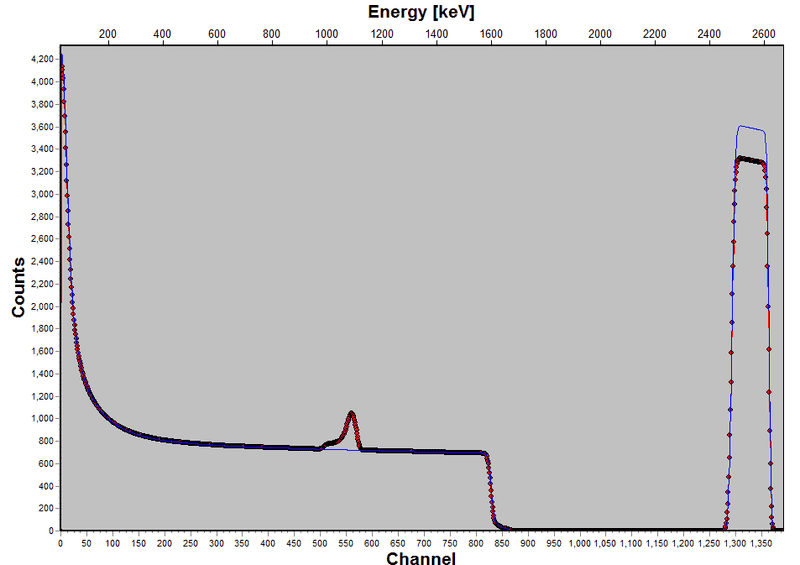
I was given a sample, that it is suppossed to be a medium thickness Rhodium on top of an infinite silicon waffer. The experimental RBS spectrum along with the simulation looks like that
LUH6djm.png


Apparently, there is another element(or maybe 2) that appear on the experimental spectrum.

I am relatively new to RBS, so I find rather confusing to see two narrow peaks, so close to each other on the substrate part of the spectrum.

If the waffer wasn't pure, I would expect some steps, rather than peaks. The way I see it, it's an indication of a possible thin and light layer of unknown elements. How to specify which elements could that be?

Is there also a way to find out if it is really another layer and its position?

On a second look, it seems that the real spectrum has less events that the simulated, which could be an indication of a non pure Rhodium sample. The question is, which element(s) is responsible for the possible impurity?
 
Physics news on Phys.org
Do you see the same peaks without your sample?
Could that be background from some radioactive material?
 
mfb said:
Do you see the same peaks without your sample?

Unfortunately, all I've got is the attached experimental data;nothing else...


mfb said:
Could that be background from some radioactive material?

It's a possible scenario, but I doubt if I can prove it with the simulation.

One thaught, was that the vacuum wasn't well built, so I thought to add a layer of oxygen and nitrus. Unfortunately I couldn't adapt this scenarion to the simulation...
 

Similar threads

  • · Replies 6 ·
Replies
6
Views
2K
  • · Replies 5 ·
Replies
5
Views
2K
  • · Replies 2 ·
Replies
2
Views
3K
  • · Replies 19 ·
Replies
19
Views
9K
  • · Replies 8 ·
Replies
8
Views
1K
  • · Replies 16 ·
Replies
16
Views
5K
  • · Replies 2 ·
Replies
2
Views
3K
  • · Replies 4 ·
Replies
4
Views
2K
  • · Replies 21 ·
Replies
21
Views
5K
  • · Replies 1 ·
Replies
1
Views
20K