Irradiance of light trapped between two parallel mirrors

Click For Summary

Homework Help Overview

The discussion revolves around the irradiance of light trapped between two parallel mirrors, specifically in the context of a Fabry-Perot etalon. Participants are exploring the contributions of reflected rays, their amplitudes, and the relevance of phase shifts in the calculation of irradiance as a function of position.

Discussion Character

  • Exploratory, Conceptual clarification, Mathematical reasoning, Assumption checking

Approaches and Questions Raised

  • Participants discuss the contributions of reflected rays and the reduction of amplitude with each reflection. Questions arise regarding the introduction of phase shifts and how they affect the overall calculation of irradiance. Some participants suggest that the phase may be irrelevant, while others argue for its importance based on the problem's requirements.

Discussion Status

The discussion is active, with participants providing hints and suggestions for approaching the problem. There is a recognition of the complexity involved in calculating phase changes and the need for careful consideration of the setup. Some participants have offered insights into the nature of the phase shifts and their implications for the problem, while others are still seeking clarification on specific points.

Contextual Notes

Participants note that the problem statement specifies not to consider rays that enter the cavity after being transmitted and reflected, which may simplify the analysis. There is also mention of the potential complexity of the phase calculations, including the need for a Kramers-Kronig integral for a complete understanding.

Sokolov
Messages
14
Reaction score
1
Homework Statement
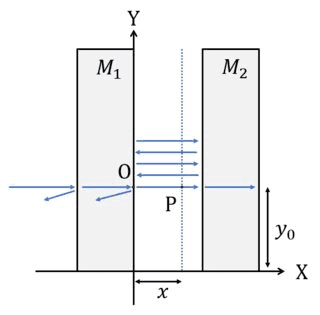
Two flat mirrors of the same reflectance ##R## are separated from each other by a distance ##d## in the air (##n=1##). A monochromatic beam of wavelength λ, linearly polarised, falls perpendicularly on the left face of ##M_1##, entering the space between the two mirrors.

Let's suppose that the intensity when the beam crosses the right surface (point ##O##) of the first mirror is ##I_0##. Calculate the irradiance at a point ##P(x,y_0)##.
Relevant Equations
Fresnel's equations
The setup of the problem is shown in the image below.

I know that I must add all the contributions of each reflected ray and that its amplitude will be reduced by a factor ##r## each time it is reflected. So after the n-th reflection, its amplitude will be ##E_0r^n##, with ##E_0## the amplitude at the point ##O##and ##r## the coefficient of reflection for the amplitude. However, I'm not sure about how to introduce the phase, ##e^{i(ωt−kx+δ_0)}## for each contribution.

Could anyone give me please a hint?
1586870931731.png
 
Last edited:
Physics news on Phys.org
The attachment doesn't exist and it's hard to follow the problem statement without a sketch.

I would expect the phase to be irrelevant. The question only asks about the amplitude.
 
mfb said:
The attachment doesn't exist and it's hard to follow the problem statement without a sketch.

I would expect the phase to be irrelevant. The question only asks about the amplitude.

I have uploaded again the image.

The problem asks about the irradiance ##I(x)##, and it is expected to have maximums and minimums depending on ##x##, so I think it is relevant...
 
Now it works.
The phase will depend on the distance between the mirrors and the wavelength. You'll get an infinite sum that should have a nice compact formula.
 
  • Like
Likes   Reactions: Sokolov
The image you have is of a thing called a Fabry-Perot etalon.

In reality, to calculate the phase change you need to do a Kramers-Kronig integral of reflectivity from 0 to infinite frequency. Obviously, they didn't give you that information and the math is for experts. We usually just say that mirrors give a 180 degree phase change on reflection. I have a feeling that you won't need it though.
 
  • Like
Likes   Reactions: Sokolov
Dr_Nate said:
The image you have is of a thing called a Fabry-Perot etalon.

In reality, to calculate the phase change you need to do a Kramers-Kronig integral of reflectivity from 0 to infinite frequency. Obviously, they didn't give you that information and the math is for experts. We usually just say that mirrors give a 180 degree phase change on reflection. I have a feeling that you won't need it though.

I didn't write, but the problem's statement says that it is not necessary to consider rays that enter the cavity after being transmitted and reflected, this may simplify the integral.

However, how could I adjust the phase in terms of ##x## for each reflected ray?
 
Sokolov said:
I didn't write, but the problem's statement says that it is not necessary to consider rays that enter the cavity after being transmitted and reflected, this may simplify the integral.

However, how could I adjust the phase in terms of ##x## for each reflected ray?
I've never done the derivation myself. My suggestion is to first think of what will happen with one reflected wave. Draw it out and then write down an equation. Then do it for the second reflection. I think eventually you will see the pattern.

You might also pulling out terms from your exponential wave function that don't depend on the reflections.
 
The issue of the exact phase change on reflection will simply add a fixed additional phase shift for each reflection. It can be wavelength dependent. Just assume that the reflectance R is a complex number and proceed.

Dr_Nate said:
The image you have is of a thing called a Fabry-Perot etalon.
And this technique in slightly different form arises often at scattering interfaces. I have used essentially this construction to describe resonant scattering of neutral atoms from periodic surfaces. I think Fano used it to describe nuclear scattering long ago. Good stuff.
 
  • Like
Likes   Reactions: Sokolov
1586874966797.png


Ok, let's denote ##E_n(x)## the amplitude of the ray emerging from the point ##n##. Then, ##E_n(x)=E_0r^ne^{i(\omega t +\Lambda _n (x))}##. For the first points, the phases ##\Lambda_n(x)## will be:

##\Lambda_0(x)=-kx+\delta_0##

##\Lambda_1(x)=\Lambda_0(L)-k(L-x)+\pi=-kL+\pi+\delta_0##

##\Lambda_2(x)=\Lambda_1(L)-kx+\pi=-k(L+x)+2\pi+\delta_0##

##\Lambda_3(x)=\Lambda_2(L)-k(L-x)+\pi=-2kL+3\pi+\delta_0##

##...##

##\Lambda_n(x)=-k(nL +x )+n\pi+\delta_0##, if ##n## even

##\Lambda_n(x)=-k\Big((n-1)L\Big)+n\pi+\delta_0## if ##n## odd

However, I find a little strange that the terms for odd ##n## doesn't have dependence on ##x##... Is it possible? Or may I have done a mistake?
 
  • #10
For convenience (and generality) let R (you call it r) be complex and subsume the π into it until the end. Just makes it better and easier.
What you have done is correct. But note the you will always be considering two reflections in successive terms in the sum, hence the phase will always include x as it should. Do you see?
So clean up the notation a bit and you will get a (hopefully) familiar series.
 
  • Informative
  • Like
Likes   Reactions: Sokolov and etotheipi
  • #11
hutchphd said:
For convenience (and generality) let R (you call it r) be complex and subsume the π into it until the end. Just makes it better and easier.
What you have done is correct. But note the you will always be considering two reflections in successive terms in the sum, hence the phase will always include x as it should. Do you see?
So clean up the notation a bit and you will get a (hopefully) familiar series.

Ok thanks. But I don't see what you said about the two reflections... Could you explain it further?
 
  • #12
Sorry I was a bit negligent and you were a little sloppy by a factor of 2 (down and back). Your original phase calculation is not quite correct the path lengths for n>0 should by 2(L-x) and 2x so that will preserve the x dependence as you noted it should. Sorry not to notice (particularly after you mentioned it!) . So the even and odd n will give right and left traveling waves.
 
  • Like
Likes   Reactions: Sokolov

Similar threads

  • · Replies 1 ·
Replies
1
Views
2K
  • · Replies 3 ·
Replies
3
Views
2K
  • · Replies 4 ·
Replies
4
Views
4K
Replies
1
Views
3K
Replies
9
Views
2K
  • · Replies 10 ·
Replies
10
Views
3K
  • · Replies 4 ·
Replies
4
Views
17K
  • · Replies 5 ·
Replies
5
Views
2K
  • · Replies 5 ·
Replies
5
Views
9K
  • · Replies 4 ·
Replies
4
Views
2K