- 1,047
- 798
swamp-thing submitted a new PF Insights post
Irrationality for Dummies
Continue reading the Original PF Insights Post.
Irrationality for Dummies
Continue reading the Original PF Insights Post.
The discussion revolves around the concept of irrational numbers, particularly in relation to rational numbers and their properties. Participants explore mathematical reasoning, historical perspectives, and personal reflections on the nature of irrationality, with references to specific mathematical proofs and approximations.
Participants express a range of views on the properties of rational and irrational numbers, with no clear consensus on the implications of these properties or the historical anecdotes shared. The discussion remains unresolved on several points, particularly regarding the nature of numbers and their relationships.
Some mathematical claims depend on specific definitions and assumptions that are not fully explored in the discussion. The historical anecdotes may also lack definitive sources, leaving their accuracy open to interpretation.
PeroK said:If you take a proper rational ##q = frac{m}{n}## where ##m, n## have no common factors, then ##q^2 = frac{m^2}{n^2}## is clearly a proper rational. Where would the common factors of ##m^2, n^2## come from? (To be rigorous, appeal to the fundamental theorem of arithmetic and unique prime factorisations).
In any case, proper rationals square to proper rationals, never to whole numbers. Hence, only whole numbers and irrationals can square to whole numbers.
Isn't that it in a nutshell?
PeroK : proper rationals square to proper rationals
Thank you, JorisL.JorisL said:Haven't checked the maths thoroughly but I really like your style of writing.
10/10 would read your future insights.
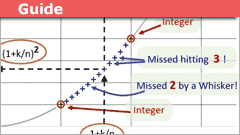
Hi micromass,micromass said:In your Insight you posted some kind of "walk" according to ##(1+ k/n)^2##. You said (and proved) that while doing this walk, you'll never land on an integer. Here's a question though: do you get arbitrarily close to an integer? For example, do you get closer than ##0.000001## to some integer?
PeroK said:If you take a proper rational ##q = \frac{m}{n}## where ##m, n## have no common factors, then ##q^2 = \frac{m^2}{n^2}## is clearly a proper rational. Where would the common factors of ##m^2, n^2## come from? (To be rigorous, appeal to the fundamental theorem of arithmetic and unique prime factorisations).
In any case, proper rationals square to proper rationals, never to whole numbers. Hence, only whole numbers and irrationals can square to whole numbers.
Isn't that it in a nutshell?
trilobite said:Ancient Greek mathematicians freaked out when they discovered that the square root of 2 is not rational. Like Swamp Thing, they were not dummies and realized that the existence of irrational numbers is a fact that is remarkable, deep, and a little scary.
Hippasus, according to Wikipedia, which says the story may be just legend.Bipolar Demon said:Was someone really murdered over it? Aristarchus? or a similar sounding name (apologies for the historical inaccuracy)