Is Becoming a Cyborg the Future of Medical Implants?

  • Thread starter Thread starter collinsmark
  • Start date Start date
Click For Summary
SUMMARY

The discussion centers on personal experiences with surgical implants, particularly hip replacements, and the advancements in medical technology that facilitate quicker recovery times. Participants share anecdotes about their journeys, including the use of mobility aids like canes and scooters, and the emotional impact of mobility issues. Notably, the current standard for hip replacement recovery allows patients to begin walking within hours post-surgery, a testament to improved surgical techniques. Dr. Alexander Sah's work is highlighted as exemplary in this field.

PREREQUISITES
  • Understanding of total hip replacement procedures
  • Familiarity with mobility aids such as canes and scooters
  • Knowledge of pain management post-surgery
  • Awareness of advances in orthopedic surgical technology
NEXT STEPS
  • Research the latest techniques in total hip replacement surgery
  • Explore the role of Human Machine Interfaces (HMI) in medical implants
  • Learn about pain management strategies following orthopedic surgeries
  • Investigate the impact of mobility aids on quality of life for individuals with disabilities
USEFUL FOR

Individuals considering surgical implants, orthopedic surgeons, physical therapists, and anyone interested in the intersection of technology and medical advancements in mobility solutions.

collinsmark
Science Advisor
Homework Helper
Messages
3,443
Reaction score
3,488
My journey to becoming a cyborg (cyberpunk?) has now begun. I got my first implant! :biggrin: I decided to go with a hip implant because of, well, the bad hip. It made sense.
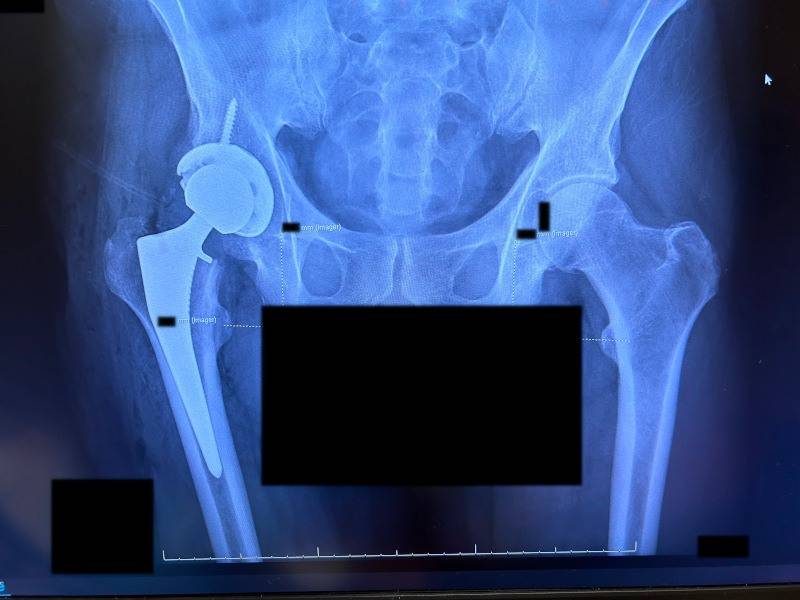
IMG_0005_redacted2_SmallForPF.jpg

(The dark rectangles are redacted text and stuff; they're not part of the actual x-ray [I made the redactions in Gnu Image Manipulation Program (GIMP)].)

Now I just gotta find the USB port. I've been pokin' around for days, but no luck yet.
(I'm starting to think there might not be an electronic Human Machine Interface [HMI] on this one.)

----------------------------

I'd like to keep the topic open to stories and anecdotes, experienced or witnessed, involving anything related to:
  • Surgical implants
  • Prostheses
  • Mobility issues
  • Handicap accessibility
  • Advances in related medical technology
  • Mobility aids (canes, walkers, wheelchairs, mobility scooters, etc.)
  • Ableism, and any discrimination experienced or witnessed involving mobility.
 
Last edited:
  • Like
Likes   Reactions: DennisN, Astronuc, nuuskur and 4 others
Biology news on Phys.org
collinsmark said:
Now I just gotta find the USB port. I've been pokin' around for days, but no luck yet.
(I'm starting to think there might not be an electronic Human Machine Interface [HMI] on this one.)
You should try wifi or bluetooth.
 
  • Haha
Likes   Reactions: fresh_42, Wrichik Basu and collinsmark
collinsmark said:
I got my first implant! :biggrin: I decided to go with a hip implant because of, well, the bad hip. It made sense.
What about pain? How many days did it take to get yourself back on your feet completely without any help?

I have an issue in my spine. It's "loss of lumbar lordosis" combined with pinched nerves b/w vertebrae. Have to rely on daily medicine to keep the pain at bay. The doc advised against surgery unless very necessary.
 
  • Like
  • Wow
Likes   Reactions: BillTre and collinsmark
collinsmark said:
The dark rectangles are redacted text and stuff; they're not part of the actual x-ray
Well, the middle redacted area is of your genitalia, so thanks for handling that for the Mentors. :wink:

A close relative recently had both of her hips replaced about a year apart (arthritis runs in her family), and she is very happy with the results. She is not allowed to run anymore, but most other non-impact athletic activities are still good to go.

Wrichik Basu said:
How many days did it take to get yourself back on your feet completely without any help?
The current standard is you are back on your feet the evening of the hip replacement surgery or the next day. Amazing stuff, and amazing skill by the ortho surgeons who help these patients. Check out the work done by my family member's surgeon -- thank you Dr. Sah:

https://sahortho.com/about/meet-alexander-sah-md
 
Last edited:
  • Like
  • Wow
Likes   Reactions: BillTre, collinsmark and Wrichik Basu
berkeman said:
Well, the middle redacted area is of your genitalia, so thanks for handling that for the Mentors. :wink:
You still have an os priapi [Latin to avoid trouble] in America?
 
Wrichik Basu said:
What about pain? How many days did it take to get yourself back on your feet completely without any help?

I have an issue in my spine. It's "loss of lumbar lordosis" combined with pinched nerves b/w vertebrae. Have to rely on daily medicine to keep the pain at bay. The doc advised against surgery unless very necessary.

Like @berkeman mentioned, I was up walking around with a walker, to a very limited extent, mere hours after surgery. This quick transition to walking is now common practice with a total hip replacement. It helps avoid blood clots, and aids in the healing (bone attaching to the new stuff).

Don't get me wrong, I wasn't doing parkour off the walls or anything. 'Just hobbling around a bit with the walker is all.

As far as pain medication goes, I followed the prescribed dosage. When flexibility was allowed, I made sure to take no more than what was necessary. I'm off all pain medication now (it's been 2 weeks since the surgery). If I need to, I just take acetaminophen (Tylenol), but I don't even take that everyday or on any schedule.

I should mention that I've been hobbling around with a cane for about 10 years now. A decade ago my orthopedic doctor at the time suggested that if I'm OK with using a cane, that might be preferable to surgery, at least for awhile. The logic being that implants don't necessarily last forever, and I was arguably pretty young for one. (And, although we didn't know it at the time, hip replacement technology would improve quite a bit over the next 10 years too.) The logic was sound. So that's what I did. Life was good; I just had a cane and a limp is all. It didn't bother me, really. I got used to it. I didn't take any pain meds. So long as I was careful with my hobbling, it wasn't too terrible.

It got pretty bad towards the end though. When I couldn't get across the crosswalk in time before the lights changed, I figured it was time for surgery. Well, that and difficulty maintaining the telescope told me it was time for surgery.

Before things got bad though, in the interim (a few years ago), there were occasions where one or two certain acquaintances -- acquaintances that I had considered friends at that time -- implied that they didn't want me around (at the pub or whatnot), because my cane/limping made them "uncomfortable." Well, that didn't inspire me to get surgery. That just pissed me off. But I'll save that for another post, maybe. (To be sure, not everybody at the pub felt that way.)

Crazy thing is if medical technology had not progressed in the last 50 years or so, I'd be on my last leg now.
 
Last edited:
  • Like
Likes   Reactions: BillTre, berkeman and Wrichik Basu
I'm likely going to need knee and hip replacement in my future. Sucks getting old.

I already use a mobility scooter when going to places that require a lot of walking.
 
  • Like
Likes   Reactions: collinsmark
berkeman said:
A close relative recently had both of her hips replaced about a year apart (arthritis runs in her family), and she is very happy with the results. She is not allowed to run anymore, but most other non-impact athletic activities are still good to go.
All-time champion downhill ski racer Lindsay Vonn got a knee partially replaced and now is back racing on the World Cup. I would not risk that. She's already forty, is she going to go on until something breaks again? Apparently so. She just can't live without it. I find this most tragic.
 
fresh_42 said:
You still have an os priapi [Latin to avoid trouble] in America?
And... even Google Translate can't/won't translate it... but it is recognized as Latin! And 'OS' is recognized as 'bone'.