Is EV Assist the Future of Semi-Trucks?

  • Thread starter Thread starter jack action
  • Start date Start date
  • Tags Tags
    Electric vehicle
Click For Summary
SUMMARY

The Revoy EV Assist system represents a significant advancement in hybrid technology for semi-trucks, providing a 250-mile range, fuel efficiency of 20-35+ mpg, and an 85% reduction in emissions. This innovative solution allows for a quick under 5-minute battery swap at designated stations, making it more efficient than traditional diesel refueling. The system utilizes an add-on ECU that coordinates with the truck's existing systems to enhance safety and performance, particularly in adverse conditions. The Revoy system is available for rent, offering a flexible solution for fleet operators transitioning to hybrid technology.

PREREQUISITES
  • Understanding of hybrid vehicle technology
  • Familiarity with ECU (Electronic Control Unit) operations
  • Knowledge of torque sensors and their applications
  • Basic principles of regenerative braking systems
NEXT STEPS
  • Research the technical specifications of the Revoy EV Assist system
  • Explore hybrid vehicle ECU coordination techniques
  • Investigate existing applications of torque sensors in automotive technology
  • Learn about regenerative charging systems in hybrid and electric vehicles
USEFUL FOR

Fleet operators, automotive engineers, and anyone interested in the future of hybrid technology in commercial trucking.

jack action
Science Advisor
Insights Author
Messages
3,553
Reaction score
9,897
I have never been impressed with Electric Vehicle (EV) solutions in general. But this one is going in a direction that I like. A great solution for an easy transition with lots of potential for the full EV semi-truck of the future.

You hook up the EV of Revoy between the trailer and the tractor, converting the vehicle instantly into a hybrid:
  • 250 mi range
  • 20-35+ mpg
  • 85% reduction in emissions
  • under 5-minute swap at their stations when depleted (faster than filling a diesel tank!)
  • additional horsepower and stopping power
  • it even adjusts reversing automatically
You don't own it, you rent it.

What do you think about this solution?
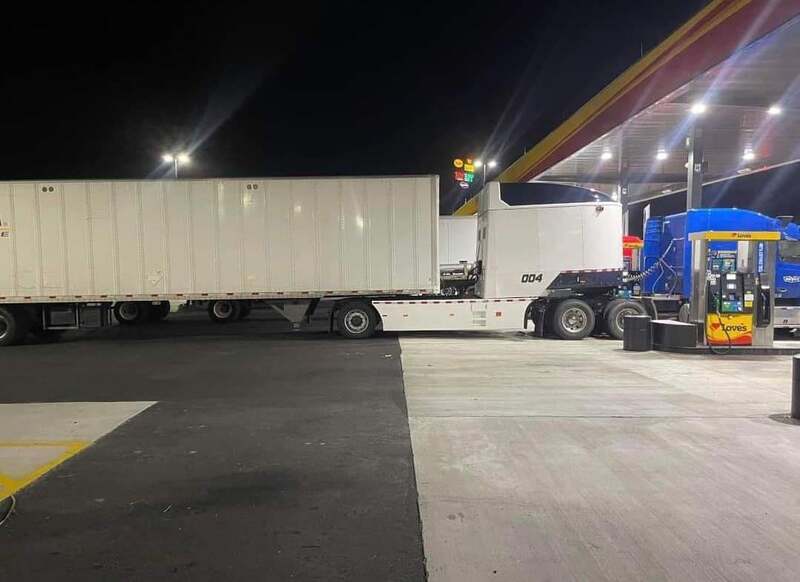
s-thing-between-the-truck-and-the-v0-plwd8qiran7c1.jpg

 
  • Like
Likes   Reactions: Ranger Mike
Engineering news on Phys.org
jack action said:
You hook up the EV of Revoy between the trailer and the tractor, converting the vehicle instantly into a hybrid:
Hybrids have coordinated control of the electric and gas propulsion (and regenerative braking) via the ECU. How does the addition of this unit handle that coordination? (Sorry if it was mentioned in the video, I didn't watch it yet).
 
  • Like
Likes   Reactions: Ranger Mike
It seems to analyze the force at the kingpin connection.
 
  • Wow
  • Like
Likes   Reactions: Ranger Mike and berkeman
jack action said:
It seems to analyze the force at the kingpin connection.
Dat sounds kind of scary. "I think the cab needs me to push more" (as the truck sits at a red light)...
 
  • Like
Likes   Reactions: Ranger Mike
"Revoy on Ice" will be a performance worth watching.
 
  • Like
Likes   Reactions: berkeman
Baluncore said:
"Revoy on Ice" will be a performance worth watching.
Actually, they claim it is safer:

https://www.revoy.com/solutions said:
Manage adverse conditions
Prevent rollovers, flipping in wind, and jackknifing on ice with intelligent auto-corrections from the electric vehicle.
 
  • Like
Likes   Reactions: Baluncore
Jack -- please point me to what I'm missing. How is the cab ECU coordinating with this add-on ECU? Please post some valid technical references. This is posted in the technical engineering forums, so you need to post valid references, not a glitzy dumb YouTube video.

Thanks.
 
This is a new company with a new product, I don't think they are spreading the details on how it works exactly.

That being said, you are the only one wanting the cab ECU to react to the add-on ECU. From what I understand - and what is explained - the add-on ECU has sensors to evaluate the pulling force of the truck; most likely the speed and acceleration are also involved.

Similar concepts are already in use with pedal assist systems for EBikes:
Torque Multiplier

The common approach to using a torque sensor. Either the torque or power to the motor increases in proportion to the human torque on the pedals. If you pedal twice as hard you get twice as much power.
There is no link between the electric motor ECU and the "human ECU" like with a throttle assist system. It seems trivial to coordinate such a system with an internal combustion engine instead of a human.

berkeman said:
Dat sounds kind of scary. "I think the cab needs me to push more" (as the truck sits at a red light)...
If the truck doesn't pull, the add-on doesn't push either. If the truck slows down, the add-on slows down as well. Even better, when the truck backs up, the add-on knows it has to make sure it is in the proper alignment. (The wheels can steer.)
 
jack action said:
Even better, when the truck backs up, the add-on knows it has to make sure it is in the proper alignment. (The wheels can steer.)
So the agent could tow many of them, back down the hill, coupled together like a caterpillar. Do they regeneratively charge?
I could hire a dozen for an hour, just to reverse around the yard.
Let's start by hooking four of them together in a ring, to see what multiplies.
 

Similar threads

Replies
22
Views
2K
  • · Replies 10 ·
Replies
10
Views
3K
Replies
13
Views
3K