Is Lagrangian Formalism the Best Approach for Analyzing Forces on a Frame?

  • Thread starter Thread starter wrobel
  • Start date Start date
  • Tags Tags
    Frame
Click For Summary
SUMMARY

The discussion centers on the application of Lagrangian formalism for analyzing forces on a frame consisting of four thin homogeneous rods connected by weightless ball joints. The problem involves calculating the acceleration of joint A when a force F is applied along the diagonal AC. Participants agree that while the Lagrangian approach is suitable, an elementary solution using Newton's second law and free body diagrams is also valuable for enhancing understanding in general physics courses. The problem is deemed appropriate for intermediate-level physics students.

PREREQUISITES
  • Lagrangian mechanics
  • Newton's second law of motion
  • Free body diagram analysis
  • Basic principles of mechanics
NEXT STEPS
  • Study Lagrangian formalism in detail
  • Practice drawing free body diagrams for complex systems
  • Explore Newton's laws of motion with practical examples
  • Investigate advanced mechanics problems suitable for intermediate physics students
USEFUL FOR

Physics students, educators in mechanics, and anyone interested in applying advanced analytical methods to solve physical problems.

wrobel
Science Advisor
Insights Author
Messages
1,281
Reaction score
1,090
First thanks everybody for discussion in previous thread https://www.physicsforums.com/threads/a-man-on-a-cart.870858/ This is a continuation of that topic. I will formulate another problem. I believe that the most suitable tool for this problem is the Lagrangian formalizm. But what do you think about elementary solution and usefulness of this problem in courses of general physics.

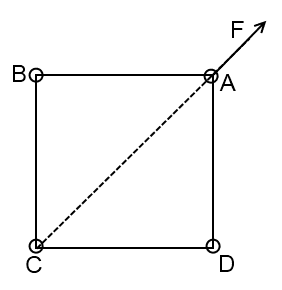
A frame consists of four thin homogeneous rods, all the rods are the same and have mass m. The tips of rods connected with each other by weightless ball joints A,B,C,D with no friction. This frame is shaped as square and rests on smooth horizontal table.
e0772c68abec.png

Then one begin to draw the joint A with the force F. The force is directed outside square along the diagonal AC.
Find the acceleration of the joint A right after the force started to act.

If you also estimate this problem is of UK GCE level I will cry :cry:
 
Science news on Phys.org
Hey wrobel.

What exactly are you trying to resolve? What quantities are you trying to estimate and solve for?


I think that using the Lagrangian formalism would definitely be the most appropriate approach for this problem. However, I also believe that finding an elementary solution could be useful in courses of general physics, as it allows for a deeper understanding of the concepts involved.

As for the problem itself, it seems like a great exercise in applying the principles of mechanics. I would approach it by first drawing a free body diagram of the frame and identifying all the forces acting on it. Then, using Newton's second law, I would write down the equations of motion for each joint and solve for the acceleration of joint A.

I'm not familiar with the UK GCE level, but I think this problem could be suitable for students at an intermediate level of physics. It requires a good understanding of basic mechanics principles, but it also introduces the concept of using Lagrangian formalism to solve problems. Overall, I think it's a challenging yet achievable problem that would be beneficial for students to tackle.
 

Similar threads

  • · Replies 62 ·
3
Replies
62
Views
10K
Replies
53
Views
6K
  • · Replies 2 ·
Replies
2
Views
506
  • · Replies 20 ·
Replies
20
Views
5K