Is Rust the Cause of My Ball Bearing's Failure?

Click For Summary

Discussion Overview

The discussion revolves around the failure analysis of a ball bearing (SKF 6025) used in a washing machine. Participants explore potential causes of the failure, including corrosion, seal integrity, and the nature of the material found within the bearing.

Discussion Character

  • Exploratory
  • Technical explanation
  • Debate/contested

Main Points Raised

  • One participant suspects rust corrosion but is uncertain, suggesting that the brown substance may be old grease instead.
  • Another participant proposes that the brown paste could be soap and questions whether it is water-soluble, indicating that the bearing may have been exposed to water due to a failed seal.
  • Concerns are raised about the materials of the ball cage and rivet, with a suggestion that electrolytic action may have caused corrosion.
  • Questions are posed regarding the sealing method of the bearing, with a request for more information about the seal type and condition.
  • One participant suggests that the part number may be incorrect, indicating it could be a 6205 instead of a 6025, and emphasizes the importance of seal integrity in preventing water ingress.
  • A practical test is suggested to determine the composition of the brown paste by using a hot soldering iron.

Areas of Agreement / Disagreement

Participants express differing views on the nature of the brown substance and the cause of the bearing's failure. There is no consensus on whether the issue is primarily due to rust, seal failure, or incorrect part identification.

Contextual Notes

Participants note the importance of understanding the bearing's sealing mechanism and the conditions under which it was used, which may affect the analysis. The discussion includes assumptions about the materials and design processes involved.

Who May Find This Useful

Individuals interested in mechanical engineering, failure analysis, or maintenance of machinery may find this discussion relevant.

Mohamed_Wael
Messages
19
Reaction score
0
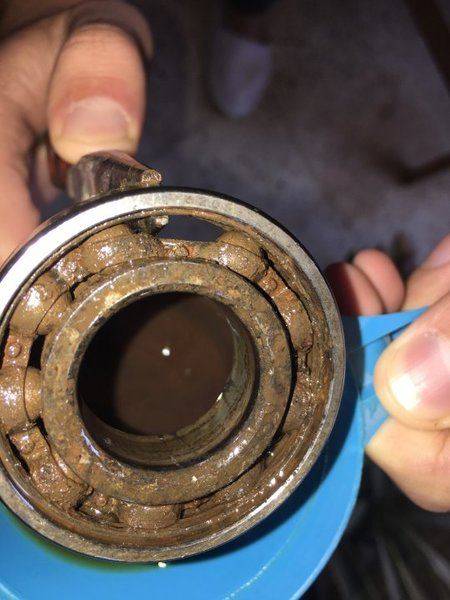
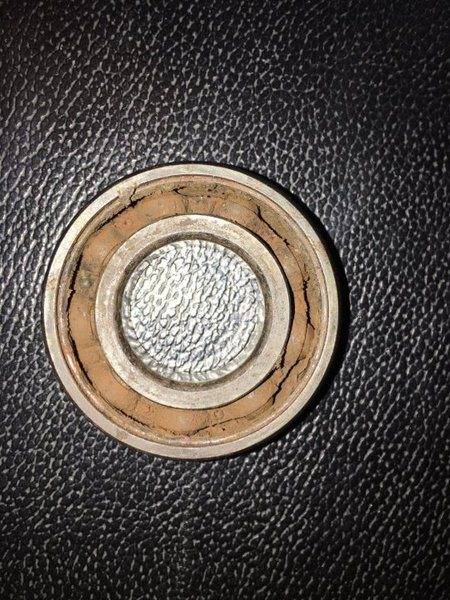
I am doing surface failure analysis for a ball bearing SKF 6025, , as an exercise, It has been used in the washing machine tub, after some time a noise has been reported and it is no longer rotating. When i got it I opened the seal and captured the attached photo. I had a feeling that it suffers rust corrosion, but I wasn't sure if it is rust or just old grease. I soaked it overnight in a gasoline basin to dissolve the grease and see if it is rusted or not. I captured image number 2 but I don't feel it is rust. What do u think ?
IMG_1481871094.181754.jpg

IMG_1481871886.219411.jpg
 
Engineering news on Phys.org
It looks like soap and dirty water has been leaking through a failed seal to the bearing, where it has accumulated and dried to some extent. If the grease does not dissolve in petrol, then it is not an oil based grease. Soap is not usually dissolved by petrol. Is the paste you call grease actually a water soluble soap ?

The ball cage has failed, it looks like a rivet has corroded, there appears to be red iron oxide there. That may be due to electrolytic action between the rivet and cage. What are the rivet and cage materials.

In what position was the bearing being used in the washing machine ?
What was the position relative to the agitator seal, or any other seals ?
 
  • Like
Likes   Reactions: Mohamed_Wael
The two top pictures are the same.

I see a step in the outer race that held the seal. The full part number text is hard to read. How was this SKF 6025 sealed, was it a metal screen, typically a Z or ZZ suffix? Or was it a rubber seal, typically an R, RR, 2R or R2 suffix? A description of the seal and a photograph of the seal and sealing surface would help.

In the third picture I see no sign of a rubber lip seal contacting the inner ball race. If it was rubber sealed, then that lip seal failed first, allowed entry of water with contaminants, which then damaged the ball race surfaces and corroded the cage rivets.

It is quite difficult to guess what the composition of the brown 'grease' might be, based only on a photograph.
 
  • Like
Likes   Reactions: Mohamed_Wael
please see if the part is a genuine one.
usually the bearing that are used are done so on the basis of a good designing process.
the usage is definitely one of the factors which has its part in this analysis, that cannot be ruled out.
 
  • Like
Likes   Reactions: Mohamed_Wael
I think the listed part number is wrong, it's a 6205 judging by what I can read in the last picture, just to the right of the pliers (you transposed a pair of numbers)

Anything that fails that operates near water, failed seals are the first thing to look it.. There is definitely corrosion on there. Any designer worth his salt would put an additional seal (and an air gap/drain) between the bearing and the water... You'd certainly never rely on the bearings integral seal to do any of that.. it's purpose is to keep the grease in.
 
  • Like
Likes   Reactions: bsheikho and Mohamed_Wael
Touch the brown paste with a hot soldering iron. If it melts it is grease. If it pops or hisses it contains water.
 
  • Like
Likes   Reactions: Mohamed_Wael and Rx7man

Similar threads

  • · Replies 1 ·
Replies
1
Views
4K
  • · Replies 19 ·
Replies
19
Views
10K
  • · Replies 43 ·
2
Replies
43
Views
7K