Is the Integral Zero for Closed Paths in Complex Analysis?

3 replies · 2K views · last reply
Gwinterz
Messages
27
Reaction score
0
Hey, I have been stuck on this question for a while:
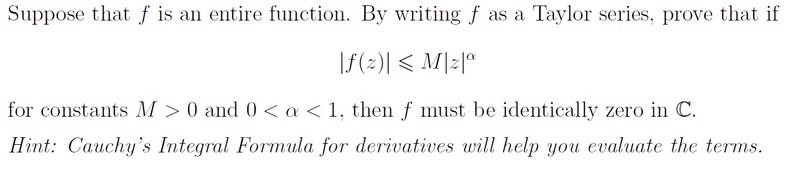
Printed problem: Suppose f is an entire function; by writing f as a Taylor series, prove that if |f(z)| ≤ M|z|^α for constants M > 0 and 0 < α < 1, then f is identically zero in C. Hint: Cauchy's Integral Formula for derivatives will help evaluate the terms.

I have tried to follow the hint, but I am not sure where to go next to get the result.


Have I started correctly? I am not sure how to show that the integral is zero.

If I can show it is less than zero, I also don't see how that shows it is always zero.

Thanks in advance for any help.
 
Attachments
  • Printed problem: Suppose f is an entire function; by writing f as a Taylor series, prove that if |f(z)| ≤ M|z|^α for constants M > 0 and 0 < α < 1, then f is identically zero in C. Hint: Cauchy's Integral Formula for derivatives will help evaluate the terms.
    WClcaAN.jpg
    17.6 KB · Views: 709
The condition in the premise is on ##\left|f(z)\right|##, not ##f(z)##. If you have in fact shown that ##\left|f(z)\right| \leq 0##, then it must be equal to 0 since it can't be negative.
 
Gwinterz said:
Hey, I have been stuck on this question for a while:

View attachment 232707
I have tried to follow the hint, but I am not sure where to go next to get the result.


Have I started correctly? I am not sure how to show that the integral is zero.

If I can show it is less than zero, I also don't see how that shows it is always zero.

Thanks in advance for any help.

Something cannot be less than zero and equal to zero at the same time. However, since you have non-strict inequalities "##\leq##" there is a chance you can show the thing is ##\leq 0##. Then (being a norm in the complex plane) it must also be ##\geq 0##, hence must ##= 0.##
 
Thanks guys that makes sense.

Is the integral equal to zero because its a closed path?