Is the Integral Zero for Closed Paths in Complex Analysis?

Join the discussion
Ask a follow-up here, or get your own question answered by working scientists, mathematicians and engineers — people, not an autocomplete.
Real named experts · corrections over time · the nuance an AI answer skips
3 replies · 1K views
Gwinterz
Messages
27
Reaction score
0
Hey, I have been stuck on this question for a while:
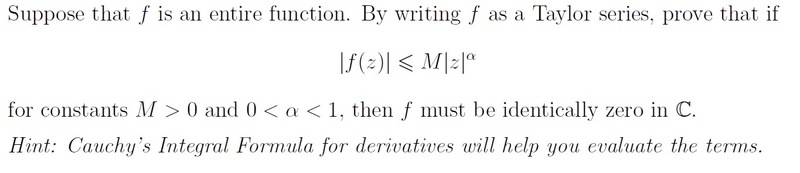
WClcaAN.jpg

I have tried to follow the hint, but I am not sure where to go next to get the result.


Have I started correctly? I am not sure how to show that the integral is zero.

If I can show it is less than zero, I also don't see how that shows it is always zero.

Thanks in advance for any help.
 

Attachments

  • WClcaAN.jpg
    WClcaAN.jpg
    17.6 KB · Views: 692
Physics news on Phys.org
The condition in the premise is on ##\left|f(z)\right|##, not ##f(z)##. If you have in fact shown that ##\left|f(z)\right| \leq 0##, then it must be equal to 0 since it can't be negative.
 
Gwinterz said:
Hey, I have been stuck on this question for a while:

View attachment 232707
I have tried to follow the hint, but I am not sure where to go next to get the result.


Have I started correctly? I am not sure how to show that the integral is zero.

If I can show it is less than zero, I also don't see how that shows it is always zero.

Thanks in advance for any help.

Something cannot be less than zero and equal to zero at the same time. However, since you have non-strict inequalities "##\leq##" there is a chance you can show the thing is ##\leq 0##. Then (being a norm in the complex plane) it must also be ##\geq 0##, hence must ##= 0.##
 
Thanks guys that makes sense.

Is the integral equal to zero because its a closed path?