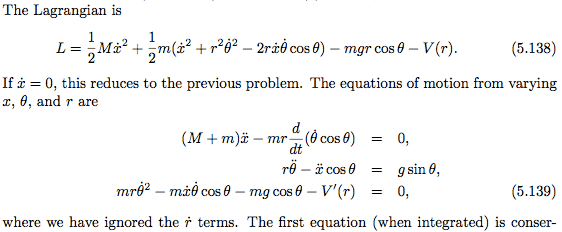
Is there a mistake in the second equation of (5.139)?

Click For Summary
SUMMARY

The discussion identifies a mistake in the second equation of (5.139) derived from the Euler-Lagrange equation. The left-hand side (LHS) is calculated as ##mr^2\ddot{\theta}-mr\dot{x}(-\sin\theta)\dot{\theta}-mr\ddot{x}\cos\theta##, while the right-hand side (RHS) is ##mgr\sin\theta##. The participant asserts that a ##\theta##-dependent term was neglected during differentiation, which is crucial for accurate equation formulation. This oversight leads to the final equation being expressed as ##r\ddot{\theta}+\dot{x}\sin\theta\dot{\theta}-\ddot{x}\cos\theta=g\sin\theta##.

PREREQUISITES
  • Understanding of the Euler-Lagrange equation in classical mechanics
  • Familiarity with Lagrangian mechanics and its applications
  • Knowledge of differentiation techniques involving trigonometric functions
  • Basic grasp of motion equations in polar coordinates
NEXT STEPS
  • Review the derivation of the Euler-Lagrange equation in classical mechanics
  • Study the implications of neglecting terms in Lagrangian formulations
  • Explore advanced topics in Lagrangian mechanics, such as generalized coordinates
  • Learn about the role of trigonometric identities in motion equations
USEFUL FOR

Students and professionals in physics, particularly those focused on classical mechanics, as well as researchers working with Lagrangian formulations and differential equations.

Happiness
Messages
686
Reaction score
30
I believe there is a mistake in the second equation of (5.139).
Screen Shot 2016-08-05 at 2.39.45 am.png


The equation is obtained from (5.138) using the Euler-Lagrange equation
##\frac{d}{dt}\frac{\partial L}{\partial\dot{\theta}}=\frac{\partial L}{\partial\theta}.##

LHS##\,\,=\frac{d}{dt}\frac{\partial L}{\partial\dot{\theta}}=\frac{d}{dt}(mr^2\dot{\theta}-mr\dot{x}\cos\theta)##
##=mr^2\ddot{\theta}-mr\dot{x}(-\sin\theta)\dot{\theta}-mr\ddot{x}\cos\theta\,\,\,\,\,\,\,\,\,\,## (Note that ##\dot{r}## terms are ignored.)

RHS##\,\,=mgr\sin\theta##

Equating LHS and RHS, and dividing by ##m## and ##r##, we have
##r\ddot{\theta}+\dot{x}\sin\theta\dot{\theta}-\ddot{x}\cos\theta=g\sin\theta##.

Am I right?
 
Physics news on Phys.org
There's a ##\theta##-dependent term that you have forgotten to differentiate inside the parentheses.
 
  • Like
Likes   Reactions: Happiness

Similar threads

Replies
8
Views
2K
  • · Replies 3 ·
Replies
3
Views
2K
  • · Replies 29 ·
Replies
29
Views
5K
  • · Replies 8 ·
Replies
8
Views
3K
  • · Replies 2 ·
Replies
2
Views
3K
  • · Replies 11 ·
Replies
11
Views
2K
  • · Replies 6 ·
Replies
6
Views
4K
  • · Replies 9 ·
Replies
9
Views
3K
Replies
1
Views
1K