Is this a typo? (Quantum Theory for Mathematicians by Brian C. Hall)

  • Context: Undergrad 
  • Thread starter Thread starter danielristic
  • Start date Start date
  • Tags Tags
    Theory
Click For Summary
SUMMARY

The discussion centers around a potential typographical error in "Quantum Theory for Mathematicians" by Brian C. Hall, specifically regarding the use of the symbols "Q" and "e" to denote charge. Participants clarify that "Q" is generally a generic symbol for charge, while "e" specifically refers to the charge of an electron. The confusion arises from the author's inconsistent use of these symbols, leading to questions about their conventional meanings in physics. The conversation emphasizes the importance of consistent notation in scientific texts.

PREREQUISITES
  • Understanding of basic quantum physics terminology
  • Familiarity with mathematical notation in physics
  • Knowledge of charge symbols in physics, specifically "Q" and "e"
  • Awareness of classical physics principles
NEXT STEPS
  • Research the conventions of charge notation in physics literature
  • Study the differences between classical and quantum physics notations
  • Explore the role of typographical accuracy in scientific communication
  • Learn about the implications of variable definitions in mathematical physics
USEFUL FOR

Students and professionals in mathematics and physics, particularly those interested in the nuances of notation in quantum theory and the importance of clarity in scientific texts.

danielristic
Messages
3
Reaction score
2
TL;DR
Just started reading this book and wondering if this is a typo or if I'm already lost.
Hello,

After reading a few vulgarisation books, I'm looking into familiarising myself with the more mathematical aspects of quantum physics so I've started reading Quantum Theory for Mathematicians by Brian C. Hall.

I'm only 9 pages in but I've already spotted what I think is a typo. I checked online and the author is providing some corrections but this one is not part of the list.

Here's the relevant except:
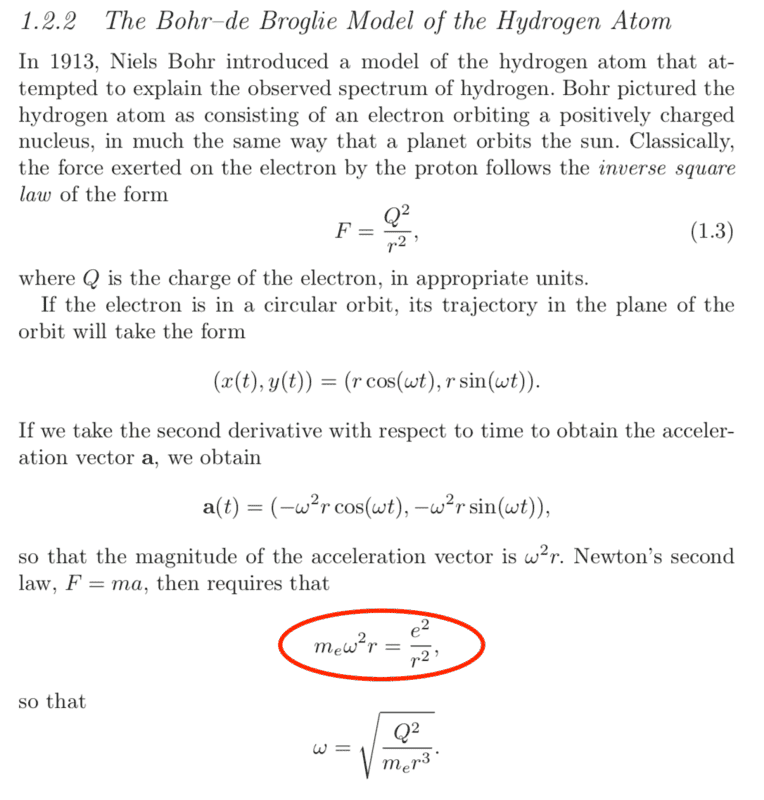
Hall_2013_pdf__page_26_of_566_.png


As "e" was never introduced I'm assuming this is really "Q", what do you think?
 
Physics news on Phys.org
danielristic said:
Summary:: Just started reading this book and wondering if this is a typo or if I'm already lost.

Hello,

After reading a few vulgarisation books, I'm looking into familiarising myself with the more mathematical aspects of quantum physics so I've started reading Quantum Theory for Mathematicians by Brian C. Hall.

I'm only 9 pages in but I've already spotted what I think is a typo. I checked online and the author is providing some corrections but this one is not part of the list.

Here's the relevant except:

View attachment 259386

As "e" was never introduced I'm assuming this is really "Q", what do you think?
Assuming you are a mathematician, can't you prove from those equations that ##Q = \pm e##?
 
  • Like
Likes   Reactions: vanhees71
From a mathematical standpoint, given the last two equations sure, you can infer that ##Q^2 = e^2## and that therefore ##Q=e## or ##Q=-e## but I'm not trying to solve a maths problem here. In physics, variables are attached to measurable quantities or constants and conventional notations tend to use the same symbols to designate the same things.

I don't have an extensive background in physics but I know that ##e## is commonly used for the charge of an electron but the previous except states "Q is the charge of the electron" so I was just trying to figure out if Q and e had a different conventional meaning for physicists or if it was simply a typographical error.
 
danielristic said:
From a mathematical standpoint, given the last two equations sure, you can infer that ##Q^2 = e^2## and that therefore ##Q=e## or ##Q=-e## but I'm not trying to solve a maths problem here. In physics, variables are attached to measurable quantities or constants and conventional notations tend to use the same symbols to designate the same things.

I don't have an extensive background in physics but I know that ##e## is commonly used for the charge of an electron but the previous except states "Q is the charge of the electron" so I was just trying to figure out if Q and e had a different conventional meaning for physicists or if it was simply a typographical error.
It certainly looks like he suddenly decided to use ##e## instead of ##Q## and then immediately changed his mind again!

From what I know, ##Q## is generally used as a generic symbol for the charge of anything. And, ##e## is often used specifically as the charge on an electron; or as minus the charge on an electron, i.e. the charge on a proton, depending on the author.
 
  • Like
Likes   Reactions: Demystifier, dextercioby and berkeman
I see, makes sense. Thanks!
 
  • Like
Likes   Reactions: berkeman
danielristic said:
From a mathematical standpoint, given the last two equations sure, you can infer that ##Q^2 = e^2## and that therefore ##Q=e## or ##Q=-e## but I'm not trying to solve a maths problem here. In physics, variables are attached to measurable quantities or constants and conventional notations tend to use the same symbols to designate the same things.

I don't have an extensive background in physics but I know that ##e## is commonly used for the charge of an electron but the previous except states "Q is the charge of the electron" so I was just trying to figure out if Q and e had a different conventional meaning for physicists or if it was simply a typographical error.
Be careful. Usually ##e## is the charge of the proton (positive). An electron then has charge ##Q_{\text{e}}=-e## (negative), but some textbooks/papers may use a different notation.
 
Why is there no Coulomb's constant in (1.3)?

Btw, AFAIK this is all classical physics.
 
I suppose that is because, "in appropriate units", ##K=1##
 
  • Like
Likes   Reactions: forcefield

Similar threads

  • · Replies 228 ·
8
Replies
228
Views
16K
  • · Replies 25 ·
Replies
25
Views
5K
  • · Replies 15 ·
Replies
15
Views
3K
  • · Replies 4 ·
Replies
4
Views
5K
  • · Replies 2 ·
Replies
2
Views
2K
  • · Replies 6 ·
Replies
6
Views
3K
  • · Replies 0 ·
Replies
0
Views
2K
  • · Replies 10 ·
Replies
10
Views
2K
  • · Replies 72 ·
3
Replies
72
Views
9K
  • · Replies 26 ·
Replies
26
Views
5K