Is this a variation on a residual plot?

  • Thread starter Thread starter Ikaros
  • Start date Start date
  • Tags Tags
    Plot Variation
Click For Summary
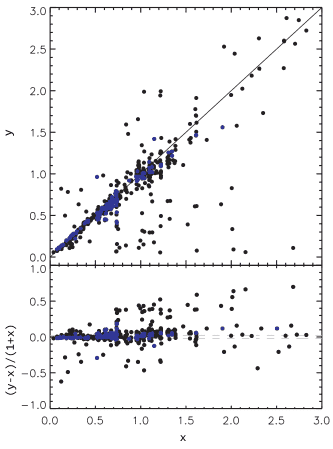
The discussion centers on a scatter plot where the bottom subplot resembles a residual plot but is plotted against (1+x) instead of (y-x). Participants explore the implications of this variation, suggesting that the scaling of uncertainty may relate to the nature of the data being analyzed. The conversation highlights the potential benefits of using this modified approach in understanding data relationships. Overall, the exchange emphasizes the importance of context in interpreting residual plots. Understanding these variations can enhance data analysis techniques.
Ikaros
Messages
19
Reaction score
0
Hi all,

Consider the scatter plot below (example only):
CpVZF04.png


The bottom subplot looks like a residual plot (y-x), but it's over (1+x). I'm hoping someone can explain what this is and the benefit of it.

Thanks
 
Physics news on Phys.org
Maybe the uncertainty is expected to scale with 1+x?
 
  • Like
Likes 1 person
Based on what type of data it is, I think you're correct. Thanks.
 
The standard _A " operator" maps a Null Hypothesis Ho into a decision set { Do not reject:=1 and reject :=0}. In this sense ( HA)_A , makes no sense. Since H0, HA aren't exhaustive, can we find an alternative operator, _A' , so that ( H_A)_A' makes sense? Isn't Pearson Neyman related to this? Hope I'm making sense. Edit: I was motivated by a superficial similarity of the idea with double transposition of matrices M, with ## (M^{T})^{T}=M##, and just wanted to see if it made sense to talk...

Similar threads

  • · Replies 3 ·
Replies
3
Views
2K
  • · Replies 1 ·
Replies
1
Views
2K
  • · Replies 17 ·
Replies
17
Views
2K
  • · Replies 4 ·
Replies
4
Views
3K
  • · Replies 4 ·
Replies
4
Views
2K
Replies
4
Views
2K
  • · Replies 5 ·
Replies
5
Views
1K
  • · Replies 1 ·
Replies
1
Views
827
  • · Replies 8 ·
Replies
8
Views
3K
Replies
2
Views
2K