Hill
- 867
- 658
- TL;DR
- The text claims that this is an example of "proof by contradiction", but it seems rather to be a "proof by contrapositive."
This is the example in question:
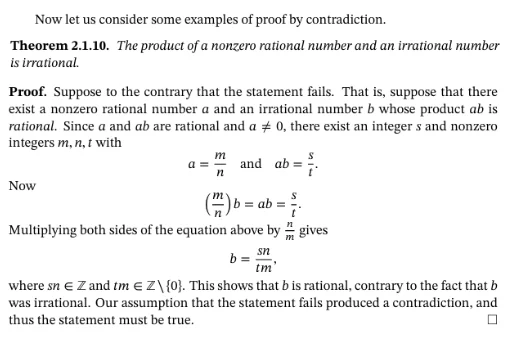
I think that this is rather an example of "proof by contrapositive": given a rational ##a##, instead of proving directly that
##b \text{ irrational} \Rightarrow ab \text{ irrational}##
they have proved the contraposition,
##ab \text{ rational} \Rightarrow b \text{ rational}##.
They did not use in their proof an assumption of ##b## being irrational. Thus, they did not produce any contradiction.
I think that this is rather an example of "proof by contrapositive": given a rational ##a##, instead of proving directly that
##b \text{ irrational} \Rightarrow ab \text{ irrational}##
they have proved the contraposition,
##ab \text{ rational} \Rightarrow b \text{ rational}##.
They did not use in their proof an assumption of ##b## being irrational. Thus, they did not produce any contradiction.