Is this proof "by contradiction" or "by contrapositive"?

  • Context: Undergrad 
  • Thread starter Thread starter Hill
  • Start date Start date
Hill
Messages
830
Reaction score
642
TL;DR
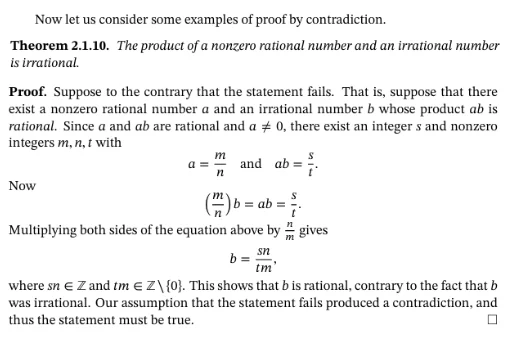
The text claims that this is an example of "proof by contradiction", but it seems rather to be a "proof by contrapositive."
This is the example in question:
1778461511534.webp


I think that this is rather an example of "proof by contrapositive": given a rational ##a##, instead of proving directly that
##b \text{ irrational} \Rightarrow ab \text{ irrational}##
they have proved the contraposition,
##ab \text{ rational} \Rightarrow b \text{ rational}##.

They did not use in their proof an assumption of ##b## being irrational. Thus, they did not produce any contradiction.
 
Mathematics news on Phys.org
Hill said:
TL;DR: The text claims that this is an example of "proof by contradiction", but it seems rather to be a "proof by contrapositive."

This is the example in question:

View attachment 371514

I think that this is rather an example of "proof by contrapositive": given a rational ##a##, instead of proving directly that
##b \text{ irrational} \Rightarrow ab \text{ irrational}##
they have proved the contraposition,
##ab \text{ rational} \Rightarrow b \text{ rational}##.

They did not use in their proof an assumption of ##b## being irrational. Thus, they did not produce any contradiction.
The text is correct. They assume the theorem is false and show this leads to a contradiction of the condition that b is irrational.
 
  • Like
Likes   Reactions: dextercioby and jedishrfu
Hill said:
they have proved the contraposition,
##ab \text{ rational} \Rightarrow b \text{ rational}##.

They did not use in their proof an assumption of ##b## being irrational. Thus, they did not produce any contradiction.
They did initially assume that a is rational and b is irrational, and they used the assumption about a in the proof to say that a=m/n. So this is more than just assuming that ab is rational.
 
  • Informative
Likes   Reactions: Hill
I have the same question about the following proof of a different statement:

"Suppose 𝑎 is a positive real number. If 𝑎 is irrational, then √𝑎 is irrational."

The proof:

Suppose to the contrary that the statement fails. That is, suppose that ##\sqrt{a} \in \mathbb{Q}##.
Then ##\exists m,n \in \mathbb{Z}, n \neq 0, \sqrt{a}=\frac m n##.
Now ##a=(\sqrt{a})^2=\frac {m^2} {n^2}## where ##m^2,n^2 \in \mathbb{Z}, n^2 \neq 0##.
That is ##a \in \mathbb{Q}##, which contradicts the condition that ##a## is irrational.

Is this a proof by contradiction or by contrapositive?
 
Last edited:
That is contrapositive. Given a statement, ##A \implies B##, the only thing it assumes is ##\neg B## and it concludes ##\neg A##.
 
  • Agree
Likes   Reactions: Hill
Hill said:
I have the same question about the following proof of a different statement:

"Suppose 𝑎 is a positive real number. If 𝑎 is irrational, then √𝑎 is irrational."

The proof:

Suppose to the contrary that the statement fails. That is, suppose that ##\sqrt{a} \in \mathbb{Q}##.
Then ##\exists m,n \in \mathbb{Z}, n \neq 0, \sqrt{a}=\frac m n##.
Now ##a=(\sqrt{a})^2=\frac {m^2} {n^2}## where ##m^2,n^2 \in \mathbb{Z}, n^2 \neq 0##.
That is ##a \in \mathbb{Q}##, which contradicts the condition that ##a## is irrational.

Is this a proof by contradiction or by contrapositive?
The contrapositive is,
if √𝑎 is rational then 𝑎 is rational​
Easily proved. There is no condition that 𝑎 is irrational so there is no contradiction.

What the proof you have does is instead assume the statement is false
there is an irrational 𝑎 with √𝑎 rational​
It is possible to prove this false using the contrapositive. This is OK because you are not using the contrapositive on faith, you are instead proving it directly. But once you have proved the contrapositive directly you are already done. The contradiction step isn't necessary.
 
Hill said:
I have the same question about the following proof of a different statement:

"Suppose 𝑎 is a positive real number. If 𝑎 is irrational, then √𝑎 is irrational."

The proof:

Suppose to the contrary that the statement fails. That is, suppose that ##\sqrt{a} \in \mathbb{Q}##.
Then ##\exists m,n \in \mathbb{Z}, n \neq 0, \sqrt{a}=\frac m n##.
Now ##a=(\sqrt{a})^2=\frac {m^2} {n^2}## where ##m^2,n^2 \in \mathbb{Z}, n^2 \neq 0##.
That is ##a \in \mathbb{Q}##, which contradicts the condition that ##a## is irrational.

Is this a proof by contradiction or by contrapositive?
It's explicitly a proof by contradiction. But, a specific type of contradiction is to contradict the initial hypothesis. That means that an explicit proof by contraposition would be very similar.

A proof by contradiction could lead to a different contradiction, unrelated to the original hypothesis. In this case, the proof cannot be immediately rewritten using contraposotion.

There's a discussion here:

https://math.stackexchange.com/ques...-contradiction-vs-proof-of-the-contrapositive
 
Thank you to everyone. I think the question has been answered.
 

Similar threads

  • · Replies 13 ·
Replies
13
Views
3K
  • · Replies 5 ·
Replies
5
Views
2K
  • · Replies 2 ·
Replies
2
Views
2K
  • · Replies 4 ·
Replies
4
Views
2K
  • · Replies 5 ·
Replies
5
Views
2K
  • · Replies 3 ·
Replies
3
Views
2K
  • · Replies 4 ·
Replies
4
Views
3K
  • · Replies 5 ·
Replies
5
Views
3K
  • · Replies 2 ·
Replies
2
Views
3K
Replies
2
Views
3K