Homework Help Overview
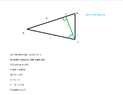
The discussion revolves around a triangle ABC with a given area of 5.5 cm² and one side length, AB = 2√3 + 1 cm. Participants are exploring whether it is possible to determine the length of side AC with the provided information, considering the triangle does not have any special properties.
Discussion Character
- Exploratory, Assumption checking, Problem interpretation
Approaches and Questions Raised
- Participants discuss the implications of having only one side length and the area, questioning if a unique solution exists. They consider various approaches, including using the area formula and trigonometric relationships, while expressing concerns about missing information or constraints.
Discussion Status
The conversation is ongoing, with participants sharing different interpretations and approaches. Some suggest drawing diagrams to visualize the problem, while others express frustration over the complexity of the equations derived from their attempts. There is no explicit consensus on a method, but several lines of reasoning are being explored.
Contextual Notes
Participants note that the triangle is a generic normal triangle without special properties, which raises questions about the uniqueness of the solution. There is also mention of potential complexities arising from the calculations, such as encountering complex numbers.