Is this really an excited state?

Click For Summary
SUMMARY

The discussion centers on the classification of excited states in carbon, specifically addressing the state labeled as "example excited state 1." Participants clarify that this state, characterized by two unpaired electrons in 2p orbitals with opposite spins, is indeed an excited state due to its singlet configuration, contrasting with the triplet ground state. The distinction arises from the Pauli exclusion principle, which influences the energy levels of these configurations. The debate emphasizes the importance of understanding spin multiplicity and electron interactions in determining the energy states of atoms.

PREREQUISITES
  • Understanding of electron configurations in atomic orbitals
  • Familiarity with Hund's rule and its implications for spin multiplicity
  • Knowledge of the Pauli exclusion principle and its effects on electron interactions
  • Basic concepts of quantum mechanics related to energy states
NEXT STEPS
  • Study the implications of the Pauli exclusion principle on atomic structure
  • Explore the differences between singlet and triplet states in quantum mechanics
  • Learn about electron configurations in transition metals and their excited states
  • Investigate the role of spin multiplicity in chemical bonding and reactivity
USEFUL FOR

Chemistry students, quantum mechanics enthusiasts, and professionals in fields related to atomic physics and molecular chemistry will benefit from this discussion.

nezahualcoyot
Messages
5
Reaction score
1
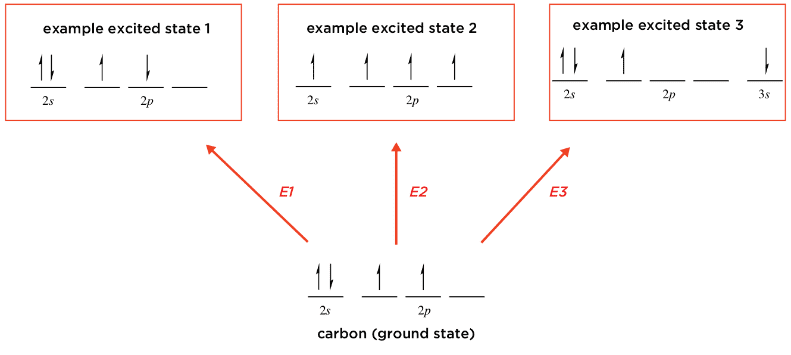
The figure below is from a textbook. It is explaining what excited states are using carbon as an example. I don't necessarily agree that the the state labeled as "example excited state 1" is really an excited state. Since the electrons in the 2p orbitals are unpaired, and in the absence of a magnetic field spin up and spin down electrons have the same energy, I think this state has the same energy as the ground state.

My understanding of the Hund's rule is that electrons in degenerate energy orbitals are accommodated to maximize spin multiplicity, but again, these two states have the same spin multiplicity. Am I correct in my thinking that this is not really an excited state?

( Note in case the figure does not show correctly: The figure claims that an state with two unpaired electrons in the 2p orbitals for carbon is an excited state if the electrons have opposite spin. Each of these electrons is in a different 2p orbital. )
upload_2018-10-19_20-38-40.png
 

Attachments

  • upload_2018-10-19_20-38-40.png
    upload_2018-10-19_20-38-40.png
    7 KB · Views: 1,457
Chemistry news on Phys.org
nezahualcoyot said:
My understanding of the Hund's rule is that electrons in degenerate energy orbitals are accommodated to maximize spin multiplicity
They are arranged that way because this state has the lowest energy - even without external magnetic field as the electrons interact with each other. The effect is not that strong, but it is there.
 
nezahualcoyot said:
My understanding of the Hund's rule is that electrons in degenerate energy orbitals are accommodated to maximize spin multiplicity, but again, these two states have the same spin multiplicity.

No, they don't have the same spin multiplicity. The ground state is a triplet while the E1 state is a singlet.
The energetic difference between the two is also not due to magnetic effect but to the Pauli principle. In the triplet ground state, the Pauli principle forbids that the two electrons with like spins approach each other. This reduces their electrostatic repulsion. In the singlet state, the distance between the electrons will be smaller on average, resulting in a higher repulsion (and energy).
 

Similar threads

Replies
11
Views
3K
  • · Replies 1 ·
Replies
1
Views
3K
  • · Replies 0 ·
Replies
0
Views
981
  • · Replies 6 ·
Replies
6
Views
4K
Replies
11
Views
3K
  • · Replies 2 ·
Replies
2
Views
2K
Replies
11
Views
4K
  • · Replies 3 ·
Replies
3
Views
2K
Replies
3
Views
3K
  • · Replies 2 ·
Replies
2
Views
3K