Is Triangle PQR Isosceles Based on Angle Equality?

  • Context:
  • Thread starter Thread starter woof123
  • Start date Start date
Join the discussion
Ask a follow-up here, or get your own question answered by working scientists, mathematicians and engineers — people, not an autocomplete.
Real named experts · corrections over time · the nuance an AI answer skips
4 replies · 4K views
woof123
Messages
9
Reaction score
0
I can't figure this one out...(I may not have drawn it exactly how it was drawn in the book)

View attachment 6270
 

Attachments

  • Capture.JPG
    Capture.JPG
    10.5 KB · Views: 148
Mathematics news on Phys.org
OK, I get x, meaning the sides opposite to the x angles are equal.

Thanks so much
 
Okay, let's label the unknown angles:

\begin{tikzpicture}
\draw[blue,thick] (0,0) -- (12,0);
\draw[blue,thick] (12,0) -- (8,4);
\draw[blue,thick] (8,4) -- (0,0);
\draw[blue,thick] (8,4) -- (6,0);
\node[left=5pt of {(0,0)}] {\large P};
\node[above=5pt of {(8,4)}] {\large Q};
\node[below=5pt of {(6,0)}] {\large R};
\node[right=5pt of {(12,0)}] {\large S};
\node[right=15pt of {(0,0)},yshift=5pt] {\large $x$};
\node[right=5pt of {(6,0)},yshift=7pt] {\large $2x$};
\node[left=5pt of {(8,4)},yshift=-13pt] {\large $\alpha$};
\node[below=3pt of {(8,4)}] {\large $\beta$};
\node[left=10pt of {(12,0)},yshift=7pt] {\large $\delta$};
\node[above=0pt of {(6,0)},xshift=-3pt] {\large $\gamma$};
\end{tikzpicture}

Now, we know the following:

$$2x+\gamma=180^{\circ}$$

$$x+\alpha+\gamma=180^{\circ}$$

$$2x+\beta+\delta=180^{\circ}$$

$$x+\alpha+\beta+\delta=180^{\circ}$$

We need to show that:

$$x=\alpha$$

Look at the first two equations above, and we see that:

$$180^{\circ}-\gamma=2x=x+\alpha$$

What does this imply?
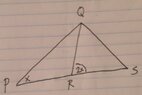
 
I would like to express my opinion here ;)

Theorem: The exterior angle formed when a side of a triangle is produced
is equal to the sum of the two interior opposite angles.

Now using this theorem,

$2x=x+\angle PQR$
$2x-x= \angle PQR$
$x= \angle PQR$

Then we may recall the theorem,

Theorem (Converse of the theorem on isosceles triangles):
The sides opposite equal angles of a triangle are equal

Now since we have proved that $ \angle PQR =\angle QPR$ what can be said about the sides PQ and PR ?