How do I determine angle equality in this graph?

  • Context: High School 
  • Thread starter Thread starter Const@ntine
  • Start date Start date
  • Tags Tags
    Angle Angles Triangles
Click For Summary

Discussion Overview

The discussion revolves around determining the equality of two angles in a graph from a physics textbook. Participants explore geometric relationships and properties related to angles formed by tangents and circles, with a focus on the application of trigonometric principles.

Discussion Character

  • Exploratory, Technical explanation, Conceptual clarification, Debate/contested

Main Points Raised

  • One participant expresses confusion about connecting two angles in a graph and seeks assistance, noting a lack of recent practice in trigonometry.
  • Another participant suggests extending a line to the tangent of the circle to relate the angles through the interior angle sum in a triangle.
  • A subsequent reply requests further clarification on how to relate the angles, indicating uncertainty about the geometric relationships involved.
  • Further contributions clarify that the angle in the upper left corner can be expressed as ##\frac \pi 2 - \theta##, and the angle between the tangents can be shown to equal ##\theta## through angle sum properties.
  • One participant acknowledges a focus on the larger triangle and realizes the need to consider a smaller triangle formed by another tangent.
  • Several participants share links to a diagram that illustrates the angle equality, with some confirming its correctness for the discussed problem.
  • Language barriers are acknowledged by participants, with some expressing gratitude for the assistance provided.

Areas of Agreement / Disagreement

Participants generally agree on the geometric relationships discussed, but there is no explicit consensus on the clarity of the initial problem or the best approach to understanding the angle equality.

Contextual Notes

Some participants express uncertainty about specific terminology and concepts, indicating potential limitations in their understanding of the material presented in the graph.

Who May Find This Useful

Readers interested in geometry, trigonometry, and their applications in physics may find this discussion relevant, particularly those encountering similar problems in academic contexts.

Const@ntine
Messages
285
Reaction score
18
Okay, this might be a tad silly, but I cam across this graph/picture i my physics textbook, and for the life of me I can't figure out how to connect the two angles. Here, have a look:
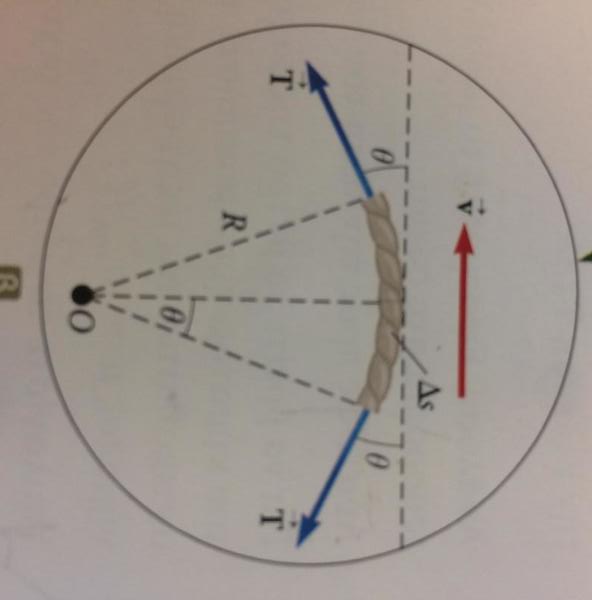
hR8gI.&token=a42e3b7e-e7c0-4fd5-a32b-4049bd74e282&owa=outlook.live.com&isc=1&isImagePreview=True.jpg


It's not a big part of what the paragraph is about, so in theory I could just skip it, but it's been killing me to not know! Granted, I haven't brushed up on my Trig. for about, what, 3 years now (aside from the basic stuff that I've so far used in First Year Undergrad Physics and Math), so I'm probably missing something.

I tried drawing the "triangles" and trying to find out if there are any opposite/alternate equal angles, but... nothing. The book itself doesn't even mention it beyond the graph, it just takes the equality for granted.

Any kind of help is appreciated!
 
Mathematics news on Phys.org
Continue the line where the "R" is until it its the tangent to the circle, then you can relate the two angles via the interior angle sum in the newly generated triangle.

Overall this is one of the standard diagrams to relate angles to each other, but I remember how it is called.
 
mfb said:
Continue the line where the "R" is until it its the tangent to the circle, then you can relate the two angles via the interior angle sum in the newly generated triangle.

Overall this is one of the standard diagrams to relate angles to each other, but I remember how it is called.
Sorry to ask this, but... could you go a bit more in-depth? From what I understand, that's what you're talking about, right?
SWhvs.&token=536700ef-92a9-4a2d-ac45-79f45f3dfe64&owa=outlook.live.com&isc=1&isImagePreview=True.jpg

But I don't see how I can relate the angles of the triangle, and the angle which is created by the "circle" and the tangent.
 
That is the basic diagram, right.

The angle in the upper left corner is ##\frac \pi 2 - \theta## via the angle sum in the large triangle.

Continue the tangent until it reaches the horizontal tangent. Via the angle sum in the small triangle, the angle between the two tangents is ##\frac \pi 2 - \left(\frac \pi 2 - \theta\right) = \theta##.
 
mfb said:
That is the basic diagram, right.

The angle in the upper left corner is ##\frac \pi 2 - \theta## via the angle sum in the large triangle.

Continue the tangent until it reaches the horizontal tangent. Via the angle sum in the small triangle, the angle between the two tangents is ##\frac \pi 2 - \left(\frac \pi 2 - \theta\right) = \theta##.

Ah, so I draw another tanget, thus creating a smaller triangle, like this:

kc1v0.&token=c0d82f73-3ca7-40f9-bd96-afe1ba4c01a6&owa=outlook.live.com&isc=1&isImagePreview=True.jpg


Yeah, I was focused on just the big triangle and forgot all about the smaller one. Well, that's quite embarassing...

Either way, thanks a ton for the help, twas driving me mad! And I guess I have to brush up on Geometry some time...
 
mfb said:

Ah, so that's the general diagram. Thanks (saved)!

The above one (at my RE) is correct for the "matter at hand" though, right?

PS: English isn't my First Language, so there might be some problems when "converting" the info from English to my native one.
 
Darthkostis said:
The above one (at my RE) is correct for the "matter at hand" though, right?
Sure.
Darthkostis said:
PS: English isn't my First Language
Same here.
 
mfb said:
Sure.

Whew, thank goodness!

mfb said:
Same here.

It's a bit of a hurdle, isn't it? I mean, sure, there are special dictionaries for scientific terms, but still.

Either way, thanks a ton for the help!
 

Similar threads

  • · Replies 4 ·
Replies
4
Views
2K
  • · Replies 4 ·
Replies
4
Views
2K
  • · Replies 6 ·
Replies
6
Views
3K
  • · Replies 20 ·
Replies
20
Views
4K
  • · Replies 2 ·
Replies
2
Views
2K
  • · Replies 4 ·
Replies
4
Views
2K
  • · Replies 2 ·
Replies
2
Views
2K
  • · Replies 14 ·
Replies
14
Views
2K
  • · Replies 6 ·
Replies
6
Views
4K
Replies
1
Views
2K