Is Your Beetle a Pet or a Pest? What Does It Eat and How to Identify It?

  • Thread starter Thread starter Fervent Freyja
  • Start date Start date
Click For Summary

Discussion Overview

The discussion focuses on identifying a beetle found by a participant, exploring whether it is a pet or a pest, and determining its dietary needs. The conversation includes aspects of entomology, regional insect identification, and care for the beetle.

Discussion Character

  • Exploratory
  • Technical explanation
  • Debate/contested

Main Points Raised

  • One participant seeks help identifying a beetle, mentioning its size and behavior, and expresses concern over its classification as a pest by a family member.
  • Another participant suggests that more information, such as geographical location and environmental context, would aid in identification.
  • Several participants emphasize the importance of providing clear images and scale for accurate identification.
  • There is a suggestion to consult regional insect guides or extension services for assistance in identification.
  • One participant mentions the tarsal formula as a useful characteristic for identification.
  • Another participant proposes that the beetle may have originated from a shipment, given its condition and location in an aerospace facility.
  • A later reply confirms the beetle's identity as an eastern Hercules beetle, indicating a successful identification process.

Areas of Agreement / Disagreement

Participants generally agree on the need for more information and images for accurate identification, but there are varying opinions on the beetle's classification and origin. The discussion includes both uncertainty and eventual identification of the beetle.

Contextual Notes

Limitations include the lack of detailed images and specific environmental context, which are necessary for precise identification. The discussion also reflects uncertainty regarding the beetle's potential origins and its classification as a pest or pet.

Who May Find This Useful

Individuals interested in entomology, insect identification, or those caring for beetles as pets may find this discussion relevant.

Fervent Freyja
Gold Member
Messages
676
Reaction score
786
TL;DR
Insect identification
Need help identifying this beetle I found a few days ago. I gave it to my nephew today as a pet, but my sister wants to kill it (she think’s that it’s a dung beetle). Also need to know what he needs to be feeding it! I threw in some tomato/lettuce, sticks and plants, but not sure what it needs!

It’s about 3” long. It didn’t move and hid under a leaf the first day I had it- I was pretty sure it was going to die. But last night it was making LOUD thumping noises and slamming itself so hard into the lid that it was shaking the container! This was as close as a shot as I was comfortable getting

Does this look familiar to anyone?
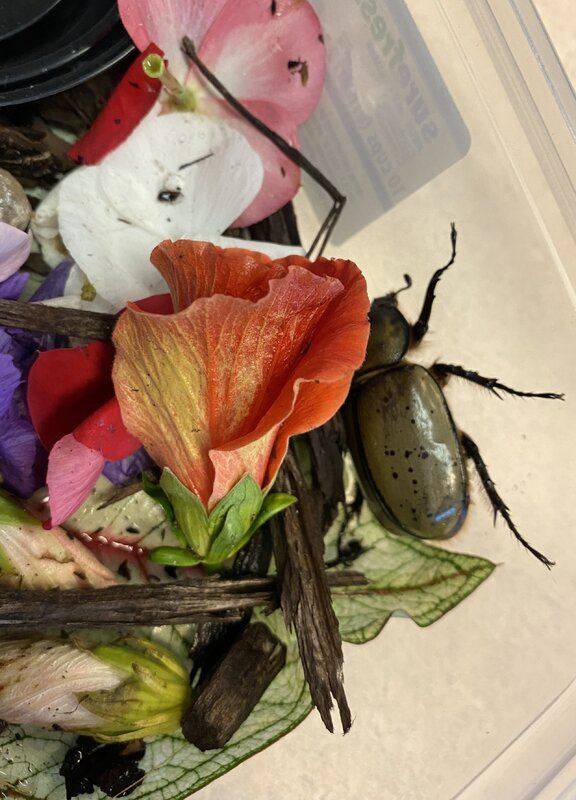
F08DF4BB-D1E7-46B6-AD50-F662A60D597B.jpeg
 
Biology news on Phys.org
Yeah, looks like a beetle, (however, there are a lot of them).

I tried a google image search, but it didn't find any good matches because the front of the head was lacking.
Pictures of that would help.
Scale would be good (picture with a ruler).
Also, where found (area of country), kind of environment (niche) would be useful in narrowing down to what it is.

It does not look like a dung beetle to me (just saw a documentary on them). They seem chunkier to me.

There are often regional guides to insects in an area.
Extension services might have these, but searches should be able to find them.
 
I'm no entomologist, but it would probably be useful to know at least the rough geograhical area it was found in.
 
It will also help to give the tarsal formula (it's on Wikipedia if you need to look it up) for the beetle.
 
Vanadium 50 said:
I'm no entomologist, but it would probably be useful to know at least the rough geograhical area it was found in.

Oh, the geographical area is southeastern US, but since it was found in an aerospace facility and the guys that tried to scare me with it work on the floor, I only assumed it could have come from overseas/nationwide too. I don't really know exactly where they found it, but was thinking it likely come from a shipment seeing how it was almost dead or in some kind of diapause state?

i don’t know, it says the tarsal formula for beetles is usually 5-5-5.

BillTre said:
Pictures of that would help.
Scale would be good (picture with a ruler).

I’ll see if he can get some better pictures!

Thanks!
 
Fervent Freyja said:
Oh, the geographical area is southeastern US, but since it was found in an aerospace facility and the guys that tried to scare me with it work on the floor, I only assumed it could have come from overseas/nationwide too. I don't really know exactly where they found it, but was thinking it likely come from a shipment seeing how it was almost dead or in some kind of diapause state?
I would look to local fauna first since they are the most likely suspects.
You wold be surprised how many different kinds of insects are around you that you probably completely unaware of.

Pictures.
Beetles (and kin) of the Southeastern US. Report your beetle here.
North American Beetles (ID guide).
 
BillTre said:
I would look to local fauna first since they are the most likely suspects.
You wold be surprised how many different kinds of insects are around you that you probably completely unaware of.

You were right, it’s native! They found out it’s an eastern Hercules beetle. Thanks! ❤️
 
  • Like
Likes   Reactions: BillTre