Jessica's question at Yahoo Answers regarding approximate integration

Join the discussion
Registration is free. Ask a follow-up in this thread, or start your own.
1 reply · 8K views
MarkFL
Gold Member
MHB
Messages
13,284
Reaction score
12
Here is the question:

Area of the definite integral?

Find an approximation of the area of the region R under the graph of the function f on the interval [1, 3]. Use n = 4 subintervals. Choose the representative points to be the right endpoints of the subintervals.
f(x) = 9/x

I have posted a link there to this topic so the OP can see my work.
 
Physics news on Phys.org
Re: Jessica's quation at Yahoo! Answers regarding approximate integration

Hello Jessica,

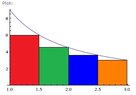
Let's look at a plot of the curve and the 4 rectangles the sum of whose areas we are to use to get an approximate value for the definite integral $$\int_1^3\frac{9}{x}\,dx$$:

View attachment 924

Rectangles have an area $A$ given by $A=bh$ where $b$ in the measure of the base and $h$ is the measure of the height. For each of these rectangles the base is $$\frac{3-1}{4}=\frac{1}{2}$$.

The red rectangle has an area of:

$$A_1=\frac{1}{2}\cdot\frac{9}{\frac{3}{2}}=3$$

The green rectangle has an area of:

$$A_2=\frac{1}{2}\cdot\frac{9}{2}=\frac{9}{4}$$

The blue rectangle has an area of:

$$A_3=\frac{1}{2}\cdot\frac{9}{\frac{5}{2}}=\frac{9}{5}$$

The orange rectangle has an area of:

$$A_4=\frac{1}{2}\cdot\frac{9}{3}=\frac{3}{2}$$

And so we may state:

$$\int_1^3\frac{9}{x}\,dx\approx3+\frac{9}{4}+\frac{9}{5}+\frac{3}{2}=\frac{171}{20}=8.55$$

We can improve the approximation by taking more sub-intervals. Let's let $n$ be the number of these regular partitions, and using the right-end-points, we may state the area of the $k$th rectangle as:

$$\Delta A=\frac{3-1}{n}\cdot\frac{9}{1+k\cdot\frac{2}{n}}=\frac{18}{n+2k}$$

And so we may state:

$$\int_1^3\frac{9}{x}\,dx\approx18\sum_{k=1}^n\frac{1}{n+2k}$$

$$\int_1^3\frac{9}{x}\,dx=18\lim_{n\to\infty}\left( \sum_{k=1}^n\frac{1}{n+2k} \right)$$

Now, since we know:

$$\int_1^3\frac{9}{x}\,dx=9\ln(3)\approx9.887510598013$$

We may state:

$$\lim_{n\to\infty}\left(\sum_{k=1}^n\frac{1}{n+2k} \right)=\ln\left(\sqrt{3} \right)$$
 

Attachments

  • jessica.jpg
    jessica.jpg
    6 KB · Views: 143