Kinetic energy of an alpha particle

Click For Summary
SUMMARY

The discussion focuses on the calculation of kinetic energy for an alpha particle and a thorium atom following an alpha decay event. The conservation of momentum and energy principles are central to the analysis. The equations derived include T = 1/2 × 4 × Va² + 1/2 × mth × Vth², where T represents total kinetic energy, Va is the velocity of the alpha particle, and Vth is the velocity of the thorium particle. The conclusion emphasizes the need to correctly apply conservation laws to relate the velocities and kinetic energies of both particles.

PREREQUISITES
  • Understanding of conservation of momentum and energy principles
  • Familiarity with kinetic energy equations: KE = 1/2 mv²
  • Basic knowledge of nuclear physics, specifically alpha decay
  • Ability to manipulate algebraic equations involving variables and constants
NEXT STEPS
  • Study the derivation of kinetic energy equations in nuclear reactions
  • Learn about the implications of mass differences in particle decay
  • Explore the relationship between momentum and kinetic energy in particle physics
  • Investigate examples of alpha decay and calculate resulting particle velocities
USEFUL FOR

Students and professionals in physics, particularly those specializing in nuclear physics, as well as educators seeking to enhance their understanding of particle decay processes and energy conservation principles.

haha0p1
Messages
46
Reaction score
9
Homework Statement
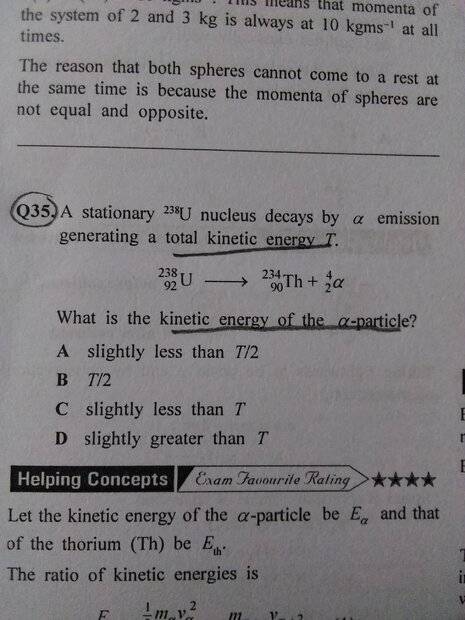
A stationary U-238 nucleus decays be alpha emission generating a total kinetic energy T. What is the kinetic energy of alpha particle?
Relevant Equations
Ek=1/2mv²
Ek=Momentum²/2m
Kindly help me solve this question. The only thing so far that I know in this question is that energy is conserved and the momentum of Alpha particle will equal momentum of Thorium.
IMG_20230103_075307.jpg
 
Physics news on Phys.org
So what is your conservation of energy equation?
Btw, the momenta will be equal and opposite, not equal.
 
  • Like
Likes   Reactions: vanhees71 and topsquark
haruspex said:
So what is your conservation of energy equation?
Btw, the momenta will be equal and opposite, not equal.
T=1/2×4×Va²+1/2×mth×Vth²
T=2Va²+117×Vth²
√(T-2Va²)÷117=Vth
Hence, the statement 'slightly less than T' will be correct
Is this approach to the answer correct ?
 
Last edited:
haha0p1 said:
T=1/2×4×Va²+1/2×m×Vth²
T=2Va²+117×Vth²
√(T-2Va²)÷117=Vth
Hence, the statement 'slightly less than T' will be correct
Is this approach to the answer correct ?
You will need to tell me what all those symbols mean if you want me to check it.
 
  • Like
Likes   Reactions: vanhees71, haha0p1 and topsquark
T=Total Kinetic energy
Va=Velocity of Alpha particle
Vth=Velocity of Thorium particle
ma=Mass of alpha particle
mth=Mass of Thorium particle
These are the symbols for the above equation.
 
haha0p1 said:
T=1/2×4×Va²+1/2×mth×Vth²
T=2Va²+117×Vth²
√(T-2Va²)÷117=Vth
Hence, the statement 'slightly less than T' will be correct
Is this approach to the answer correct ?
Your approach is not correct because you did not use the fact that the momenta are equal in agnitude and opposite in direction. Furthermore, your conclusion does not follow from the work that you have shown. The last equation is an expression for the speed of the thorium. You have not explained your reasoning in terms of this equation that leads to your conclusion
haha0p1 said:
Hence, the statement 'slightly less than T' will be correct
 
kuruman said:
Your approach is not correct because you did not use the fact that the momenta are equal in agnitude and opposite in direction. Furthermore, your conclusion does not follow from the work that you have shown. The last equation is an expression for the speed of the thorium. You have not explained your reasoning in terms of this equation that leads to your conclusion
Can you please explain to me how we got the right answer.?
 
I would write separate equations for the kinetic energy of the thorium and the alpha. I would then use the momentum conservation equation to relate the alpha speed to the thorium speed. Do that first and maybe you will see where to go from there.
 
There are two equations for kinetic energy i.e, Ek= p²÷2m & 1/2mv². Which one should i use from these two for finding separate kinetic energies for the alpha particle and thorium
 
  • #10
Use the first form and write the total kinetic energy. It should be easier to see what’s going on.
 
  • #11
kuruman said:
Use the first form and write the total kinetic energy. It should be easier to see what’s going on.
Solving the question through your method:
T=(Pth²÷2×234)+(pa²÷2×4)
=((234×v1)²÷468)+((4×v2)²÷8)
= 117v1²+2v2²
What should I do next. Also note that I am facing the problem that i was facing from the beginning i.e: The value of V1 (velocity of Thorium) and V2 (velocity of alpha particle) is still there.
 
  • #12
haha0p1 said:
Solving the question through your method:
T=(Pth²÷2×234)+(pa²÷2×4)
=((234×v1)²÷468)+((4×v2)²÷8)
= 117v1²+2v2²
What should I do next. Also note that I am facing the problem that i was facing from the beginning i.e: The value of V1 (velocity of Thorium) and V2 (velocity of alpha particle) is still there.
You are still not using conservation of energy. What other energy change occurs in the reaction?
 
  • #13
haruspex said:
You are still not using conservation of energy. What other energy change occurs in the reaction?
I am not getting your point. As far as I know, conservation of energy remains same at the end of the reaction. So T will equal the energy of alpha particle+energy of thorium. I am making the equation based upon this concept. Am I missing out something?
 
  • #14
haha0p1 said:
I am not getting your point. As far as I know, conservation of energy remains same at the end of the reaction. So T will equal the energy of alpha particle+energy of thorium. I am making the equation based upon this concept. Am I missing out something?
Where did that KE come from?
 
  • #15
haruspex said:
You are still not using conservation of energy. What other energy change occurs in the reaction?
At first the nucleus was stationary. So, the energy T is in form of chemical energy. After the emission of Alpha particle and thorium, the energy is converting to mostly kinetic energy of the particle.
 
  • #16
haha0p1 said:
At first the nucleus was stationary. So, the energy T is in form of chemical energy. After the emission of Alpha particle and thorium, the energy is converting to mostly kinetic energy of the particle.
Not chemical.
 
  • #17
haruspex said:
Not chemical.
The kinetic energy came from the internal energy of the nucleus?
 
  • #18
haha0p1 said:
Then internal energy?
Try nuclear.
But I am guilty of not checking exactly what the question asked for. It is possible to calculate T's value from the masses of all the reagents involved, but you don't need to.
Let's start again .

Working wholly symbolically (no plugging in numbers for the masses!), write the expressions for:
  • momentum of alpha particle
  • momentum of thorium atom
  • KE of alpha particle
  • KE of thorium atom
in terms of their masses and velocities.
Then write the equation relating the momenta and consider the ratio of the KEs, not their sum.
 
  • Like
Likes   Reactions: PeroK
  • #19
haruspex said:
Try nuclear.
But I am guilty of not checking exactly what the question asked for. It is possible to calculate T's value from the masses of all the reagents involved, but you don't need to.
Let's start again .

Working wholly symbolically (no plugging in numbers for the masses!), write the expressions for:
  • momentum of alpha particle
  • momentum of thorium atom
  • KE of alpha particle
  • KE of thorium atom
in terms of their masses and velocities.
Then write the equation relating the momenta and consider the ratio of the KEs, not their sum.
Momentum of alpha particle=m×v
Momentum of thorium atom=m1×v1
KE of alpha particle = 1/2 mv²
KE of Thorium atom = 1/2×m1×v1²
Since momentum is conserved:
Momentum of alpha particle=Momentum of Thorium atom
1/2mv=1/2×m1×v1²
I am stuck here.
 
  • #20
haha0p1 said:
Momentum of alpha particle=Momentum of Thorium atom
1/2mv=1/2×m1×v1²
Try that one again.
Then use the momentum equation to eliminate v1 from the expression for the KE of Thorium atom.
 
  • Like
Likes   Reactions: haha0p1
  • #21
haruspex said:
Try that one again.
Then use the momentum equation to eliminate v1 from the expression for the KE of Thorium atom.
I am unable to understand how we can use momentum equation to eliminate this one. Can you please explain.
 
  • #22
haha0p1 said:
I am unable to understand how we can use momentum equation to eliminate this one. Can you please explain.
Write the momentum equation correctly, then use it to express v1 in terms of the other variables. You can then use that to replace v1 in the energy expression.
 
  • Like
Likes   Reactions: haha0p1
  • #23
mv=m1v1
mv÷m1=v1
T=k.e of alpha+k.e of Th =1/2×4×v²+1/2×m1×(m×v)÷m1
T-E.K of th = E.K of alpha
T-1/2 m1×((mv)÷m1)= E.K of alpha
T-1/2×234×((4×v)÷234)=E.K of alpha
T-2v=E.K of alpha
I have reached the answer T-2v. Is it right.?
 
Last edited:
  • #24
haha0p1 said:
I have reached the answer T-2v. Is it right.?
That can't be right as the dimensions of the ##2v## are not right. The expression must have dimensions of energy.

There are two things here. First, is simply manipulating equations to get to the answer. The second is understanding what each equation is saying and using that to guide what you are doing.

The key point here is we have a single particle decaying into two particles. The first partcle, the Thorium atom, is much more massive than the second, the alpha particle. I think you should number both particles. Let ##m_1## be the mass of the alpha particle amd ##m_2## be the mass of the Thorium atom. Conservation of momentum gives you:$$m_1v_1 = m_2v_2$$Where ##v_1, v_2## are the magnitudes of the velocities of the two particles.

Given that ##m_1 \ll m_2##, what does that tell you about ##v_1## and ##v_2##?
 
  • Like
Likes   Reactions: haha0p1 and malawi_glenn
  • #25
haha0p1 said:
Solving the question through your method:
T=(Pth²÷2×234)+(pa²÷2×4)
=((234×v1)²÷468)+((4×v2)²÷8)
= 117v1²+2v2²
What should I do next. Also note that I am facing the problem that i was facing from the beginning i.e: The value of V1 (velocity of Thorium) and V2 (velocity of alpha particle) is still there.
You have reached the equation for the total energy that can be aritten as $$T=\frac{P_{Th}^2}{2m_{Th}}+\frac{P_{\alpha}^2}{2m_{\alpha}}.$$The problem is not asking you to find the kinetic energy of the alpha particle. It is giving you 4 choices. You can find the correct one by examining the equation above and using momentum conservation that says ##P_{Th}^2=P_{\alpha}^2.## If you cannot do this simply by looking at the equation, substitute ##m_{Th}=234~##u and ##m_{\alpha}=4~##u in the equation and figure out whether the second term is closer to ##T/2## than ##T##, i.e. if the answer one of (A, B) or one of (C, D). Then refine your choice.
 
  • Like
Likes   Reactions: haha0p1
  • #26
PeroK said:
Let ##m_1## be the mass of the alpha particle amd ##m_2## be the mass of the Thorium atom. Conservation of momentum gives you:$$m_1v_1 = m_2v_2$$Where ##v_1, v_2## are the magnitudes of the velocities of the two particles.

Given that ##m_1 \ll m_2##, what does that tell you about ##v_1## and ##v_2##?
To try to progress this, the conclusion is that ##v_1 \gg v_2##. I.e. if a small mass and a large mass have the same magnitude of momentum, then the small mass must have the greater speed.

This is something that you should try to understand and remember. You can, of course, encapsulate this idea in an equation, but you should be able to picture the Thorium atom moving slowly away in one direction, while the alpha particle flies off much faster in the opposite direction.

The next step is to think about KE. What's the relationship between ##T_1## and ##T_2##?
 

Similar threads

  • · Replies 3 ·
Replies
3
Views
986
Replies
13
Views
1K
  • · Replies 3 ·
Replies
3
Views
1K
  • · Replies 24 ·
Replies
24
Views
2K
  • · Replies 2 ·
Replies
2
Views
2K
Replies
12
Views
2K
Replies
26
Views
1K
Replies
3
Views
2K
Replies
2
Views
2K
Replies
1
Views
1K