Prove It
Gold Member
MHB
- 1,434
- 20
Consider the equation $\displaystyle 8\cos{\left( x \right) } = \mathrm{e}^{-x/7} $.
Perform four iterations of the Bisection Method to find an approximate solution in the interval $\displaystyle x \in \left[ 1.35, 1.6 \right] $.
The Bisection Method is used to solve equations of the form $\displaystyle f\left( x \right) = 0 $, so we need to rewrite the equation as $\displaystyle 8\cos{ \left( x \right) } - \mathrm{e}^{-x/7} = 0 $. Thus $\displaystyle f\left( x \right) = 8\cos{ \left( x \right) } - \mathrm{e}^{-x/7} $.
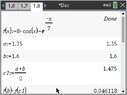
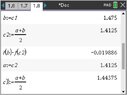
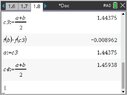
I have used my CAS to solve this problem. Note that the calculator must be in Radian mode.
View attachment 9640
View attachment 9641
View attachment 9642
So our solution is $\displaystyle x \approx c_4 = 1.45938 $.
Attachments