Lagrangian for a free particle

Click For Summary
SUMMARY

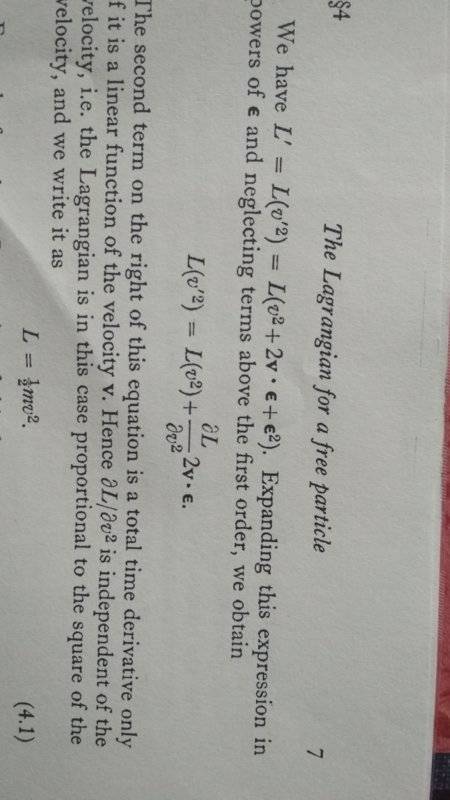
The discussion centers on the implications of defining multiple Lagrangians for a system in Landau mechanics, specifically regarding the Taylor expansion of the Lagrangian. It is established that for two Lagrangians, ##L'## and ##L##, to be physically equivalent, the second term in the Taylor expansion must be a total derivative, which necessitates that the term is at most linear in velocity. The conclusion drawn is that the partial derivative of the Lagrangian with respect to ##v^2## must be constant, reinforcing that ##L## is proportional to ##v^2##.

PREREQUISITES
  • Understanding of Lagrangian mechanics
  • Familiarity with Taylor series expansion
  • Knowledge of Euler-Lagrange equations
  • Basic concepts of total derivatives in calculus
NEXT STEPS
  • Study the derivation of the Euler-Lagrange equations in detail
  • Explore the implications of total derivatives in Lagrangian mechanics
  • Learn about the role of velocity in Lagrangian formulations
  • Investigate examples of Lagrangians that differ by total derivatives
USEFUL FOR

Physicists, particularly those specializing in classical mechanics, students of theoretical physics, and anyone interested in the mathematical foundations of Lagrangian dynamics.

RohanJ
Messages
18
Reaction score
2
TL;DR
Discussion leading to Lagrangian for a free particle being (mv^2)/2
In Landau mechanics it's been given that multiple Lagrangians can be defined for a system which differ by a total derivative of a function.
This statement is further used for the following discussion.
IMG-20190531-WA0005.jpeg

I understand that the term for L has been expanded as a Taylor series but I can't understand the statement given just after that claims that partial derivative of L w.r.t v^2 is independent of the velocity.Can anyone lead me through it mathematically?
 

Attachments

  • IMG-20190531-WA0003.jpeg
    IMG-20190531-WA0003.jpeg
    40.4 KB · Views: 480
Physics news on Phys.org
We want ##L'## and ##L## to be physically equivalent, i.e., yielding the same equations of motion (EoM). For this to be true, the 2nd term in the Taylor-expanded Lagrangian must be a total derivative. That's only true if the term is at most linear in the velocity (do you understand why this is so?).

Since there's already a linear factor in that term, i.e., the ##v \cdot \epsilon##, the factor ##\partial L/\partial v^2## can't have any ##v## terms.

(I'll stop here for now, since I'm not quite sure which bit you're not understanding.)
 
  • Like
Likes   Reactions: vanhees71
strangerep said:
We want ##L'## and ##L## to be physically equivalent, i.e., yielding the same equations of motion (EoM). For this to be true, the 2nd term in the Taylor-expanded Lagrangian must be a total derivative. That's only true if the term is at most linear in the velocity (do you understand why this is so?).

Since there's already a linear factor in that term, i.e., the ##v \cdot \epsilon##, the factor ##\partial L/\partial v^2## can't have any ##v## terms.

(I'll stop here for now, since I'm not quite sure which bit you're not understanding.)
I don't understand why the second term must be linear in velocity and the part after that.
 
It is easy to see that a Lagrangian
$$\tilde{L}(q,\dot{q},t)=L(q,\dot{q},t)+\frac{\mathrm{d}}{\mathrm{d} t} \Lambda(q,t)$$
gives precisely the same equations of motion as ##L##. To see this, note that
$$\frac{\mathrm{d}}{\mathrm{d} t} \Lambda(q,t) = \dot{q}^k \frac{\partial \Lambda}{\partial q^k} + \partial_t \Lambda.$$
From this you find
$$\frac{\partial}{\partial \dot{q}^k} \frac{\mathrm{d} \Lambda}{\mathrm{d} t} = \frac{\partial \Lambda}{\partial q^k}$$
and thus
$$\frac{\mathrm{d}}{\mathrm{d} t} \left (\frac{\partial}{\partial \dot{q}^k} \frac{\mathrm{d} \Lambda}{\mathrm{d} t} \right) = \frac{\mathrm{d}}{\mathrm{d} t} \frac{\partial \Lambda}{\partial q^k} = \dot{q}^j \frac{\partial^2 \Lambda}{\partial q^k \partial q^j} + \frac{\partial \partial_t \Lambda}{\partial q^k}.$$
On the other hand
$$\frac{\partial}{\partial q^k} \frac{\mathrm{d} \Lambda}{\mathrm{d} t}=\dot{q}^j \frac{\partial^2 \Lambda}{\partial q^j \partial q^k} + \frac{\partial \partial_t \Lambda}{\partial q^k}.$$
This implies that the Euler-Lagrange equations for
$$\Omega(q,\dot{q},t)=\frac{\mathrm{d}}{\mathrm{d} t} \Lambda(q,\dot{q},t),$$
i.e.,
$$\frac{\mathrm{d}}{\mathrm{d} t} \frac{\partial \Omega}{\partial \dot{q}^k}=\frac{\partial \Omega}{\partial q^k},$$
are fulfilled identically, and thus ##\tilde{L}## and ##L## lead to the same equations of motion through Hamilton's least-action principle.

The crucial point is that ##\Omega## is a total time derivative of a function, that only depends on ##q## and ##t## but NOT on ##\dot{q}##.
 
Last edited:
vanhees71 said:
It is easy to see that a Lagrangian
$$\tilde{L}(q,\dot{q},t)=L(q,\dot{q},t)+\frac{\mathrm{d}}{\mathrm{d} t} \Lambda(q,t)$$
gives precisely the same equations of motion as ##L##. To see this, note that
$$\frac{\mathrm{d}}{\mathrm{d} t} \Lambda(q,t) = \dot{q}^k \frac{\partial \Lambda}{\partial q^k} + \partial_t \Lambda.$$
From this you find
$$\frac{\partial}{\partial \dot{q}^k} \frac{\mathrm{d} \Lambda}{\mathrm{d} t} = \frac{\partial \Lambda}{\partial q^k}$$
and thus
$$\frac{\mathrm{d}}{\mathrm{d} t} \left (\frac{\partial}{\partial \dot{q}^k} \frac{\mathrm{d} \Lambda}{\mathrm{d} t} \right) = \frac{\mathrm{d}}{\mathrm{d} t} \frac{\partial \Lambda}{\partial q^k} = \dot{q}^j \frac{\partial^2 \Lambda}{\partial q^k \partial q^j} + \frac{\partial \partial_t \Lambda}{\partial q^k}.$$
On the other hand
$$\frac{\partial}{\partial q^k} \frac{\mathrm{d} \Lambda}{\mathrm{d} t}=\dot{q}^j \frac{\partial^2 \Lambda}{\partial q^j \partial q^k} + \frac{\partial \partial_t \Lambda}{\partial q^k}.$$
This implies that the Euler-Lagrange equations for
$$\Omega(q,\dot{q},t)=\frac{\mathrm{d}}{\mathrm{d} t} \Lambda(q,\dot{q},t),$$
i.e.,
$$\frac{\mathrm{d}}{\mathrm{d} t} \frac{\partial \Omega}{\partial \dot{q}^k}=\frac{\partial \Omega}{\partial q^k},$$
are fulfilled identically, and thus ##\tilde{L}## and ##L## lead to the same equations of motion through Hamilton's least-action principle.

The crucial point is that ##\Omega## is a total time derivative of a function, that only depends on ##q## and ##t## but NOT on ##\dot{q}##.
I understand that addition of a total time derivative does not affect the Euler Lagrange equation.
My question is in the discussion in Landau mechanics ,why does the second term of the taylor expansion being the total time derivative leads to the conclusion that ##∂L/∂v^2## is a linear function of velocity?
 
RohanJ said:
I understand that addition of a total time derivative does not affect the Euler Lagrange equation.
My question is in the discussion in Landau mechanics ,why does the second term of the taylor expansion being the total time derivative leads to the conclusion that ##∂L/∂v^2## is a linear function of velocity?
$$\frac{\partial L}{\partial v^2}$$ is not linear in velocity it's constant, that's why ##L\propto v^2##
 
Gaussian97 said:
$$\frac{\partial L}{\partial v^2}$$ is not linear in velocity it's constant, that's why ##L\propto v^2##
Sorry I made a mistake.I meant why the term containing ##∂L/∂v^2## or the "second term" i.e. ## 2v.e(∂L/∂v^2)## must be linear in velocity?
 
Well, as @vanhees71 said you can add a total derivative to your Lagrangian ##\frac{d}{dt}\Lambda##, but ##\Lambda## cannot be any function, must be function only of ##x## and ##t##. So then, using the chain rule, we have $$\frac{d}{dt}\Lambda=\frac{\partial \Lambda}{\partial x}\frac{d x}{d t}+\frac{\partial \Lambda}{\partial t}=v\frac{\partial \Lambda}{\partial x}+\frac{\partial \Lambda}{\partial t}$$.
So it's a linear term with the velocity.
 
  • Like
Likes   Reactions: vanhees71

Similar threads

  • · Replies 48 ·
2
Replies
48
Views
3K
  • · Replies 3 ·
Replies
3
Views
903
  • · Replies 3 ·
Replies
3
Views
1K
  • · Replies 1 ·
Replies
1
Views
1K
  • · Replies 4 ·
Replies
4
Views
2K
  • · Replies 5 ·
Replies
5
Views
4K
  • · Replies 3 ·
Replies
3
Views
1K
  • · Replies 3 ·
Replies
3
Views
3K
  • · Replies 25 ·
Replies
25
Views
3K
  • · Replies 6 ·
Replies
6
Views
2K