Length change of diagonal in deformable triangle

Click For Summary
SUMMARY

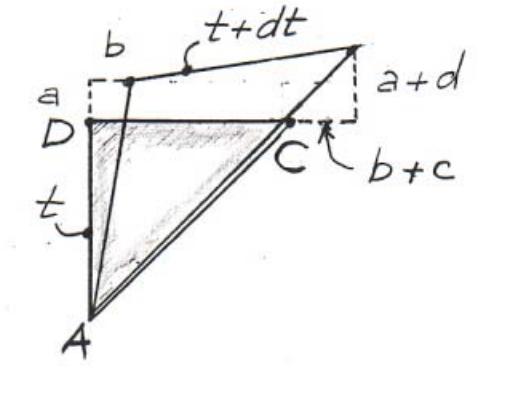
The discussion focuses on the deformation of a triangular element and the calculation of the change in diagonal AC during this deformation. The correct expression for the increase in diagonal AC is given by the formula δ(AC) = (a+d)/√2 + (b+c)/√2, as stated in the lecture notes. This contrasts with the incorrect assumption that the change should be calculated using √((a+d)² + (b+c)²). The distinction lies in the movement of vertex C, which does not travel directly along the original AC line.

PREREQUISITES
  • Understanding of basic geometry and triangle properties
  • Familiarity with deformation concepts in mechanics
  • Knowledge of vector movement and distance calculation
  • Ability to interpret mathematical expressions related to geometry
NEXT STEPS
  • Study the principles of deformation in triangular elements
  • Learn about vector displacement and its impact on distance calculations
  • Explore advanced geometric transformations and their applications
  • Review mathematical proofs related to triangle properties and distances
USEFUL FOR

Students in engineering or physics, particularly those studying mechanics and geometry, as well as educators looking to clarify concepts related to triangle deformation and distance calculations.

Niles
Messages
1,834
Reaction score
0
Hi

I have a problem understanding a figure in my lecture notes. The figure is the following one
Y9loP.jpg


It shows the deformation of a triangular element from time t to time t+dt: So at t it is a isosceles triangle and at t+dt it is deformed. According to my lecture notes (page 16, eq. 28), the increase in the diagonal AC is given by

<br /> \delta(AC) = \frac{a+d}{\sqrt{2}} + \frac{b+c}{\sqrt{2}}<br />

It is not clear to me why that is the case. I would just have said it should be
<br /> \sqrt{(a+d)^2 + (b+c)^2}<br />
but this seems not to be the case. Does anyone see how one arrives at the first expression? I'd be very happy to get some help, I am pretty stuck.Niles.
 
Last edited:
Physics news on Phys.org
Niles said:
It is not clear to me why that is the case. I would just have said it should be
<br /> \sqrt{(a+d)^2 + (b+c)^2}<br />
but this seems not to be the case.

That's the correct calculation for the distance that the vertex C moves. However, the vertex C is not moving directly along the original AC line, so that's not the amount by which the distance AC changes.

If I am five km to the north of you, and I move one km, will the distance between us change by exactly one km? Only if I move due north or due south.
 

Similar threads

  • · Replies 2 ·
Replies
2
Views
2K
  • · Replies 2 ·
Replies
2
Views
1K
  • · Replies 18 ·
Replies
18
Views
2K
  • · Replies 5 ·
Replies
5
Views
1K
  • · Replies 4 ·
Replies
4
Views
4K
  • · Replies 9 ·
Replies
9
Views
4K
  • · Replies 10 ·
Replies
10
Views
3K
  • · Replies 3 ·
Replies
3
Views
2K
  • · Replies 1 ·
Replies
1
Views
3K
Replies
3
Views
1K