Niles
- 1,834
- 0
Hi
I have a problem understanding a figure in my lecture notes. The figure is the following one
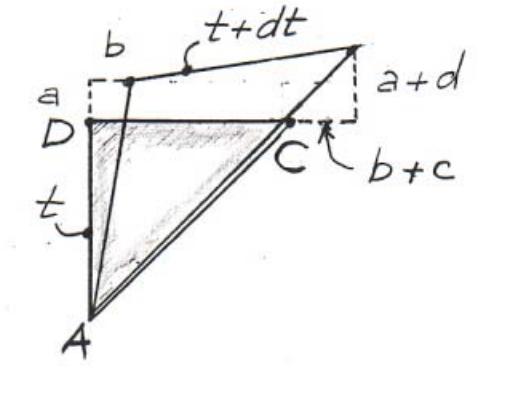
It shows the deformation of a triangular element from time [itex]t[/itex] to time [itex]t+dt[/itex]: So at t it is a isosceles triangle and at t+dt it is deformed. According to my lecture notes (page 16, eq. 28), the increase in the diagonal AC is given by
[tex] \delta(AC) = \frac{a+d}{\sqrt{2}} + \frac{b+c}{\sqrt{2}}[/tex]
It is not clear to me why that is the case. I would just have said it should be
[tex] \sqrt{(a+d)^2 + (b+c)^2}[/tex]
but this seems not to be the case. Does anyone see how one arrives at the first expression? I'd be very happy to get some help, I am pretty stuck.Niles.
I have a problem understanding a figure in my lecture notes. The figure is the following one
It shows the deformation of a triangular element from time [itex]t[/itex] to time [itex]t+dt[/itex]: So at t it is a isosceles triangle and at t+dt it is deformed. According to my lecture notes (page 16, eq. 28), the increase in the diagonal AC is given by
[tex] \delta(AC) = \frac{a+d}{\sqrt{2}} + \frac{b+c}{\sqrt{2}}[/tex]
It is not clear to me why that is the case. I would just have said it should be
[tex] \sqrt{(a+d)^2 + (b+c)^2}[/tex]
but this seems not to be the case. Does anyone see how one arrives at the first expression? I'd be very happy to get some help, I am pretty stuck.Niles.
Last edited: