Lewis H Ryder: Cartesian to Polar Coord Transformations

Click For Summary
SUMMARY

The discussion focuses on the transformation between Cartesian coordinates and polar coordinates, specifically addressing Lewis H. Ryder's method. A key point of confusion was identified regarding a sign typo in Ryder's definition of the variable ##r##, where the exponent should be ##1/2## instead of ##-1/2##. The participants clarified the calculation of partial derivatives, demonstrating that ##\frac{\partial x}{\partial r} = \cos\theta## and providing a pathway to complete the derivative of ##r## with respect to ##x##.

PREREQUISITES
  • Understanding of Cartesian and polar coordinate systems
  • Familiarity with partial derivatives in calculus
  • Knowledge of trigonometric functions, specifically cosine
  • Basic algebraic manipulation skills
NEXT STEPS
  • Study the derivation of polar coordinates from Cartesian coordinates
  • Learn about the properties and applications of partial derivatives
  • Explore the implications of sign errors in mathematical definitions
  • Practice problems involving transformations between coordinate systems
USEFUL FOR

Students and professionals in mathematics, physics, and engineering who are working with coordinate transformations and calculus.
Ayoub Tamin
Messages
12
Reaction score
2
TL;DR
I had a problem understanding an example in the page 60-61 In Lewis's Ryder's Book
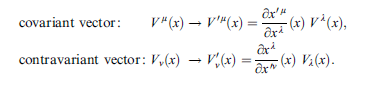
The example is about the transformation between the cartesian coordinates and polar coordinates using the definition
Sans titre.png

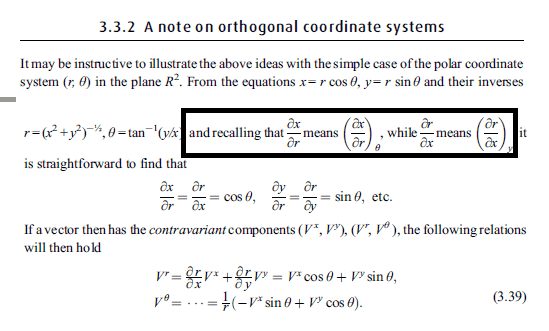
In lewis Ryder's solution, I got confused in this specific line
Sans titre1.png

I really can't see how is that straightforward to find?
 
Physics news on Phys.org
I'm reasonably sure you're overthinking this (although there is a sign typo in his definition of ##r##: his "##-1/2##" exponent should be "##1/2##").

Your boxed section is just the definition of partial derivative. I.e., ##\frac{\partial x}{\partial r}## means the derivative of ##x## by ##r##, with ##\theta## treated as a constant. So... $$\frac{\partial x}{\partial r} ~=~ \frac{\partial (r \cos\theta)}{\partial r} ~=~ \cos\theta \, \frac{dr}{dr} ~=~ \cos\theta ~,$$and $$\frac{\partial r}{\partial x} ~=~ \frac{\partial (x^2+y^2)^{1/2}}{\partial x} ~=~ \frac{1}{2} (x^2+y^2)^{-1/2} (2x) ~=~ x/r ~=~ \dots$$(Can you complete the last step?)
 
  • Love
Likes   Reactions: Ayoub Tamin
strangerep said:
I'm reasonably sure you're overthinking this (although there is a sign typo in his definition of ##r##: his "##-1/2##" exponent should be "##1/2##").

Your boxed section is just the definition of partial derivative. I.e., ##\frac{\partial x}{\partial r}## means the derivative of ##x## by ##r##, with ##\theta## treated as a constant. So... $$\frac{\partial x}{\partial r} ~=~ \frac{\partial (r \cos\theta)}{\partial r} ~=~ \cos\theta \, \frac{dr}{dr} ~=~ \cos\theta ~,$$and $$\frac{\partial r}{\partial x} ~=~ \frac{\partial (x^2+y^2)^{1/2}}{\partial x} ~=~ \frac{1}{2} (x^2+y^2)^{-1/2} (2x) ~=~ x/r ~=~ \dots$$(Can you complete the last step?)
Oh you are absolutely righ, I overthinked that haha and yes i can complete the last step ^^ thanks for your help I appreciate it
 

Similar threads

  • · Replies 8 ·
Replies
8
Views
1K
  • · Replies 5 ·
Replies
5
Views
2K
  • · Replies 13 ·
Replies
13
Views
2K
  • · Replies 40 ·
2
Replies
40
Views
5K
  • · Replies 22 ·
Replies
22
Views
2K
  • · Replies 47 ·
2
Replies
47
Views
7K
  • · Replies 18 ·
Replies
18
Views
4K
  • · Replies 5 ·
Replies
5
Views
2K
  • · Replies 9 ·
Replies
9
Views
1K
  • · Replies 5 ·
Replies
5
Views
2K