Light cone angle from a lamp moving at v = c/4

5 replies · 2K views · last reply
radimkupcak
Messages
3
Reaction score
0
Thread moved from the technical forums, so no HH Template is shown.
Hello, I need help with this problem. In 2D we have a lamp that emits light in 360 degrees around itself while stationary. Than it starts moving at velocity of c/4 what is the degree of the cone in which the light now emits to ? I hope you understand, like the angle of the field where the light falls from the perspetive of observer who is stationary. I don't know how to solve it, does anebody know ?
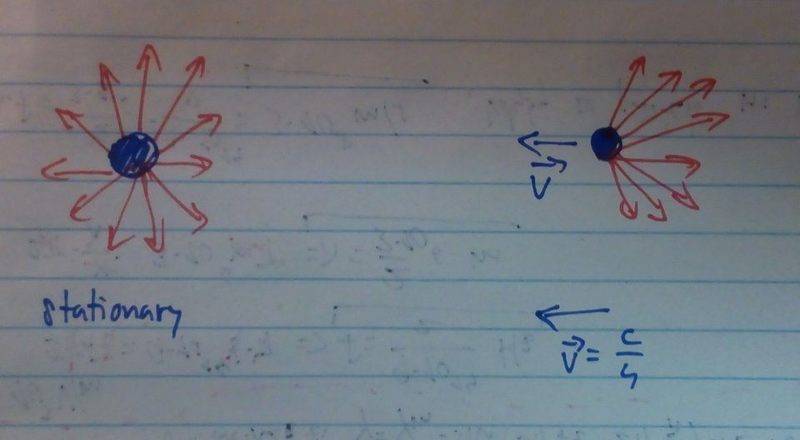
Hand-drawn diagram of a blue dot emitting red arrows in all directions, labelled stationary, beside a second blue dot moving left at velocity v with red arrows bunched toward the right; a blue arrow marked v = c/4 points left.

Thank you Radim
 
Consider a photon emitted directly to the left when the source is stationary. In what direction will it travel when the source is moving?
 
  • Like
Likes   Reactions: radimkupcak
Light is still being emitted in all directions, with Doppler shifts.
 
  • Like
Likes   Reactions: radimkupcak
Yes you are correct, I misunderstood the problem, it made no sense to me that the light would not be emitted to the left from the stationary observers perspective. They are asking for angle of beams of photons that were emitted perpendicular on the vector of velocity (but they won´t be perpendicular while it is moving) The answer is supposed to be 152 degrees, but I don't know how they got this result.
 
Attachments
  • Handwritten diagram in red and blue ink on lined paper: two blue dots each with two opposite red arrows, the left pair at 180 degrees and the right pair at 152 degrees, with a blue arrow pointing left labelled v = c/4.
    IMG_20160426_225010.jpg
    30.5 KB · Views: 450
The phenomenon is called "aberration", and occurs in both Newtonian and relativistic physics. Google for relativistic aberration.
 
  • Like
Likes   Reactions: radimkupcak
Handwritten relativistic aberration calculation: cos θ0 = (cos θr - v/c)/(1 - v/c cos θr), with θr = 90°, v/c = 0.25, giving cos θ0 = -0.25 and θ0 = 104.47°. Diagram shows velocity v = c/4 to the left, angles α0 and α1 marked, and α1 = 151.06°.

So could anyone confirm me that this approach is correct ?