jaychay
- 58
- 0
Can you please help me
Thank you in advance
The discussion focuses on the Limit Comparison Test, a method used to determine the convergence of series. Participants suggest using the series \( a_k = \frac{1}{k^2} \) and the original series \( b_k \) to apply the test. The key rule presented states that if \( \lim_{k \to \infty} \frac{a_k}{b_k} = c \) where \( 0 < c < \infty \), then both series converge or diverge together. The convergence of \( \sum_{k=1}^\infty \frac{1}{k^2} \) is established, confirming that the series in question converges as well.
PREREQUISITESStudents and educators in mathematics, particularly those studying calculus and series convergence, as well as anyone seeking to deepen their understanding of convergence tests in mathematical analysis.
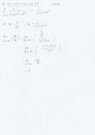
okay I will try to do it from what you guide me and I will let you check it for me.Evgeny.Makarov said:Have you tried to apply the limit comparison test or find the limit of the terms as $k\to\infty$?
Evgeny.Makarov said:Have you tried to apply the limit comparison test or find the limit of the terms as $k\to\infty$?
Can you guide me more because I am very confused right now ?Evgeny.Makarov said:Why didn't you include the numerator $k$ in $a_k$ and $b_k$? Your $b_k$ is different from the series in the problem statement.
I suggest using $a_k=1/k^2$ and $b_k$ as in the original series. Also use the following rule. If $f(x)=ax^m+\sum_{i=0}^{m-1}a_ix^i$ and $g(x)=bx^n+\sum_{i=0}^{n-1}b_ix^i$, then
$$\lim_{x\to\infty}\frac{f(x)}{g(x)}=\begin{cases}0,&m<n\\a/b,&m=n.\\\infty,&m>n\end{cases}$$
jaychay said:
So here is the work that I have done recently so how can I determine that it is convergent or divergent ?Evgeny.Makarov said:The limit comparison test says that in order to ascertain convergence of $\sum b_k$ one can come up with another series $\sum a_k$ for which it is known whether it converges. If $\lim a_k/b_k=c$ and $0<c<\infty$, then the answer for $\sum b_k$ is the same as the one for $\sum a_k$.
I suggest considering $\sum b_k$ to be the series from the problem statement and $a_k=1/k^2$. It is known that $\sum 1/k^2$ converges. What limit do we have to consider to determine the convergence for $\sum b_k$?
jaychay said:so how can I determine that it is convergent or divergent ?
In fact, $\sum_{k=1}^\infty 1/k^2=\pi^2/6$ (see Wikipedia).Evgeny.Makarov said:It is known that $\sum 1/k^2$ converges.
I still do not understand what you are trying to tell me sir.Evgeny.Makarov said:In fact, $\sum_{k=1}^\infty 1/k^2=\pi^2/6$ (see Wikipedia).