Undergrad How Does the Limit of cosh and sinh Approach 1?

  • Thread starter Thread starter thegirl
  • Start date Start date
  • Tags Tags
    Limit Limits
Click For Summary
The discussion centers on understanding the limits of the hyperbolic functions sinh(x) and cosh(x) as x approaches infinity. It is established that both functions behave similarly to e^x in this limit, leading to the conclusion that the term "1" becomes negligible compared to cosh(x). As T approaches 0, the logarithmic expression ln(1 + 2cosh(μB/kBT) is approximated by μB/kBT, reinforcing the relationship between these functions and their exponential counterparts. The key takeaway is that as x approaches infinity, cosh(x) effectively equals e^x, simplifying the analysis of limits. This understanding is crucial for evaluating expressions involving these hyperbolic functions in thermodynamic contexts.
thegirl
Messages
40
Reaction score
1
Hi I was wondering how you get this when taking the limit of T going to 0
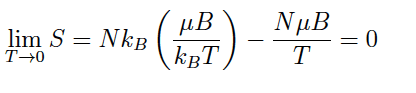
Screen Shot 2016-03-30 at 16.44.47.png

From this expression of S:
Screen Shot 2016-03-30 at 16.49.30.png


Please help I don't see how ln infinity goes to uB/KbT (used u to represent the greek letter. And how does the other expression of sinh and cosh approach 1?
 
Physics news on Phys.org
Both sinh(x) and cosh(x) approach e^x as x->infinity. Do you see why? So the 1 term becomes negligible compared to the cosh term. Does this help?
 
  • Like
Likes thegirl
phyzguy said:
Both sinh(x) and cosh(x) approach e^x as x->infinity. Do you see why? So the 1 term becomes negligible compared to the cosh term. Does this help?
is that because when x aproaches infinity cosh(x) = infinity and as e^x also approaches infinity when x approaches infinity it can be said that lim(x-> infinity) cosh(x) = (lim x-> infinity)e^x? Also, thanks for replying!
 
As ##T\rightarrow 0## we have that ##\ln{\left(1+2\cosh{\left(\frac{\mu B}{k_{B}T}\right)}\right)}\sim \ln{\left(1+ e^{\left(\frac{\mu B}{k_{B}T}\right)}\right)}\sim \frac{\mu B}{k_{B}T}## ...
 
  • Like
Likes thegirl
thegirl said:
is that because when x aproaches infinity cosh(x) = infinity and as e^x also approaches infinity when x approaches infinity it can be said that lim(x-> infinity) cosh(x) = (lim x-> infinity)e^x? Also, thanks for replying!

cosh(x) = \frac{e^x + e^{-x}}{2}

As x->infinity the e^(-x) term approaches zero and becomes negligible compared to the e^x term.
 

Similar threads

  • · Replies 9 ·
Replies
9
Views
2K
  • · Replies 12 ·
Replies
12
Views
2K
  • · Replies 16 ·
Replies
16
Views
4K
Replies
3
Views
2K
  • · Replies 8 ·
Replies
8
Views
5K
  • · Replies 18 ·
Replies
18
Views
2K
  • · Replies 6 ·
Replies
6
Views
4K
  • · Replies 3 ·
Replies
3
Views
2K
  • · Replies 5 ·
Replies
5
Views
2K
Replies
15
Views
7K
